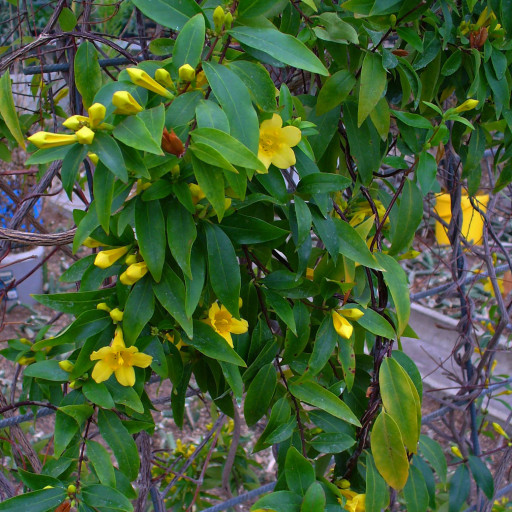
Plant Overview
Known as the Carolina Jasmine or Evening Trumpet Flower, this vigorous evergreen vine is a true herald of spring in the American South. Its cascading golden blooms emit a sweet, honey-like fragrance that can perfume an entire garden on a warm afternoon. While it looks delicate and romantic, it is a tough, fast-growing climber that has earned its place as the state flower of South Carolina.
🔍 How to Identify
- 🌼 The Flowers: Look for bright, butter-yellow, trumpet-shaped blossoms. They typically appear in late winter or early spring and often have a deeper orange throat.
- 🍃 The Foliage: Its leaves are lance-shaped, shiny, and dark green. Because it is evergreen, it provides a lush privacy screen even during the colder months.
- 🌀 Growth Habit: This is a "twining" vine, meaning it wraps its stems tightly around poles, trellises, or fences rather than using tendrils or suckers.
🏡 In Your Garden
- ☀️ Sun Seeker: While it can survive in partial shade, you’ll get the most dramatic "wall of gold" if it’s planted in full sun. In deep shade, the vine becomes leggy and produces very few flowers.
- 🧗 Support Systems: Because it grows rapidly, it needs a sturdy structure. It’s perfect for disguising chain-link fences or softening the look of a wooden arbor, but avoid letting it climb into delicate trees where it might "strangle" smaller branches.
- ✂️ Post-Bloom Pruning: To keep it from becoming a tangled mess, prune it immediately after the spring flowering ends. This encourages new growth and more blooms for the following year.
⚠️ Safety & Toxicity
- 🚫 High Toxicity: Every part of this plant is poisonous if ingested. It contains toxic alkaloids (related to strychnine) that can affect the central nervous system.
- 🐾 Pets & Children: Keep this plant away from curious pets and toddlers. Ingesting even a small amount of the leaves or flowers can cause serious illness, including weakness or respiratory issues.
- 🧤 Skin Sensitivity: Some gardeners experience skin irritation (dermatitis) when handling the sap, so wearing gloves while pruning is highly recommended.
✨ Fun Fact
The nectar of the Carolina Jasmine is so potent that it can be toxic to honeybees if they consume too much of it, though it is a favorite treat for native spicebush swallowtail butterflies!

Detailed Care Instructions
| Lighting | Full Sun |
| Hibernation | Cold Period |
| Hardiness Zones | 7 - 10 |
To grow Gelsemium sempervirens, also known as Carolina jessamine or yellow jessamine, follow these steps:
- Choose a suitable location: Gelsemium sempervirens prefers full sun to partial shade. Select a spot that receives at least 6 hours of direct sunlight per day. Ensure the soil is well-draining.
- Prepare the soil: Gelsemium sempervirens thrives in moist, rich, and slightly acidic soil. If your soil is heavy clay or does not drain well, consider amending it with organic matter like compost or leaf litter to improve drainage.
- Planting: Dig a hole that is slightly wider and deeper than the root ball of the plant. Gently place the plant in the hole and backfill with soil, ensuring that the base of the plant is level with or slightly above the soil surface. Pat down the soil to remove any air pockets around the roots.
- Watering: After planting, water the plant thoroughly to settle the soil and ensure adequate moisture for establishment. Keep the soil moist but avoid overwatering, as Gelsemium sempervirens can be sensitive to excessive moisture. Water regularly, especially during dry spells, until the plant is established.
- Mulching: Apply a layer of organic mulch, such as wood chips or bark, around the base of the plant to help retain moisture, suppress weeds, and regulate soil temperature.
- Pruning: Prune Gelsemium sempervirens in late winter or early spring before new growth appears. This plant blooms on old wood, so avoid excessive pruning during the growing season, as it may reduce the number of flowers.
- Fertilizing: Apply a balanced slow-release fertilizer in early spring, following the instructions provided by the manufacturer. Avoid overfertilizing, as it can lead to excessive foliage growth at the expense of flowers.
- Support and training: Gelsemium sempervirens is a climbing vine that can reach heights of up to 20 feet. If you desire vertical growth, provide a trellis, fence, or other support for the plant to climb. Guide the vine along the support structure as it grows.
- Pests and diseases: Monitor the plant for common pests such as aphids, scale insects, and spider mites. Use appropriate insecticides or treatments if necessary. Gelsemium sempervirens is generally resilient to diseases but may occasionally be susceptible to fungal infections, especially in overly wet conditions.
Remember that Gelsemium sempervirens is toxic if ingested and can cause severe reactions in humans and pets. Handle the plant with care and keep it out of reach of children and pets.

Place in a window with dappled sun or a spot in the middle of a room. Or directly in a window facing west or east.

To water this plant, first assess the moisture content of the soil by feeling the top inch of the soil with your finger. If it feels dry to the touch, give the plant a thorough watering. Water slowly and evenly, ensuring that the water reaches the roots below the surface. Avoid getting water on the foliage, as this can lead to fungal issues or damage. Give the plant enough water to saturate the soil but avoid letting it sit in standing water, as this can cause root rot. Depending on the growing conditions, this plant may need to be watered weekly or every few days.
To fertilize this plant, you should first make sure that the soil is moist before applying any fertilizer. Use a slow-release, balanced fertilizer with equal amounts of nitrogen, phosphorus, and potassium. Apply the fertilizer at the base of the plant, avoiding contact with the leaves and stems. Water the plant thoroughly after fertilizing. Repeat this process every four to six weeks during the growing season, which is typically spring and summer. Avoid fertilizing during the dormant season, which is typically autumn and winter.
Gelsemium Sempervirens plant requires a well-draining, nutrient-rich soil that is slightly acidic in pH. The ideal soil should be composed of a mix of 2 parts sandy loam, 2 parts peat moss, and 1 part perlite or vermiculite to ensure proper drainage. It is also recommended to add some organic matter, such as compost or aged manure, to the soil to improve its fertility and texture. Additionally, the soil should be kept consistently moist, but not waterlogged, as this can lead to root rot.
To propagate this plant, take stem cuttings in the early summer. Make sure to select a healthy stem with several leaves. Cut the stem at a 45-degree angle with a sharp, clean pair of shears. Remove any leaves from the bottom 2/3 of the stem. Dip the cut end in rooting hormone and plant in a well-draining potting mix. Water the cutting thoroughly and cover with a plastic bag to create a humid environment. Place the cutting in a bright, indirect light location and keep the soil moist. After a few weeks, the cutting should develop roots and can be transplanted to its permanent location.
Common pests of the carolina-jasmine include Scale insect, spider mites, aphids. Make a habit of checking your carolina-jasmine frequently for pests so that any infestations can be caught and managed early.








