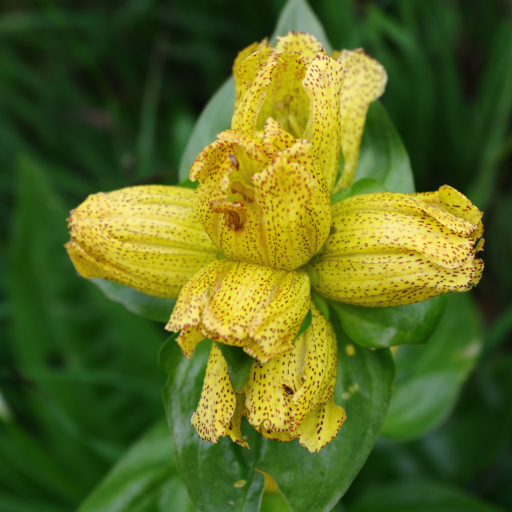
Plant Overview
Known as the "Spotted Gentian," this rugged beauty is a crown jewel of the European Alps and Carpathians. While most people associate gentians with a brilliant electric blue, Gentiana punctata breaks the mold with its buttery yellow petals dusted in mysterious dark freckles. It is a stoic high-altitude survivor, often found standing tall against mountain winds and thin air where few other flowers dare to grow.
🔍 How to Identify
- 🔔 The Flowers: Large, bell-shaped blooms that are pale yellow to greenish-yellow. They are easily recognized by the dense pattern of dark purple or brownish spots (the "freckles") on the petals.
- 🌿 Leaf Structure: Broad, oval-shaped leaves with prominent longitudinal veins. They grow in opposite pairs along a thick, sturdy, and unbranched stem.
- 📏 Growth Habit: A clump-forming perennial that stands quite erect, reaching heights of 20 to 60 cm. It looks more like a structural spire than a spreading groundcover.
🏡 In Your Garden
- ⛰️ Alpine Ambitions: Because it originates from rocky mountain slopes, this plant thrives in "cool feet" conditions. It requires very well-drained, slightly acidic soil and will struggle in heavy clay or areas with high summer humidity.
- ⏳ The Virtue of Patience: This gentian grows a deep, thick taproot. This makes it incredibly drought-resistant once established, but it also means it absolutely hates being moved. Choose its "forever home" carefully, as transplanting often leads to failure.
⚠️ Safety & Toxicity
- 🟢 Status: Generally non-toxic, but should not be treated as food.
- 👅 Bitter Defense: The plant contains gentiopicroside, one of the bitterest substances known to man. While not strictly poisonous to pets or children, the intense bitterness is a natural deterrent that usually prevents anything from eating enough to cause a stomach ache.
✨ Fun Fact
The genus name Gentiana is a tribute to King Gentius of Illyria, who allegedly discovered the medicinal properties of the plant's roots back in 180 BC. To this day, the extremely bitter roots of spotted gentians are still used in Europe to flavor traditional digestive liqueurs and schnapps!

Detailed Care Instructions
To grow Gentiana Punctata plants, also known as spotted gentian, follow these steps:
- Choose a suitable planting location: Gentiana Punctata prefers well-draining soil with partial shade to full sun exposure. The soil should be slightly acidic and rich in organic matter.
- Prepare the soil: Clear any weeds or debris from the planting area. Amend the soil with compost or well-rotted organic matter to improve fertility and drainage.
- Sow the seeds: Gentiana Punctata can be grown from seeds. Scatter the seeds over the prepared soil in early spring or autumn. Press them lightly into the soil, but do not bury them deeply, as they require light to germinate.
- Water regularly: Keep the soil consistently moist, but not waterlogged. Water gently to avoid disturbing the seeds or young seedlings. Use a misting nozzle or spray bottle to water if needed.
- Provide shade: During the germination period and while the plants are still young, provide some shade or protection from direct sunlight. This can be done by placing a piece of shade cloth or using other methods to diffuse sunlight.
- Thin out seedlings: Once the seedlings have grown to about 2 inches tall, thin them out to provide adequate space for the remaining plants to grow properly. Space them about 6-8 inches apart.
- Mulch the soil: Apply a layer of mulch around the plants to help retain soil moisture, suppress weed growth, and protect the roots.
- Fertilize sparingly: Gentiana Punctata does not require heavy fertilization. A light application of a balanced, slow-release fertilizer once a year during the growing season is usually sufficient.
- Support the plants: As the plants grow taller, they may benefit from support to prevent bending or breaking. Place small stakes or use plant supports around the plants to provide stability.
- Monitor for pests and diseases: Keep an eye out for any signs of pests or diseases, such as leaf spots or aphids. Treat as necessary with appropriate organic insecticides or fungicides.
- Enjoy the blooms: Gentiana Punctata typically blooms in late summer or early autumn, producing vibrant yellow or orange flowers with purple spots. Admire the beautiful blooms and consider collecting seeds for future propagation if desired.
Remember that Gentiana Punctata is a perennial plant, meaning it will come back year after year. With proper care and patience, you can enjoy the beauty of this unique plant in your garden.

Place in a bright room that is sun drenched almost all day. Or directly in a south-facing window.

Gentiana Punctata is a plant that requires consistent watering to thrive. When watering, it is important to avoid getting water directly on the leaves, as this can lead to fungal diseases. Instead, aim to water the soil around the base of the plant, taking care not to overwater as this can cause root rot. It is best to water when the top inch of soil feels dry to the touch. If the plant is in a pot, ensure that it has drainage holes to prevent waterlogged soil. Additionally, avoid using hard tap water, which can contain chemicals that are harmful to the plant, and instead opt for rainwater or distilled water.
To fertilize this plant, you should first determine the soil pH. If the pH is below 6.0, apply a fertilizer that is high in nitrogen and phosphorus. If the pH is above 6.0, use a balanced fertilizer. In general, fertilize this plant at least once during the growing season, but avoid over-fertilization as this can lead to decreased flowering. Apply the fertilizer to the soil around the plant, taking care not to get it on the leaves. Water the plant thoroughly after fertilizing.
The Gentiana Punctata plant prefers to grow in nutrient-rich, well-drained soil that is slightly acidic in pH. The soil should have good drainage to prevent waterlogging, which can lead to root rot. It is recommended to use a mixture of peat moss, perlite, and sand to promote good drainage and aeration. Additionally, adding organic matter such as compost or aged manure can help to improve soil fertility and structure. It is important to avoid using heavy clay or compacted soil, as this can limit root growth and cause stress to the plant.
To propagate this plant, you will first need to collect seeds from mature plants. The seeds can be harvested from the plant after the flowering season. You can then clean and store the seeds in a dry place.
Next, you can start sowing the seeds in a well-draining potting mix. Make sure the potting mix is moist but not too wet. You can cover the seeds lightly with soil and keep them in a slightly shaded area with indirect sunlight.
Once the seeds have germinated and the seedlings have grown to a suitable size, you can transfer them to individual pots. This will allow each plant enough space to grow and develop their roots.
As the plants grow, you will need to ensure they receive adequate light, water, and nutrients. You can fertilize them with a balanced fertilizer once every few weeks to support their growth.
Eventually, when the plants have matured, you can plant them in a suitable location in your garden or in larger containers. Gentiana Punctata plant prefers well-draining soil and partial shade, so make sure to choose a location that meets these requirements.








