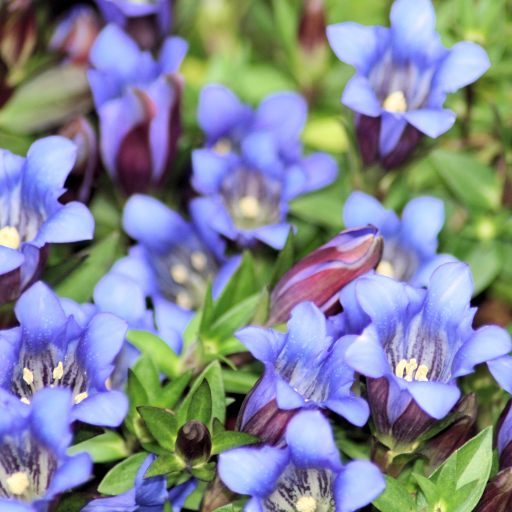
Plant Overview
Known as the "Japanese Gentian," this striking perennial is famous for its intense, electric-blue flowers that look like they’ve been dipped in cobalt ink. In East Asian culture, it is deeply revered not just for its late-season beauty but also for its historically significant medicinal roots. Because it blooms as summer fades into autumn, it provides a much-needed splash of royal color when many other garden plants are beginning to retreat.
🔍 How to Identify
- 🌸 The Bloom: Upright, bell-shaped flowers in a deeply saturated violet-blue. If you look closely inside the "throat" of the flower, you will often find delicate greenish-white speckles.
- 🍃 The Foliage: Dark green, lance-shaped leaves that grow in neat, opposite pairs along the stems. The leaves have a slightly rough, sandpaper-like texture, which is where the species name scabra comes from.
- 📏 The Habit: It grows in a compact, clumping fashion, usually reaching about 10–12 inches in height, making it a tidy addition to garden edges.
🏡 In Your Garden
- 💧 The Moisture Balance: This plant is a "thirsty" beauty. It demands consistent moisture and will wilt quickly if the soil dries out, so it’s best suited for areas with rich, organic soil that holds water well.
- 🏔️ Cool Feet: Reflecting its mountain heritage, the Japanese Gentian hates "hot feet." It thrives best when the soil is kept cool with a layer of mulch or when tucked behind a rock that provides shade to its root zone.
- 🌱 Don't Move Me: It develops a sensitive root system that dislikes being disturbed. Once you plant it, try to avoid transplanting it, as it may take a full season or more to recover from the shock.
⚠️ Safety & Toxicity
- ✅ Status: Generally considered non-toxic to humans, cats, and dogs.
- 👅 Bitter Warning: While safe, the plant contains gentiopicroside, one of the most bitter substances known in nature. A curious pet or child who tries a nibble will be met with an incredibly unpleasant, lingering taste that acts as a natural deterrent.
✨ Fun Fact
The genus name Gentiana is a tribute to King Gentius of Illyria (an ancient Balkan kingdom), who allegedly discovered the medicinal properties of these plants in 180 BC. To this day, the intensely bitter extracts are used in "bitters" for cocktails and digestive tonics!

Detailed Care Instructions
To grow Gentiana Scabra, also known as Korean Gentian or Japanese Gentian, follow these steps:
- Choose the right location: Gentiana Scabra prefers a spot with full sun to partial shade. It should be sheltered from strong winds and have well-draining soil.
- Soil preparation: Prepare the soil by adding organic matter such as compost or well-rotted manure to improve drainage and fertility. Gentiana Scabra prefers slightly acidic to neutral soil with a pH between 5.5 and 7.0.
- Planting: Dig a hole slightly larger than the root ball of the plant. Place the plant in the hole, ensuring that the crown (where the stems emerge from the roots) is level with the soil surface. Backfill the hole and gently firm the soil around the plant.
- Watering: Keep the soil consistently moist but not waterlogged. Gentiana Scabra doesn't tolerate drought well, so be sure to water regularly, especially during dry spells.
- Mulching: Apply a layer of organic mulch around the base of the plant to help conserve moisture and suppress weed growth. Avoid covering the crown of the plant with mulch, as it can lead to rotting.
- Fertilization: Gentiana Scabra benefits from regular fertilization during the growing season. Use a slow-release fertilizer or apply a balanced liquid fertilizer every few weeks according to the instructions on the product.
- Pruning: After flowering, you can deadhead the spent flowers to maintain a neat appearance and potentially encourage a second flush of blooms. However, avoid cutting back the foliage until it naturally dies back in the fall as it provides nourishment to the plant.
- Winter care: Gentiana Scabra is a hardy perennial that can survive cold temperatures. However, in regions with severe winters, it may benefit from winter protection such as a layer of mulch or a temporary covering.
- Divide and propagate: Every few years, consider dividing and propagating Gentiana Scabra to maintain its health and vigor. The best time to divide the plant is in early spring before new growth begins.
By following these steps and providing proper care, you should be able to successfully grow Gentiana Scabra and enjoy its beautiful blue flowers.

Place in a window with dappled sun or a spot in the middle of a room. Or directly in a window facing west or east.

Gentiana Scabra plant is a flowering perennial that requires consistent and careful watering for optimal growth and blooming. When watering this plant, it is important to avoid over-watering or under-watering, as either extreme can cause damage to the plant.
The best way to water Gentiana Scabra is to keep the soil lightly moist at all times, but not waterlogged. This can be achieved by water deeply and slowly at the base of the plant, allowing the water to soak into the soil. It is important to avoid getting water on the foliage or flowers, as this can cause damage or disease.
The frequency of watering will depend on factors such as the climate, soil type, and exposure to sunlight. In general, Gentiana Scabra will need more consistent watering in hot or dry weather and less frequent watering in cooler or more humid conditions.
To determine if the plant needs watering, gently touch the soil with your fingers. If the top inch of soil feels dry, then it is time to water. If the soil still feels moist, then wait a few more days and check again.
Overall, taking care with the watering of Gentiana Scabra is an essential aspect of its care and can help ensure that the plant remains healthy and beautiful.
To fertilize this plant, it is recommended to use a well-balanced, slow-release fertilizer that is high in nitrogen. Apply the fertilizer two to three times during the growing season, starting in early spring and continuing until late summer. Be sure to follow the manufacturer's instructions for application rates and methods. Avoid fertilizing during winter, as the plant is dormant during this time.
For optimal growth and health, Gentiana Scabra plants require a well-draining soil with a slightly acidic pH level. The soil should be rich in organic matter and minerals, such as nitrogen, phosphorus, and potassium. It is important to avoid using heavy, clay-based soils, as these can lead to waterlogging and root rot. A mixture of peat moss, sandy loam, and perlite or vermiculite can be used to create the ideal planting medium for Gentiana Scabra plants. Additionally, regular fertilization with a balanced fertilizer can help to encourage strong growth and vibrant blooms.
To propagate this plant, you will need to first prepare a container of well-draining potting soil. Take stem cuttings of about 6-8 inches in length from healthy, established plants of Gentiana Scabra. Make sure each cutting has at least three leaf nodes.
Remove the lower leaves from the stem, leaving only a few leaves on the top. Dip the cut end of the stem into rooting hormone powder and gently tap off the excess. Make a hole in the potting soil and insert the stem cutting, burying it about half an inch deep.
Water the cutting gently and cover the container with a plastic bag to create a humid environment. Place the container in a bright, indirect light location that maintains a consistent temperature of around 70-75°F for the first few weeks.
After about 3-4 weeks, check for roots by gently tugging on the stem. If there is resistance, the cutting has successfully rooted. Remove the plastic bag and gradually acclimate the plant to lower humidity and brighter light.
Once the plant is established and has grown a few new leaves, you can transplant it into a larger container or outdoors. Make sure to provide adequate water and fertilization to ensure good growth.








