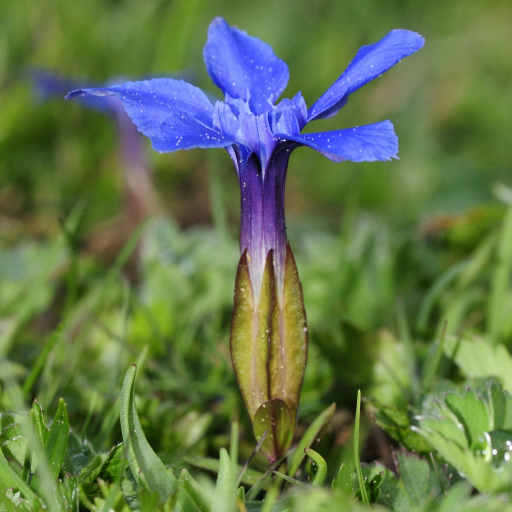
Plant Overview
Known as the "Star of the Mountain," the Gentiana verna is a jewel of the alpine world. Famous for its impossibly vivid "gentian blue" petals, this petite perennial is often one of the first signs of life in high-altitude meadows as the snow melts. It has long been a symbol of the European Alps and even appears on the Austrian 2-cent coin, representing a love for nature and purity.
🔍 How to Identify
- 💙 The Flower: Stunning, five-lobed petals that form a perfect star shape. The color is a deep, electric blue with a distinct white "eye" or throat in the center.
- 🌿 The Foliage: Small, leathery, oval-shaped leaves that grow in tight, ground-hugging basal rosettes.
- 📐 Growth Habit: This is a "mat-forming" plant. It stays very low to the ground, creating a dense cushion of green leaves that rarely exceeds 3 or 4 inches in height.
🏡 In Your Garden
- ⛰️ Alpine Roots: Because they originate in rocky mountain crevices, they require exceptional drainage. They thrive in rock gardens or "scree" beds where water can flow away from the crown quickly.
- ❄️ The Cooling Effect: Unlike many garden flowers, the Spring Gentian dislikes "hot feet." In warmer climates, it benefits from having a layer of grit or small stones around its base to keep the roots cool and moist.
- 🚫 Handle with Care: These plants have sensitive root systems. They are notoriously difficult to transplant once established, so choose their "forever home" in your garden carefully.
⚠️ Safety & Toxicity
- 🟢 Status: Generally non-toxic and safe for home gardens.
- 👅 Bitter Defense: While not poisonous, gentians contain "gentiopicroside," one of the bitterest substances known to man. This usually prevents pets or curious children from eating enough to cause any digestive upset.
✨ Fun Fact
In ancient mountain folklore, it was widely believed that bringing a Spring Gentian into a house would attract lightning strikes. Because of this, children were often warned never to pick them, which inadvertently helped protect the wild populations of these rare beauties!

Detailed Care Instructions
| Humidity | Normal |
| Difficulty | Medium |
| Temperature | 15°C - 20°C |
| Hardiness Zones | 4 - 7 |
To grow Gentiana Verna, also known as spring gentian or dwarf gentian, you can follow these steps:
- Choose the right location: Gentiana Verna prefers full sun to partial shade. Find a location in your garden that receives at least 4-6 hours of direct sunlight per day.
- Prepare the soil: The plant prefers well-draining, slightly acidic soil. Add organic matter like compost into the soil to improve its texture and fertility. Avoid heavy clay or waterlogged soil.
- Planting: Gentiana Verna can be propagated from seeds or purchased as starter plants from a nursery. If using seeds, sow them in early spring when the soil is still cool. Cover the seeds lightly with soil or use a seed starting mix. Keep the soil consistently moist until germination, which usually takes a few weeks. If using starter plants, dig a hole slightly larger than the root ball and place the plant in it. Backfill the hole and gently firm the soil around the plant.
- Watering: Gentiana Verna prefers consistently moist soil. Water the plant deeply once or twice a week, depending on the weather conditions. Ensure the plant doesn't sit in standing water, as it can lead to root rot.
- Mulching: Apply a layer of organic mulch, such as shredded bark or compost, around the plant. This helps to retain moisture and regulate soil temperature, especially during hot summers.
- Fertilization: Gentiana Verna is not a heavy feeder, so it generally doesn't require much fertilization. A light application of a balanced, slow-release fertilizer in spring can provide the necessary nutrients for healthy growth.
- Pruning: After the flowering season is over, you can trim back any dead or faded foliage. However, avoid cutting back the entire plant as it needs some foliage to gather energy for the next growing season.
- Pests and diseases: Gentiana Verna is generally pest and disease resistant. However, keep an eye out for slugs, snails, and aphids, which can occasionally affect the plant. Apply organic pest control measures if necessary.
Remember, Gentiana Verna is a native alpine plant and can be challenging to grow in certain climates or soil conditions. However, with proper care and suitable growing conditions, it can thrive and reward you with beautiful blooms in spring.

Place in a bright room that is sun drenched almost all day. Or directly in a south-facing window.

Gentiana Verna is a plant that requires specific conditions for watering. First, it is important to ensure that the soil is well-draining and does not become waterlogged. Watering should be done at the base of the plant and not from overhead to avoid getting water on the leaves or flowers, which may lead to disease or flower damage.
It is best to water Gentiana Verna deeply and infrequently, allowing the soil to dry out between waterings. This will encourage the plant to develop deep roots and become more drought-tolerant. During the growing season, it may need to be watered more frequently, especially during prolonged periods of hot and dry weather.
It is also important to keep in mind that Gentiana Verna is a mountain plant that grows in rocky areas with cool, moist conditions. As such, it is recommended to use cool or room temperature water for watering, rather than warm water.
Overwatering or underwatering can lead to problems with Gentiana Verna, so it is important to monitor the soil moisture levels and adjust watering accordingly. With proper watering and care, Gentiana Verna can produce beautiful blooms in the spring and summer.
To fertilize the Gentiana Verna plant, follow these instructions:
- Choose a balanced, slow-release fertilizer with an NPK ratio of 10-10-10 or 20-20-20.
- Begin fertilizing in early spring, just as new growth starts to emerge.
- Dilute the fertilizer according to the package instructions, usually 1 tablespoon per gallon of water.
- Water the soil around the plant thoroughly before applying the fertilizer.
- Carefully pour the diluted fertilizer solution onto the soil, avoiding direct contact with the plant's foliage.
- Repeat the fertilization process every 4-6 weeks throughout the growing season.
- Alternatively, you can use an organic fertilizer such as compost or well-rotted manure. Apply a thin layer around the base of the plant, and gently work it into the topsoil with a garden fork.
- Avoid over-fertilization, as it can lead to excessive foliage growth at the expense of flowers.
- During the winter months, refrain from fertilizing as the plant goes dormant.
- Regularly monitor the plant for any signs of nutrient deficiencies or excesses, adjusting the fertilization schedule accordingly.
Remember to always refer to the specific fertilizer product's instructions for the best results!
The ideal soil for the Gentiana Verna plant is well-draining and rich in organic matter. It should be slightly acidic with a pH range of 5.0 to 6.5. The soil should be moist but not waterlogged, as this plant is susceptible to root rot. A sandy loam or loamy soil is recommended, as these types of soils provide both good drainage and moisture retention. Avoid heavy clay soils and soils with high alkaline levels, as they can cause nutrient deficiencies and stunt the growth of the plant. If planting in a container, use a potting mix specifically formulated for acidic-loving plants or add peat moss to the soil mix to lower the pH. Lastly, ensure that the soil is well-aerated to support healthy root growth.
Gentiana Verna is a perennial plant species belonging to the Gentianaceae family. It is native to Europe and characterized by its vibrant blue flowers. Propagating Gentiana Verna can be done using various methods such as seed propagation or division.
- Seed Propagation:
- Collect ripe seeds from the plant when the seed capsules turn brown and start to split open, usually in late summer or early autumn.
- Prepare a seed tray or small pots with well-draining soil mix. The soil should be slightly acidic with good fertility.
- Sow the seeds thinly on the soil surface, ensuring they are not too deep, as they require light to germinate.
- Gently press the seeds onto the soil and lightly cover them with a layer of fine soil or vermiculite.
- Water the seeds lightly, ensuring that the soil remains moist but not waterlogged.
- Place the tray or pots in a cool, shaded area or a greenhouse with a temperature range of 60-68°F (15-20°C) for optimal germination.
- Germination can take several weeks, so be patient and keep the soil consistently moist during this time.
- Once the seedlings develop true leaves, they can be transplanted into individual pots and grown until they are large enough to be planted in the garden.
- Collect ripe seeds from the plant when the seed capsules turn brown and start to split open, usually in late summer or early autumn.
- Division:
- Choose a mature Gentiana Verna plant that has multiple stems or crowns.
- Dig up the plant in early spring or autumn, ensuring to include a good portion of the root system.
- Gently separate the root clumps, making sure each divided portion has at least one healthy stem and a sufficient amount of roots.
- Trim any damaged or withered roots, as well as any dead or diseased stems or foliage.
- Prepare the desired planting location by loosening the soil and adding organic matter to improve fertility and drainage.
- Dig a hole slightly larger than the divided plant's root system and place the plant in the hole at the same depth it was growing previously.
- Backfill the hole with soil, gently firming it around the plant to remove any air pockets.
- Water the newly planted division thoroughly to settle the soil around the roots.
- Mulch around the base of the plant with organic matter to retain moisture and suppress weed growth.
- Provide regular watering during the growing season, ensuring the soil remains slightly moist but not saturated.
- With proper care and suitable growing conditions, the divided plants will establish and grow into healthy specimens.
Propagation by seed or division allows for the multiplication of Gentiana Verna, ensuring the continuation of this beautiful plant species in gardens and landscapes.
- Choose a mature Gentiana Verna plant that has multiple stems or crowns.
Common pests of the spring gentian include Aphids, thrips. Make a habit of checking your spring gentian frequently for pests so that any infestations can be caught and managed early.








