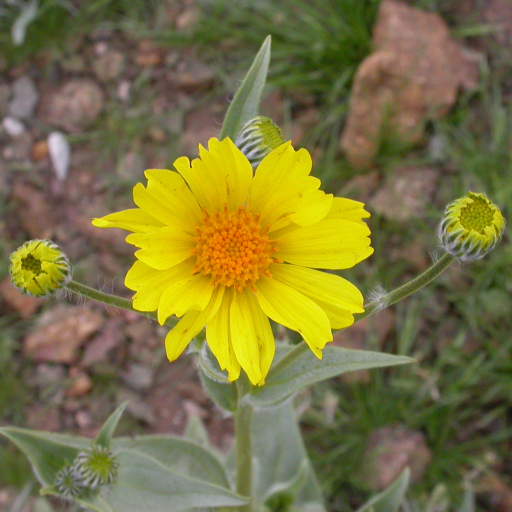
Plant Overview
Known as "Desert Gold" or the "Desert Sunflower," Geraea canescens is the legendary artist behind the vast yellow carpets that transform scorched desert floors into golden seas. These sun-loving annuals are the true stars of the Southwestern "superblooms," appearing almost overnight following rare, heavy winter rains. While they look like delicate daisies, they are rugged survivors perfectly adapted to the intense heat of the Mojave and Sonoran deserts.
🔍 How to Identify
- 🌼 The Blooms: Each flower head features bright yellow ray petals surrounding a matching yellow center (disc). Unlike many sunflowers with dark centers, Desert Gold is monochromatic yellow.
- 🌿 Silvered Foliage: The leaves and stems are covered in stiff, grayish-white hairs, giving the entire plant a "dusty" or silvery sheen that helps reflect harsh UV rays.
- 📏 Slender Stature: It typically grows on thin, branching stems reaching 1 to 3 feet in height, allowing the heavy flower heads to bob and sway in the desert wind.
🏡 In Your Garden
- 🏜️ Drought Specialists: This plant thrives in "wasteland" conditions. If you are trying to grow it at home, avoid rich potting soil or heavy compost; it demands sandy, rocky, and fast-draining earth to prevent root rot.
- 🌧️ Seasonal Timing: As a desert annual, its life cycle is triggered by moisture. In a garden setting, sow seeds in late autumn and provide occasional deep watering during the winter to mimic the natural rains that signal it’s time to wake up.
⚠️ Safety & Toxicity
- 🐾 Pet Friendly: Geraea canescens is generally considered non-toxic to dogs, cats, and horses, making it a safe addition to a native plant or xeriscaped garden.
- 🧤 Bristly Texture: While not poisonous, the stiff hairs (trichomes) on the stems can be mildly irritating to people with sensitive skin. It is best to wear gloves if you are thinning out a large patch.
✨ Fun Fact
👴 The "Old Man" Name: The genus name Geraea is derived from the Greek word geraios, which means "old man." This isn't a reference to the plant's lifespan, but rather to the white, hairy tufts on its seeds that look like a tiny, wispy white beard!

Detailed Care Instructions
To grow Geraea Canescens, also known as Desert Sunflower, follow these steps:
- Select the right location: Desert Sunflowers require full sun exposure. Make sure to choose a spot in your garden or yard that receives at least 6-8 hours of direct sunlight each day.
- Prepare the soil: Geraea Canescens prefers well-draining soil. If your soil is heavy or clay-like, amend it with organic matter (such as compost or peat moss) to improve its drainage capabilities.
- Sow the seeds: Geraea Canescens can be grown from seeds. Sow the seeds directly into the prepared soil in early spring (after the risk of frost has passed) or in late fall. Scatter the seeds on the soil surface and lightly press them into the soil. Keep in mind that these plants are native to the desert, so excessive watering is not required.
- Watering: Water the seeds lightly immediately after sowing, and then provide regular, deep watering until the plants are established. After that, you can reduce the frequency of watering. Desert Sunflowers are drought-tolerant and can survive on low amounts of water once established. Avoid overwatering, as it may cause root rot and other issues.
- Maintenance: Remove any weeds that compete for resources with the growing plants. Desert Sunflowers can tolerate high temperatures, but they may benefit from occasional pruning to remove dead or damaged branches.
- Pest and disease control: Desert Sunflowers are generally not prone to major pest or disease issues. However, keep an eye out for aphids, snails, or slugs, and take appropriate measures if required.
- Harvesting seeds: Geraea Canescens produce attractive seedheads. You can harvest the seeds by cutting off the dried flower heads once they have ripened and turned brown. Store the seeds in a cool, dry place for future planting or sharing.
Remember, Geraea Canescens is a native plant species, so it is often beneficial to consult with local gardening experts or extension offices for specific tips and advice based on your region's climate and conditions.

Place in a bright room that is sun drenched almost all day. Or directly in a south-facing window.

To properly water this plant, you will need to first understand its specific needs. It is important to ensure that the soil is consistently moist but not soggy. One of the best ways to achieve this is to water deeply and infrequently, allowing the soil to dry out a bit between waterings.
You should aim to water the plant deeply once per week during the growing season, and reduce watering in winter when the plant is dormant. Avoid watering too frequently, as this can lead to root rot and other issues.
When watering, be sure to direct water towards the soil around the base of the plant rather than overhead watering, which can encourage disease and mildew. Consider using a drip or soaker hose to deliver water directly to the soil.
It is also important to note that this plant is native to arid regions and can withstand drought conditions for short periods. In fact, overwatering can be more harmful to this plant than underwatering. So be sure to monitor soil moisture levels and adjust your watering schedule accordingly.
To fertilize this plant, use a balanced fertilizer with an NPK ratio of 10-10-10 or 20-20-20. Apply the fertilizer during the growing season, which is typically in spring and summer. Dilute the fertilizer to half-strength and apply it every 2-4 weeks. Water the plant thoroughly after fertilizing to ensure the nutrients are absorbed properly. Avoid over-fertilizing as this can lead to burning of the roots and foliage.
The ideal soil for growing Geraea Canescens should have good drainage properties and should not retain too much water. It should have a slightly sandy texture and should not be too heavy or clayey. Additionally, the soil should be well-aerated and fertile, with enough nutrients to support the growth and development of the plant. The pH level of the soil should be slightly acidic to neutral, ranging between 6.0 to 7.5. When planting Geraea Canescens, it is recommended to mix the soil with compost or other organic matter to improve its quality and fertility. Overall, the soil for growing Geraea Canescens should be lightweight, well-draining, and rich in nutrients to ensure healthy growth of the plant.
To propagate this particular plant, one can start by collecting mature seeds. The seeds should be cleaned and soaked in water for a couple of hours. After soaking, the seeds should be placed in a seedling mix in a pot or tray. The soil should be kept moist and placed in a warm, sunny location. Germination typically takes about two weeks, and once the seedlings have grown big enough, they can be transplanted into individual pots or directly into the ground. Alternatively, the plant can be propagated through cuttings. Cuttings should be taken from mature branches and placed in a well-draining soil mix. The cuttings should be kept moist and placed in a bright location but not in direct sunlight. Rooting typically takes a few weeks, and once established, the new plant can be transplanted to a larger container or directly into the ground.








