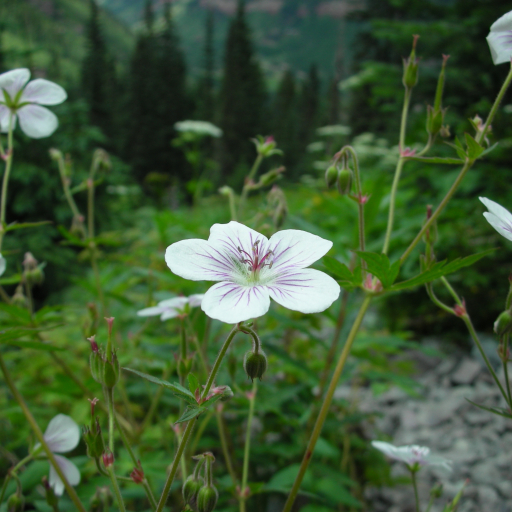
Plant Overview
Often called the Richardson’s Crane’s-bill, this elegant wildflower is a staple of North American mountain meadows and cool forest edges. While it looks delicate with its translucent white petals, it is a hardy perennial that signals the peak of summer in the high country. It is a favorite for those trying to recreate a "mountain meadow" aesthetic in their own landscape.
🔍 How to Identify
- 🌸 Petals & Veining: The flowers are typically stark white or very pale lavender, featuring five petals etched with delicate purple veins. These veins aren't just for show; they act as "nectar guides" for pollinating insects.
- 🍃 Jagged Foliage: The leaves are deeply divided into 3 to 7 sharp lobes. They have a fuzzy texture due to fine hairs, which help the plant retain moisture in breezy mountain environments.
- 🌿 The "Crane's Bill": Look for the distinctive seed pod that forms after the flower drops. It is long, slender, and pointed, bears a striking resemblance to the beak of a crane.
🏡 In Your Garden
- 💧 Moisture Seeker: Unlike some of its desert-dwelling cousins, Richardson’s Geranium thrives in consistently moist, well-drained soil. It is the perfect candidate for a "rain garden" or a spot near a pond where the soil stays cool.
- 🏔️ Cool Roots: Because it is native to high altitudes, this plant dislikes intense, stagnant heat. If you live in a warmer zone, plant it in a spot that receives morning sun but is shielded from the harsh afternoon rays to prevent the foliage from wilting.
⚠️ Safety & Toxicity
- ✅ Low Risk: Richardson’s Geranium is generally considered non-toxic to humans and is not listed as a major threat to livestock.
- 🐾 Pet Watch: While it isn't "poisonous" like a Lily or Foxglove, the essential oils and tannins in the leaves can cause mild stomach upset in curious dogs or cats if eaten in large quantities.
- 🧤 Skin Sensitivity: The glandular hairs on the stems can occasionally cause a mild, itchy redness for gardeners with very sensitive skin.
✨ Fun Fact
🚀 The Seed Catapult: This plant doesn't just drop its seeds; it launches them! When the "crane’s bill" pod dries out, it creates a mechanical tension that eventually snaps, catapulting the seeds several feet away from the parent plant to ensure the next generation has plenty of room to grow.

Detailed Care Instructions
To grow Geranium Richardsonii (Richardson's geranium), you can follow these steps:
- Choose a suitable location: Geranium Richardsonii prefers full sun to partial shade. Select a location in your garden that receives at least 6 hours of sunlight per day.
- Prepare the soil: The soil should be well-draining and rich in organic matter. You can amend the soil with compost or well-rotted manure to improve its fertility. Ensure the pH level of the soil is slightly acidic to neutral.
- Planting: Dig a hole that is slightly larger than the root ball of the plant. Place the plant in the hole, ensuring the top of the root ball is level with the soil surface. Fill the hole with soil and gently pat it down to remove any air pockets.
- Watering: Water the plant thoroughly after planting and keep the soil evenly moist during the growing season. Avoid overwatering or letting the soil become waterlogged, as this can cause root rot.
- Mulching: Apply a layer of organic mulch, such as wood chips or straw, around the base of the plant. This helps to retain moisture, suppress weeds, and regulate soil temperature.
- Fertilizing: Geranium Richardsonii doesn't require heavy fertilization. You can apply a balanced slow-release fertilizer once in early spring and again in late summer, following the package instructions.
- Pruning: Trim back any dead or damaged growth as necessary to maintain the plant's health and appearance. You can also prune the plant in early spring to encourage compact growth.
- Pests and diseases: Monitor the plant for common pests like aphids, caterpillars, or snails. Use organic pest control methods or insecticidal soap if necessary. Geranium Richardsonii is generally resistant to most diseases.
- Winter care: This plant is native to North America and can tolerate cold temperatures. Mulching around the base of the plant in late fall can help protect it during the winter months.
By following these steps, you can successfully grow Geranium Richardsonii in your garden and enjoy its beautiful flowers and foliage.

Place in a bright room that is sun drenched almost all day. Or directly in a south-facing window.

Geranium richardsonii plant thrives well in moist soil. The watering frequency required for this plant depends on various factors, such as the climatic conditions, soil type, and exposure to sunlight. It is important to avoid overwatering the plant as it can lead to root rot and damage to the plant.
To water Geranium richardsonii plant, first, check the soil to determine if it has dried out or not. Insert your finger a few inches deep into the soil and feel the moisture level. If the soil is dry, it's time to water the plant.
The best way to water Geranium richardsonii plant is to use a watering can or a hose with a gentle spray nozzle. Water the plant until the soil is moist but not overly saturated. It is important to avoid getting water on the leaves of the plant as this can lead to fungal diseases.
During hot and dry weather conditions, the plant may require more frequent watering to prevent the soil from drying out completely. On the other hand, during cooler and wetter weather, the plant may not require as much watering.
It is recommended to water Geranium richardsonii plant in the early morning or late afternoon as it allows the water to absorb into the soil before the heat of the day and prevents the plant from losing moisture through evaporation. With proper watering and care, Geranium richardsonii plant can grow into a beautiful and healthy plant.
To fertilize this plant, use a balanced fertilizer with an NPK ratio of 10-10-10. Apply the fertilizer every two to three weeks during the growing season (spring and summer months) according to the package instructions. Make sure to water the plant thoroughly before and after fertilizing to prevent root burn. Additionally, avoid fertilizing during the dormant season (fall and winter months) as the plant does not actively grow during this time.
Geranium Richardsonii is a plant that prefers well-drained soil that is slightly acidic to neutral in pH. The soil should be rich in organic matter and have good fertility. It is important to avoid using heavy soils that retain water as the roots of this plant can rot easily. A soil that is a mixture of sand, peat moss, and loam is ideal.
It is recommended to add a slow-release fertilizer to the soil before planting to ensure the plant has a good start. The soil should be kept moist but not waterlogged, and it is important to allow the top inch of soil to dry out before watering again.
It is advisable to mulch around the plant to help retain moisture and regulate the soil temperature. The mulch will also help to suppress weeds and improve soil health.
Overall, using a well-drained, slightly acidic to neutral soil that is rich in organic matter and has good fertility is ideal for growing Geranium Richardsonii successfully.
To propagate this plant, start by taking cuttings from healthy stems that are about 3-4 inches long. Remove the lower leaves from the cutting and dip the cut end in rooting hormone powder. Place the cutting in a pot with well-draining soil and water it thoroughly. Cover the pot with a plastic bag to create a humid environment and place it in a bright, warm area with indirect sunlight. Keep the soil moist but not waterlogged. After 2-3 weeks, the cutting should begin to root and new growth will appear. Once the cutting has established roots, remove the plastic bag and continue to care for the new plant as you would an adult Geranium Richardsonii.








