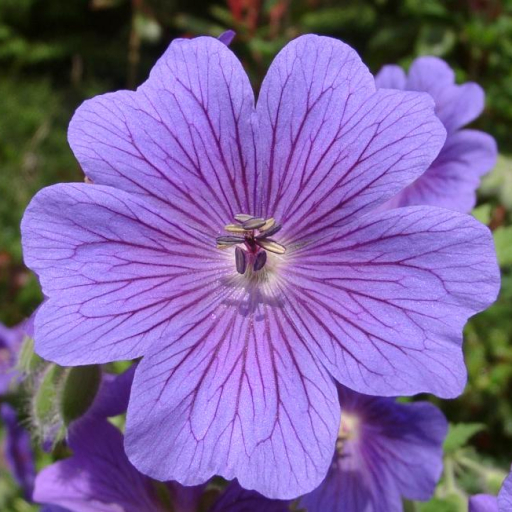
Plant Overview
Known as the Purple Cranesbill, this plant is a horticultural masterpiece born from a cross between two wild Caucasian species. It is widely considered one of the most beautiful hardy geraniums because of its oversized, neon-violet blooms that seem to glow at dusk. While its flowering season is shorter than some of its cousins, it makes up for it with a spectacular, fiery foliage display when autumn arrives.
🔍 How to Identify
- 🌸 The Bloom: Large, saucer-shaped flowers featuring five petals of intense violet-blue, intricately etched with dark purple veins that act as "honey guides" for bees.
- 🍃 The Foliage: Deeply lobed, palmate leaves that have a soft, velvety texture due to a fine coating of hairs.
- 📏 Growth Habit: Forms a dense, robust mound that typically reaches about 2 feet in height and width, creating a perfect weed-smothering carpet.
🏡 In Your Garden
- ✂️ The "Chelsea Chop": To keep the plant from flopping over after its heavy June flowering, many gardeners cut the entire plant back to the ground. This encourages a fresh flush of beautiful new leaves and occasionally a second, smaller round of flowers.
- ☀️ Sun Seeker: While it can tolerate light shade, it produces the most vivid colors and strongest stems in full sun. It is particularly valued for its "sterile" nature—unlike other geraniums, it won't aggressively self-seed and take over your entire flower bed.
⚠️ Safety & Toxicity
- ✅ Safe for All: This variety is generally considered non-toxic to humans, cats, and dogs. It is a "true" Geranium, which is much safer than the common potted Pelargonium (often also called geraniums) which can be mildly irritating.
- 🧤 Sensitive Skin: While non-toxic, the hairy stems can occasionally cause very mild mechanical skin irritation for people with highly sensitive skin during heavy pruning.
✨ Fun Fact
The name "Cranesbill" comes from the long, beak-like shape of the seed capsules found in this genus. However, because Geranium × magnificum is a hybrid, it is almost entirely sterile and rarely produces these "beaks" at all!

Detailed Care Instructions
To grow Geranium x Magnificum, also known as "Magnificum Geranium," you can follow these steps:
- Choose the right location: Magnificum Geranium prefers partial shade to full sun. Select a spot in your garden or balcony that receives at least 4-6 hours of direct sunlight per day.
- Prepare the soil: Geranium x Magnificum thrives in well-drained soil with a pH level between 6.1 and 7.8. Improve the soil by adding organic matter like compost or well-rotted manure to enhance drainage and fertility.
- Sowing seeds or transplanting: You can either grow Geranium x Magnificum from seeds or purchase young plants from a nursery. If starting from seeds, sow them indoors about 10-12 weeks before the last frost date. Transplant the seedlings outdoors once all chances of frost have passed.
- Planting: Dig a hole in the soil large enough to accommodate the root ball of your Geranium x Magnificum plant. Place the plant in the hole, ensuring that the soil surface remains level with the surrounding soil. Space each plant about 12-18 inches apart to allow for ample growth.
- Watering: Geranium x Magnificum prefers moderate moisture levels. Water the plant deeply but infrequently, allowing the top inch of soil to dry out before watering again. Avoid overwatering, as it can lead to root rot.
- Fertilization: Apply a balanced, slow-release fertilizer once every 4-6 weeks during the growing season to promote healthy growth and abundant flowers. Follow the instructions on the fertilizer packaging for proper dosage.
- Pruning: To maintain a compact and tidy appearance, deadhead faded flowers regularly. Additionally, trim back any leggy or overgrown stems to promote bushier growth.
- Mulching: Apply a layer of organic mulch, such as bark chips or straw, around the base of the plant to help retain soil moisture and suppress weeds. Keep the mulch a few inches away from the plant's stems to prevent rotting.
- Pests and diseases: Geranium x Magnificum is generally resistant to pests and diseases. However, keep an eye out for common garden pests like aphids or snails and treat them promptly if detected.
- Winter care: In colder regions, where temperatures drop below freezing, provide winter protection to Geranium x Magnificum by mulching heavily around the plant's base. Alternatively, you can move potted plants indoors or into a greenhouse for the winter.
By following these steps and providing the right care, you can successfully grow and enjoy your Geranium x Magnificum plant.

Place in a bright room that is sun drenched almost all day. Or directly in a south-facing window.

Geranium X Magnificum is a perennial plant that requires regular watering to thrive and maintain its growth. To water this plant, it is essential to monitor the soil moisture levels regularly. Begin by gently inserting your finger into the soil, about an inch deep, to check the moisture level.
If the soil feels dry to the touch, it's time to water the plant. Water slowly and deeply, ensuring that the entire root system is thoroughly saturated. Allow the water to penetrate the soil to a depth of at least 6 inches, but avoid overwatering, as this can lead to root rot.
It is also essential to water this plant early in the morning or late in the evening when temperatures are cooler. Watering during the hottest part of the day can cause the water to evaporate more quickly, potentially leaving the soil too dry.
In summary, water Geranium X Magnificum regularly, but ensure the soil is not waterlogged. Monitor moisture levels regularly, water slowly, and deeply early or late in the day for optimal growth.
- Use a high-quality, balanced fertilizer with equal or higher amounts of nitrogen, phosphorus, and potassium.
- Apply fertilizer in the spring, before the plant starts growing vigorously.
- Follow package instructions for dosage and application method (granular or liquid).
- Apply fertilizer evenly around the base of the plant.
- Water the plant thoroughly after fertilizing to help distribute the nutrients to the roots.
- Repeat fertilizer application every 4-6 weeks during the growing season.
- Avoid over-fertilizing, which can result in burned foliage or weakened plants.
- Monitor the plant's growth and adjust fertilizing accordingly.
It is recommended to use well-draining soil that is rich in organic matter for this specific plant. The pH level of the soil should be slightly acidic to neutral, with a range of 6.0-7.0. Avoid using heavy clay soils, as they can cause waterlogging and root rot. Additionally, the soil should be moist but not waterlogged. Organic fertilizers can be added to the soil to provide additional nutrients. Overall, a loose and well-aerated soil mixture is ideal for the healthy growth of this plant.
- Select a healthy parent plant - Choose a mature and healthy Geranium X Magnificum plant that you wish to propagate.
- Prepare a rooting medium - Prepare a sterile rooting medium, such as vermiculite, perlite, or a mixture of peat moss and sand, that is well-drained and provides good aeration.
- Take stem cuttings - Take stem cuttings from the parent plant that are 3-4 inches long, and make a clean cut just below a node. Remove any lower leaves from the cutting, leaving only a few at the top.
- Dip cuttings in rooting hormone - Dip the end of the cutting in rooting hormone powder to promote root growth.
- Place cutting in rooting medium - Insert the cutting into the prepared rooting medium, making sure that at least one node is covered. Firmly press the medium around the cutting to remove any air pockets.
- Water the cuttings - Water the cuttings thoroughly, until excess water drains from the bottom.
- Provide a suitable environment - Place the cuttings in a suitable environment, such as under a plastic tent, to maintain high humidity and prevent water loss.
- Monitor and care for the cuttings - Keep the rooting medium moist but not waterlogged. Monitor the cuttings daily and remove any dead or diseased leaves.
- Transplant the rooted cuttings - After 4-6 weeks, check for root growth by gently tugging on the cutting. When the roots are long enough, transplant the new plants into individual pots or into a prepared planting bed.
- Continue to care for the new plants - Water the newly propagated plants regularly and provide them with the appropriate amount of light and fertilizer, depending on their growing conditions.
Common pests of the purple crane's-bill include Aphids, whiteflies. Make a habit of checking your purple crane's-bill frequently for pests so that any infestations can be caught and managed early.








