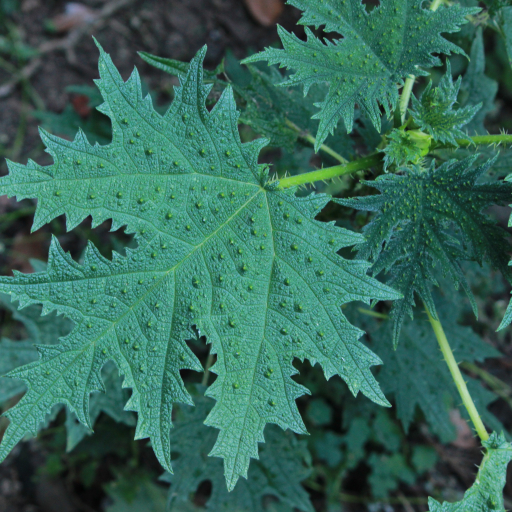
Plant Overview
Known as the Himalayan Giant Nettle or "Allo" in its native Nepal, this plant is a legendary giant of the mist-covered mountain slopes. For centuries, it has been revered by mountain communities as a "wilderness weaver," providing strong fibers for everything from fishing nets to high-end sustainable clothing. Despite its intimidating appearance, it is a cornerstone of Himalayan culture and biodiversity.
🔍 How to Identify
- 🌿 Lobed Leaves: The leaves are impressively large and heart-shaped at the base, but they feature deep, jagged lobes that vary significantly in shape—a trait that gives the plant its name, diversifolia.
- 🪡 Needle Armor: The stems and leaves are densely covered in long, translucent stinging hairs (trichomes) that look like tiny, upright glass shards.
- 📏 Staggering Height: This is no ordinary garden weed; in the right conditions, it can tower over humans, reaching heights of up to 3 meters (nearly 10 feet).
🏡 In Your Garden
- 💧 Moisture & Shade: In the wild, it thrives in the damp, nitrogen-rich soil of forest edges and riverbanks. If you are growing it, it requires constant moisture and semi-shaded spots to mimic the cool mountain mist.
- 🎋 Aggressive Spreading: Because it spreads via both seeds and a vigorous root system, it is best kept in "wild" sections of a property where it won't overtake more delicate ornamentals.
- 🧤 Handling Needs: It hates being moved once established due to its deep root system, and any maintenance must be done with heavy-duty protection to avoid its formidable sting.
⚠️ Safety & Toxicity
- 🚫 Severe Irritant: CAUTION. The plant is armed with stinging hairs that inject a cocktail of formic acid and other irritants into the skin upon contact. The sting is significantly more painful and longer-lasting than that of the common European nettle.
- 🐾 Pets & Kids: It is highly recommended to keep this plant away from areas frequented by children or pets. Contact causes immediate burning, redness, and swelling that can last for several hours.
✨ Fun Fact
🧶 The Silk of the Mountains: The fiber extracted from the inner bark of the Girardinia Diversifolia is considered one of the strongest and longest natural fibers in the world. It is naturally antimicrobial and is becoming a sought-after material in the "slow fashion" industry as a sustainable alternative to cotton and synthetic fabrics.

Detailed Care Instructions
To grow Girardinia Diversifolia (also known as Himalayan Nettle), you can follow these steps:
- Obtaining seeds or cuttings: You have two options to propagate this plant. You can either obtain seeds from a reputable supplier or collect mature seeds from existing plants. Alternatively, you can obtain stem cuttings from a healthy and mature Himalayan Nettle plant.
- Germination: If you opt for seeds, sow them in a pot filled with well-draining potting soil. Cover the seeds with a thin layer of soil and keep the pot in a warm and partially-shaded location. Maintain consistent moisture levels by lightly misting the soil whenever it starts to dry out.
- Transplanting: Once the seedlings have grown to a suitable size, typically around 3-4 inches in height, you can transplant them into individual pots or containers. Ensure each pot has good drainage holes and use a mixture of well-draining soil, compost, and sand.
- Location: Select a suitable location for your Girardinia Diversifolia plant. It prefers partial shade to filtered sunlight, as direct sunlight can scorch its delicate leaves. If growing indoors, find a spot near a window that provides indirect light or use fluorescent grow lights.
- Watering: Girardinia Diversifolia requires consistently moist soil. Water the plant whenever the top inch of soil feels dry to the touch. Avoid overwatering, as it can lead to root rot. Mist the leaves occasionally to provide additional humidity.
- Fertilization: Feed the plant every two to four weeks during the growing season with a balanced liquid fertilizer diluted to half strength. Reduce or stop fertilization during the winter months when the plant goes dormant.
- Pruning: Trim back any dead or damaged leaves regularly to maintain plant health and appearance.
- Pests and diseases: Keep an eye out for common plant pests like aphids, mealybugs, or spider mites. If any infestations occur, treat them with appropriate organic insecticides or natural pest control methods. Monitor the plant for any signs of diseases, such as leaf spot or powdery mildew, and take appropriate measures if necessary.
Remember to do some research specific to your climate and growing conditions to ensure the best care for your Girardinia Diversifolia plant.

Place in a bright room that is sun drenched almost all day. Or directly in a south-facing window.

To water this plant, you should allow the soil to dry out partially between each watering. This will help prevent overwatering and promote healthy root growth. When you do water the plant, be sure to water it deeply and thoroughly, ensuring that the water penetrates the soil to a depth of several inches. Be careful not to splash water onto the foliage, as this can promote the growth of fungal diseases. Additionally, if you notice any signs of wilting or yellowing leaves, this may be a sign that the plant is not getting enough water and should be watered more frequently.
To fertilize this plant, start by selecting a slow-release, balanced fertilizer that is high in nitrogen and phosphorus, with a moderate amount of potassium. Mix the fertilizer into the top few inches of soil around the base of the plant, being careful not to disturb the roots. Water the plant immediately after fertilizing, and repeat every two to four weeks during the growing season. Avoid over-fertilizing, as this can cause the plant to produce excessive foliage at the expense of flowers and fruit. Monitor the plant closely for signs of nutrient deficiency or excess, such as yellowing leaves or stunted growth, and adjust the fertilizer accordingly.
Girardinia Diversifolia plant is a species of plant that requires a particular type of soil to thrive. This plant grows well in soil that is rich in nutrients and has good drainage. A pH level of 5.5 to 7.5 is best for the growth of this plant. The soil should also have good water retention capacity to prevent the roots from drying out. It is important to ensure that the soil is not too compact as this can affect the plant's root system and inhibit growth. A suitable soil for Girardinia Diversifolia plant would ideally be a mixture of well-aged compost, sandy soil, and a small amount of clay soil. This will provide the plant with the required nutrients, drainage, and water retention capacity for optimal growth.
The Girardinia Diversifolia plant can be propagated using the technique of stem cuttings. For this, select a healthy and disease-free stem from the parent plant, which is approximately 6 inches long and has two to three pairs of leaves.
Ensure that the leaves do not touch the soil while propagating, as this might lead to rotting and cause the cutting to die. Also, remove any leaves from the lower part of the stem, leaving only one pair of leaves on top.
Place the stem cutting in moist soil and cover it with a plastic bag or a transparent container to maintain a higher level of humidity. Water regularly to ensure the soil remains moist, but not waterlogged.
After about two to three weeks, new roots will appear, indicating that the cutting has successfully rooted. You can then gradually acclimatize the plant to the surrounding environment by removing the plastic covering in stages.
Finally, transplant the new plant into a pot or a suitable growing medium, and continue to care for it by providing adequate sunlight, water, and nutrients as per the plant's requirements.








