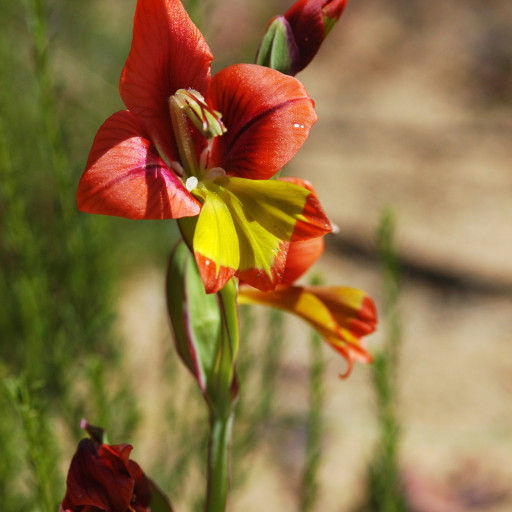
Plant Overview
Known as the "Sword Lily," the Gladiolus is the undisputed champion of the summer garden, standing tall with regal elegance. Its name comes from the Latin word gladius, meaning sword, a direct reference to its sharp, blade-like foliage. In the Victorian language of flowers, gifting a Gladiolus meant the recipient’s heart was "pierced with love," though today it is more commonly associated with strength, victory, and moral integrity.
🔍 How to Identify
- 🗡️ Sword-Shaped Leaves: The foliage is distinctively long, slender, and pointed, emerging in a fan-like arrangement that resembles a classic Roman shortsword.
- 🗼 Towering Spikes: The flowers grow on a tall, vertical stalk known as a raceme, which can reach heights of 2 to 5 feet depending on the variety.
- 🎺 Funnel-Shaped Blooms: The individual flowers are ruffled and trumpet-like, uniquely blooming in sequence from the bottom of the stalk toward the very tip.
🏡 In Your Garden
- 🌬️ Support Systems: Because they are so top-heavy when in full bloom, these "divas" often require staking or a sheltered spot to prevent summer winds from snapping their magnificent stems.
- 🥔 Corm Care: Unlike tulips or lilies which grow from bulbs, Gladioli grow from "corms." In colder climates, these must be dug up and stored in a cool, dry place over winter, as they cannot survive a deep ground freeze.
- 🥗 Staggered Planting: To enjoy a continuous parade of color, gardeners often plant a new batch of corms every two weeks; this ensures a rolling bloom cycle rather than one single burst.
⚠️ Safety & Toxicity
- 🐾 Toxic to Pets: The entire plant is considered toxic to dogs, cats, and horses.
- 🧤 Corm Concentration: While the leaves are irritating, the highest concentration of toxic glycosides is found in the underground corms. If a pet digs them up and eats them, it can cause lethargy, vomiting, and excessive drooling.
- 🌱 Skin Irritation: Some sensitive individuals may develop a mild skin rash (dermatitis) after handling the corms, so wearing gardening gloves is recommended.
✨ Fun Fact
- ⚔️ Gladiator Amulets: Ancient Roman legends claim that gladiators wore Gladiolus corms around their necks as protective amulets during combat, believing the "Sword Lily" would shield them from harm and bring them victory in the arena.

Detailed Care Instructions
| Humidity | Normal |
| Lighting | Full Sun |
| Toxicity | Toxic |
| Difficulty | Medium |
| Hibernation | Cold Period |
| Temperature | Min 13°C |
| Hardiness Zones | Min 7A |
To successfully grow a Gladiolus plant, follow these steps:
- Select a suitable location: Gladiolus plants thrive in well-drained soil and need a full sun exposure for at least 6-8 hours a day. Choose a spot that receives ample sunlight and has good soil drainage.
- Prepare the soil: Loosen the soil using a garden fork or tiller to improve drainage. Add organic matter such as compost or well-rotted manure to enrich the soil and improve water retention.
- Planting: Plant gladiolus corms (bulbs) in early spring after the last frost date in your area. Dig holes about 4-6 inches deep and space them about 6 inches apart. Place the corms with the pointed end facing up and cover them with soil. If you want continuous blooms, plant new corms every few weeks.
- Watering: Keep the soil consistently moist but not overly saturated. Water deeply once or twice a week, ensuring the water reaches the roots. Avoid over-watering, as it can lead to root rot.
- Mulching: Apply a layer of mulch around the plants to conserve moisture, suppress weed growth, and regulate soil temperature. Use organic mulch like wood chips, straw, or compost.
- Support: Gladiolus plants grow tall and may require support to prevent them from bending or breaking. Insert stakes or place a trellis in the ground near the planted corms when they are about 8-10 inches tall.
- Fertilizing: Feed the gladiolus plants with a balanced fertilizer high in phosphorus just as they begin to emerge from the ground. Repeat this every 3-4 weeks until they finish blooming. Follow the package instructions for the right amount and frequency of application.
- Deadheading and pruning: Remove faded flowers regularly to encourage more blooms and prevent seed production. After the first frost, when the foliage turns yellow or brown, cut the stems back to about 2 inches above the ground.
- Winter care: In areas with harsh winters, dig up the corms after the foliage dies back and store them in a cool, dry place (around 40-50°F or 4-10°C) for winter. Replant them in the spring for the next growing season.
By following these steps, you can enjoy beautiful gladiolus blooms in your garden.

Place in a bright room that is sun drenched almost all day. Or directly in a south-facing window.

Watering instructions for a certain flowering plant, belonging to the genus of perennial cormous plants in the family Iridaceae, are as follows:
- Water the plant regularly, keeping the soil consistently moist but not waterlogged.
- Avoid letting the soil dry out completely, as this may cause the corms to shrivel and die.
- Water deeply, ensuring that the water penetrates to the root level, rather than just moistening the surface.
- Use a watering can or hose with a gentle nozzle to avoid damaging the delicate foliage and flowers.
- Water in the morning or evening, when temperatures are cooler and evaporation is lower.
- In hot, dry weather, increase the frequency of watering to prevent the soil from drying out too quickly.
- Be careful not to overwater, as this may lead to root rot and other fungal diseases.
- During periods of heavy rain, allow the soil to dry out slightly between waterings to prevent waterlogging.
To promote healthy growth and blooming of the plant, fertilize it with a balanced, water-soluble fertilizer once every two weeks during the growing season. Apply the fertilizer according to the manufacturer's instructions, but be careful not to over-fertilize as this can lead to burned roots and foliage. Additionally, ensure that the soil is well-draining to prevent water-logging and root rot.
The best type of soil to use for the Gladiolus plant is a well-draining soil, with a pH level between 6.0 and 7.0. It should be rich in nutrients, with a mixture of organic matter such as compost or aged manure. It is important to avoid using heavy clay soil as it can retain too much water, leading to root rot. Alternatively, sandy soil may not hold enough moisture for the plant to grow properly. It is recommended to amend the soil with organic matter and maintain a consistent moisture level by watering regularly, but not allowing the soil to become waterlogged. Over-fertilization should also be avoided as it can lead to disease and pest issues.
Gladiolus is a popular plant that can be propagated by several techniques such as corm division, seed propagation and stem cuttings. One of the easiest ways to propagate this plant is through corm division.
For corm division, the first step is to dig up the corm during the dormant season when the plant has finished blooming and the foliage has turned yellow. Use a garden fork or spade to gently lift the corm from the soil. Remove all dirt and debris from the corm, then separate the newly formed cormels from the parent corm.
Make sure each cormel has a small bud or “eye” on it, which will produce a new plant. Allow the cormels to dry for a day or two to prevent rotting. Once the cormels have dried, they should be planted in well-draining soil in a sunny location. The cormels should be planted 4-6 inches apart and 3-4 inches deep, with the pointed end facing up.
Water the cormels thoroughly, then wait for them to sprout. Once the new plants begin to grow, water them regularly and fertilize them with a balanced fertilizer. With proper care, the new Gladiolus plants should bloom in the next growing season.
Common pests of the gladioli include Aphids, thrips, larvae, snails. Make a habit of checking your gladioli frequently for pests so that any infestations can be caught and managed early.







