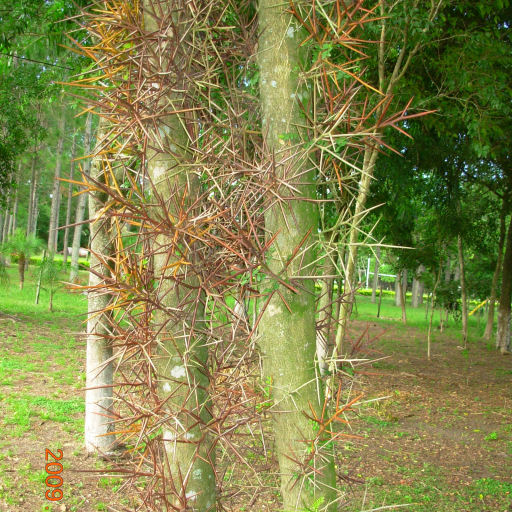
Plant Overview
Known in its native South America as "Espina de Corona" (Crown of Thorns), Gleditsia amorphoides is a formidable and fascinating tree that looks like it stepped out of a prehistoric landscape. While it is a close relative of the common Honey Locust, this species is distinct for its intensely defensive architecture and its traditional use in making natural soaps. It is a tree that demands respect and offers a striking, albeit prickly, silhouette against the horizon.
🔍 How to Identify
- 🌵 The Thorns: The most striking feature is its large, multi-pointed, and often branched thorns that grow directly from the trunk and larger branches, serving as a natural "barbed wire."
- 🍃 The Foliage: It sports delicate, fern-like bipinnate leaves that provide a soft, dappled shade, creating a beautiful contrast against its aggressive, dark wood.
- 🫘 The Seed Pods: Late in the season, it produces thick, leathery, dark-brown pods that are often curved or twisted, containing hard, bean-like seeds embedded in a pulpy interior.
🏡 In Your Garden
- 💪 Rugged Adaptability: This tree is incredibly hardy and thrives in various soil types, particularly in subtropical and temperate regions. Because of its deep taproot, it is highly drought-tolerant once established and can act as a great windbreak.
- 🐝 Pollinator Magnet: In late spring, it produces clusters of small, greenish-yellow flowers. While they aren't showy to humans, they are highly fragrant and provide a massive nectar source for local honeybees and butterflies.
⚠️ Safety & Toxicity
- 🛡️ Physical Hazard: The primary danger of this plant is mechanical. The thorns are extremely sharp and can easily puncture skin, heavy clothing, or even tractor tires. Always plant this tree far away from walkways or areas where children and pets play.
- 🤢 Ingestion Risk: The pods contain saponins. While not considered "deadly," ingesting the seeds or pods can cause significant digestive upset, nausea, or vomiting in dogs, cats, and humans.
- 🧤 Handling Note: When pruning, wear puncture-resistant "gauntlet" style gloves to protect your forearms from the long lateral spines.
✨ Fun Fact
- 🧼 The Soap Tree: In rural South American communities, the pods of Gleditsia amorphoides have historically been used as a natural detergent. If you crush a mature pod and rub it with a little water, it will produce a foamy lather that can be used to wash clothes or hair!

Detailed Care Instructions
To water this particular plant, it is important to take into consideration the season and weather conditions. Generally, it is recommended to water deeply and infrequently, rather than shallowly and frequently. This encourages the roots to grow deeper into the soil, making the plant more drought-resistant.
During the growing season, the plant should be watered approximately once a week. In hot and dry conditions, it may be necessary to water more frequently. It is important to ensure that the soil is well-draining to prevent waterlogging and root rot.
To water, slowly apply water at the base of the plant until the soil is saturated. Avoid getting water on the leaves or foliage, as this can encourage fungal growth. It may be helpful to mulch around the base of the plant to help retain moisture in the soil.
During the dormant season, it is important to reduce watering to once every two to three weeks. This will prevent the plant from rotting and encourage healthy growth when spring arrives.
The recommended soil for the Gleditsia Amorphoides plant is a well-draining soil mixture that is rich in organic matter, such as compost or peat moss. The pH of the soil should be between 6.0 to 7.5, and it should be moist but not waterlogged. The plant prefers sandy loam soil that is high in fertility and provides adequate drainage. The soil should also be slightly acidic or neutral for optimal growth, though it can tolerate mildly alkaline soil as well. It is recommended to avoid heavy clay soils or soils that are low in fertility due to their poor drainage and nutrient availability. Additionally, the plant prefers to be grown in full sun to partial shade conditions with moderate moisture levels.








