Plant Overview
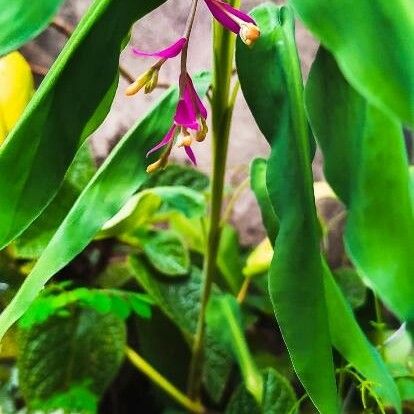
Often called the Dancing Ladies Ginger or Dancing Crane, this Thai native is one of the most elegant members of the ginger family. It earns its name from its delicate, pendulous flowers that dangle from arching stems, swaying gracefully in the slightest breeze like tiny ballerinas in mid-performance. While it looks like a rare orchid, it is actually a hardy tropical perennial that brings a touch of exotic mystery to shaded corners.
🔍 How to Identify
- 💃 The "Dancers": The true flowers are small and yellow, featuring long, curved stamens that resemble the arms of a dancer. These emerge from much larger, heart-shaped purple or white bracts.
- 🍃 Elegant Foliage: The plant produces slender, lance-shaped leaves that grow in a staggered pattern along a central stem, reaching about 1-2 feet in height.
- 🎋 Arching Habit: Unlike many upright gingers, Globba winitii has stems that naturally weep or arch downward, making it a favorite for hanging baskets or the edges of raised beds.
🏡 In Your Garden
- 💤 The Winter Nap: One of the most important things to know is that this plant is deciduous. It will completely disappear underground during the winter months. Do not panic or throw the pot away—it is simply resting and will return when the soil warms up in spring.
- ☁️ Tropical Humidity: Being a forest-floor dweller, it thrives in dappled light and high humidity. If the air is too dry or the sun too direct, the delicate edges of the leaves will crisp and turn brown.
- 💧 Moisture Balance: It prefers consistently moist soil during its growing season but requires very little water while dormant. Too much water during the winter can cause the fleshy rhizomes to rot.
⚠️ Safety & Toxicity
- ✅ Safe for the Family: Globba winitii is generally considered non-toxic to humans, dogs, and cats. It is a "friendly" ginger that poses little risk if accidentally nibbled.
- 🚫 Not for Cooking: While it is a relative of the edible culinary ginger, this species is strictly ornamental. Its rhizomes do not share the same flavor profile and are not used in cooking.
✨ Fun Fact
In its native Thailand, the Dancing Ladies Ginger is traditionally offered to monks during the "Tak Bat Dok Mai" (Flower Offering) festival at the start of the Buddhist Lent, symbolizing grace and devotion.

Detailed Care Instructions
To grow Globba winitii, follow these steps:
- Start by obtaining a healthy rhizome or bulb. You can purchase one from a plant nursery or online.
- Select a suitable planting container. Choose a pot with drainage holes to prevent waterlogging of the plant's roots. The pot should be at least 6-8 inches deep.
- Prepare a well-draining potting mix. Use a combination of peat moss, perlite, and well-composted organic matter, such as compost or leaf mold.
- Plant the rhizome or bulb in the potting mix, making sure the growing tip is facing upwards and is slightly exposed above the soil surface.
- Place the pot in a warm and bright location. Globba winitii prefers temperatures between 60-80°F (15-27°C) and indirect or filtered sunlight. Avoid placing it in direct sunlight, which may scorch the plant.
- Keep the soil consistently moist but not overly saturated. Water the plant regularly, allowing the top inch of the soil to dry out slightly between waterings. Avoid letting the soil completely dry out or become waterlogged.
- Maintain a humid environment around the plant. Mist the leaves with water daily or place a tray filled with water near the plant to increase humidity. You can also use a humidifier if needed.
- Fertilize the plant every 4-6 weeks during the growing season (spring to fall) with a balanced, water-soluble fertilizer diluted to half strength. Follow the instructions on the fertilizer package for dosage instructions.
- Repot the plant every 1-2 years when it outgrows its current pot. Use a slightly larger pot and fresh potting mix.
- Remove any yellowing or withered leaves and spent flowers to maintain the plant's appearance and health.
With proper care and attention, your Globba winitii plant should thrive and produce its unique and beautiful flowers.

Place in a window with dappled sun or a spot in the middle of a room. Or directly in a window facing west or east.

To water the Globba Winitii plant, you should ensure that the soil is consistently moist but not waterlogged. This can be achieved by watering the plant thoroughly when the top inch of soil feels dry to the touch. It is important to water around the base of the plant, avoiding getting water on the leaves to prevent fungal diseases. Additionally, it is recommended to use room temperature water to avoid shocking the plant's roots. During the growing season, which is typically in spring and summer, the plant may require more frequent watering. In contrast, during the dormant period in fall and winter, you should reduce the frequency of watering to prevent root rot. Observing the plant's behavior, such as wilting or yellowing leaves, can also help determine when it needs to be watered.
To fertilize the Globba Winitii plant, use a balanced fertilizer with equal amounts of nitrogen, phosphorus, and potassium. Apply the fertilizer once every two weeks during the plant's active growing period, which is typically from spring to fall. Dilute the fertilizer according to the instructions on the package and apply it directly to the soil around the plant's base. Avoid getting the fertilizer on the plant's leaves or stem, as it can cause damage. Water the plant thoroughly after fertilizing to help the nutrients reach the roots.
The ideal soil for the plant in question would be well-draining and loose, with a pH level of around 6.0 to 7.0. It should also be rich in organic matter and have good water retention capabilities. Adding humus, compost or leaf mold to the soil can improve the quality of the soil.
It is important not to use heavy clay-based soils, as these can impede drainage and cause waterlogging, which can cause root rot. A light soil that is a bit sandy or loamy would be ideal.
The plant also prefers well-aerated soil, which can be achieved by adding perlite or vermiculite to the potting mixture. Additionally, the plant should be potted in a pot that is neither too small nor too large in relation to the size of the plant.
To propagate this plant, select a healthy mature plant with several stems. Using a clean and sharp knife, cut the stems into pieces, making sure each piece has at least one node. Place the stem cuttings into a well-draining potting mix and keep them moist.
Choose a location with indirect sunlight and a temperature between 20-30°C. Mist the plants regularly to keep them humid and cover the pot with a plastic bag or clear plastic wrap to create a mini greenhouse environment and promote rooting.
Once the stem cuttings have rooted, you can transplant them into their own pots and continue caring for them as mature plants. Be patient, as it may take several weeks for the cuttings to root and begin to grow. With the proper care, you can successfully propagate your plant and enjoy it for years to come.








