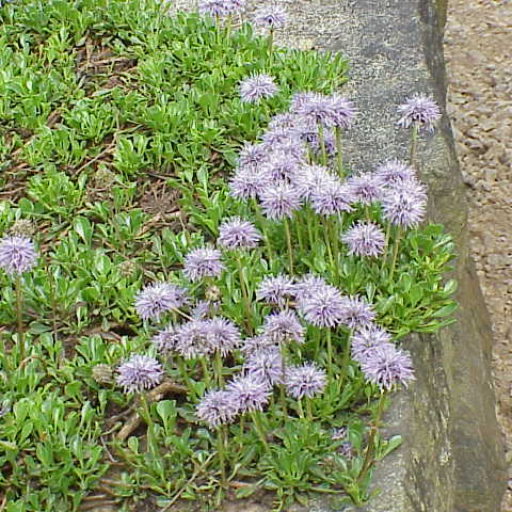
Plant Overview
Often called the Heart-leaved Globe Daisy, this alpine treasure looks like something straight out of a miniature fairytale. It forms dense, evergreen carpets that hug the ground, making it a darling of rock gardeners who wish to recreate high-altitude mountain vistas. Its name is a romantic nod to the tiny notch at the tip of its leaves, which gives them a distinct heart-like silhouette.
🔍 How to Identify
- 🌸 The "Globe" Flowers: These are fluffy, powder-blue spheres that sit atop short stalks, appearing like tiny, mystical pompoms scattered across the foliage in late spring.
- 💚 Heart-Shaped Foliage: The small, leathery leaves are dark green and glossy, measuring only about an inch long with a notched tip that mimics a heart.
- 🌿 Mat-Forming Habit: It grows as a low, creeping woody subshrub that slowly spreads to cover rocky crevices, creating a "living rug" over the soil.
🏡 In Your Garden
- 🪨 The Rock Garden Specialist: Originating from limestone cliffs in the Alps, this plant thrives in gravelly, alkaline soils. It is the perfect candidate for "crevice gardening" where other plants might struggle to find a foothold.
- ☀️ Sun and Drainage: While it loves basking in the sun, its biggest enemy is stagnant water. It requires sharp drainage to survive the winter; otherwise, its roots may rot in soggy soil.
⚠️ Safety & Toxicity
- 🛡️ General Safety: Globularia cordifolia is widely considered non-toxic and is not known to pose a threat to humans, cats, or dogs.
- 🚫 Ornamental Only: Although it is safe to touch and grow, it is not an edible plant. It should be kept as a visual delight rather than a culinary addition to prevent minor stomach upset if leaves are ingested.
✨ Fun Fact
✨ Even though it looks like one single round flower, each "globe" is actually a dense colony of hundreds of individual tiny tubular blossoms, all grouped together to make a bigger target for mountain-dwelling pollinators!

Detailed Care Instructions
| Humidity | Normal |
| Lighting | Full Sun |
| Difficulty | Medium |
| Temperature | 13°C - 21°C |
| Hardiness Zones | 6 - 8 |

Place in a bright room that is sun drenched almost all day. Or directly in a south-facing window.

Some plants require more regular watering than others, which should be done every few days. It's critical to maintain the soil moist all of the time. The water requirements of the same plant placed in pots with varying sizes will differ. Because the water in the smaller pot evaporates faster than the water in the larger pot, it will require more watering. Regardless of pot size, the surface should constantly be maintained moist.
The relative humidity levels between 30 and 50 percent are ideal for these plants. They exhibit unpleasant symptoms when the moisture content in the environment is unfavorable. Avoid letting the air temperature rise too high or low and use a humidifier, whenever possible. Misting is also beneficial, although frequent watering is also necessary. The optimal relative humidity will promote plant growth.








