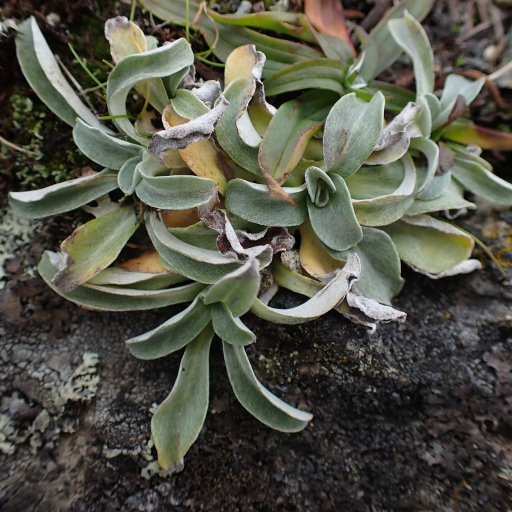
Plant Overview
Often called "Spoonleaf Purple Everlasting," this humble plant looks as though it has been dusted with moonlight due to its soft, silvery hairs. While many modern gardeners encounter it as a common lawn "weed," it belongs to the sunflower family and possesses a quiet, felt-like charm that has historically earned it a place in traditional folk medicine.
🔍 How to Identify
- 🍃 Foliage: The leaves are distinctly spoon-shaped (spatulate). While the tops may be a dull green, the undersides are coated in a dense, white, woolly felt.
- ☁️ Texture: The entire plant has a "cobwebby" or felted appearance. These hairs are a clever evolutionary trick to trap moisture and reflect harsh sunlight.
- 🌸 Flower Clusters: Unlike showy daisies, its flowers are tiny, brownish-purple heads tucked into the leaf axils along the upper stem, giving the plant a vertical, spike-like silhouette.
🏡 In Your Garden
- 🌱 Soil Strategy: You’ll most often find it in "disturbed" areas—think thinning lawns, sandy coastal spots, or the edges of garden beds. It prefers sandy, well-draining soil and struggles in heavy, waterlogged clay.
- 🛡️ Resilience: It is incredibly drought-tolerant. Because of its taproot and fuzzy coating, it can stay upright and green in mid-summer heat while surrounding grass turns brown. If you find it in your lawn, it usually indicates that the soil is somewhat acidic or compacted.
⚠️ Safety & Toxicity
- ✅ Status: Generally considered non-toxic to humans, cats, and dogs.
- 🐾 Details: While it is not known to contain dangerous toxins, the "woolly" texture can be mildly irritating if a pet decides to chew on a large amount. It is always best to discourage pets from grazing on wild garden plants to avoid digestive upset.
✨ Fun Fact
The name "Cudweed" stems from an ancient folk belief that these plants could help cattle recover their "cud" (the ability to chew and digest) if they had lost it due to illness! While the cows might disagree, the name has stuck for centuries.

Detailed Care Instructions

Place in a bright room that is sun drenched almost all day. Or directly in a south-facing window.

Some plants require more regular watering than others, which should be done every few days. It's critical to maintain the soil moist all of the time. The water requirements of the same plant placed in pots with varying sizes will differ. Because the water in the smaller pot evaporates faster than the water in the larger pot, it will require more watering. Regardless of pot size, the surface should constantly be maintained moist.
To maintain their leaves healthy and green, these plants need a lot of nitrogen. Because they rely on fertilizers to grow, fertilize them once a week with diluted fertilizers. The plants housed in containers need fertilizers more frequently. However, adding excessive fertilizers makes it hard for the roots to take up water that causes their leaves to turn yellow or brown.








