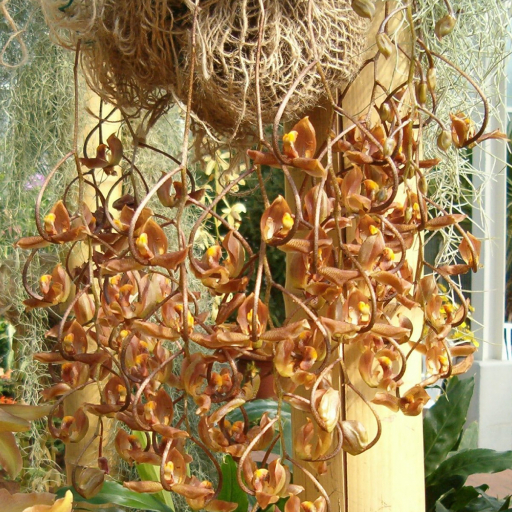
Plant Overview
Known as the "Helmeted Gongora," this fascinating orchid hails from the humid mountain forests of Mexico. It is a favorite among collectors not just for its alien-looking blooms, but for its intoxicating fragrance that can fill an entire room with the scent of warm cinnamon and orange. Unlike traditional upright orchids, this species is a "pendulous" grower, sending its flower spikes downward in a dramatic floral cascade.
🔍 How to Identify
- 🌸 The "Helmet" Bloom: The flowers are brownish-yellow or orange and uniquely shaped like a miniature helmet or a bird in flight, hanging upside down on long, dangling stems.
- 🍃 Pleated Leaves: Its foliage is distinctively "plicate," meaning the leaves have deep, longitudinal ridges that look like a folded paper fan.
- 🍐 Ribbed Pseudobulbs: At the base, you will find sturdy, egg-shaped green bulbs with vertical ribs that act as the plant's water reservoir.
🏡 In Your Garden
- 🧺 The Hanging Requirement: Because the flower spikes grow straight down from the base, this plant should never be kept in a solid pot. It thrives best in a slatted wooden basket or mounted on a piece of cork bark so the blooms can "fall" freely.
- 🌬️ Air & Moisture Balance: It is an epiphyte that hates "wet feet" but loves high humidity. If you see the new leaves growing in a "zig-zag" or accordion shape, it’s a cry for more moisture in the air.
- 💧 Water Quality: This orchid is a bit of a connoisseur; it is sensitive to the minerals in hard tap water. Using rainwater or distilled water will prevent the tips of those beautiful pleated leaves from turning brown.
⚠️ Safety & Toxicity
- 🐾 Non-Toxic: Good news for pet owners—the Gongora galeata is generally considered non-toxic to cats, dogs, and horses.
- 🛡️ Gentle Handling: While safe, the leaves are quite thin compared to a Phalaenopsis and can tear easily. Position it away from high-traffic areas where it might be bumped.
✨ Fun Fact
In the wild, this orchid doesn't produce nectar to reward its pollinators. Instead, it produces a complex perfume that male Euglossine bees "harvest" and store in special pockets on their hind legs to use as a pheromone to attract female bees!

Detailed Care Instructions

Some plants require more regular watering than others, which should be done every few days. It's critical to maintain the soil moist all of the time. The water requirements of the same plant placed in pots with varying sizes will differ. Because the water in the smaller pot evaporates faster than the water in the larger pot, it will require more watering. Regardless of pot size, the surface should constantly be maintained moist.








