Plant Overview
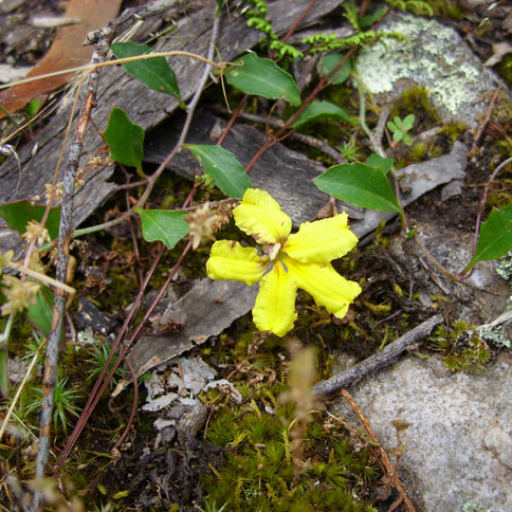
Meet the Ivy Goodenia, a resilient little Aussie gem that hugs the earth with a carpet of scalloped green leaves. Often found trailing over rocky ledges or brightening up woodland floors, this plant is a favorite for those who love "wild" aesthetics. It is best known for its bright yellow flowers that look like tiny, hand-held fans dropped by forest sprites.
🔍 How to Identify
- 🌿 The Foliage: Look for heart-shaped or "ivy-like" leaves (hence the name hederacea) with slightly lobed or toothed edges. The undersides are often a paler, silvery-green.
- 🌼 The Blooms: It features distinctively asymmetrical yellow flowers. The petals are arranged on one side, creating a "fan" shape that is a signature of the Goodenia family.
- 🌱 The Habit: This is a prostrate or scrambling herb. It doesn't climb high; instead, it spreads outward, creating a lush, low-profile mat that suppresses weeds.
🏡 In Your Garden
- 🪨 The Rockery Expert: Because it naturally grows in stony or sandy soils, it is the perfect candidate for rock gardens or "spilling" over the edges of terracotta pots.
- 💧 Drought Tolerance: Once established, the Ivy Goodenia is incredibly tough. It has adapted to survive dry spells, making it a "set and forget" choice for low-maintenance native gardens. It prefers well-drained soil and will rot if its "feet" stay too wet.
⚠️ Safety & Toxicity
- ✅ Generally Safe: The Ivy Goodenia is not known to be toxic to humans or common household pets like dogs and cats.
- 🧤 Garden Hygiene: While safe, it is always a good practice to wash your hands after gardening, as wild-type plants can sometimes harbor soil bacteria or cause mild mechanical irritation to very sensitive skin.
✨ Fun Fact
The genus name Goodenia honors the 18th-century Bishop of Carlisle, Samuel Goodenough. Despite his botanical contributions, the Bishop famously once stated he was "unworthy" of having such a beautiful genus named after him—though the Ivy Goodenia's cheerful yellow face suggests otherwise!

Detailed Care Instructions
To grow Goodenia Hederacea, also known as Ivy-leaf Goodenia or Scurvy Weed, follow these steps:
- Climate and Location:
- Choose a location that receives full sun to partial shade.
- Goodenia Hederacea prefers a mild climate, but it can tolerate both cool and warm temperatures.
- Choose a location that receives full sun to partial shade.
- Soil Preparation:
- The plant grows well in a range of soil conditions.
- Ensure the soil is well-draining, fertile, and enriched with organic matter.
- Amend the soil with compost or well-rotted manure before planting to provide nutrients.
- The plant grows well in a range of soil conditions.
- Planting:
- Goodenia Hederacea can be propagated from seeds or cuttings.
- If using seeds, sow them directly in the prepared soil in early spring after the last frost date.
- Plant the seeds at a depth of 1/8 to 1/4 inches and space them about 12 inches apart.
- If using cuttings, collect them from healthy plants and plant them in well-moistened soil.
- Goodenia Hederacea can be propagated from seeds or cuttings.
- Watering:
- Keep the soil consistently moist, especially during the plant's establishment phase.
- Once the plant has established, it can tolerate short periods of drought.
- Water deeply and infrequently, allowing the top inch of soil to dry out before watering again.
- Keep the soil consistently moist, especially during the plant's establishment phase.
- Fertilizer:
- Goodenia Hederacea is not a heavy feeder but can benefit from a balanced, slow-release fertilizer.
- Apply a general-purpose fertilizer in spring or early summer, following the package instructions.
- Goodenia Hederacea is not a heavy feeder but can benefit from a balanced, slow-release fertilizer.
- Pruning:
- To encourage bushier growth, pinch back the tips of the plant when it reaches around 6 inches in height.
- Regular pruning can help maintain a compact and tidy appearance.
- Remove any dead or damaged leaves or branches as needed.
- To encourage bushier growth, pinch back the tips of the plant when it reaches around 6 inches in height.
- Pest and Disease Control:
- Goodenia Hederacea is relatively resistant to pests and diseases.
- However, keep an eye out for slugs, snails, and aphids. Treat any infestations promptly.
- Goodenia Hederacea is relatively resistant to pests and diseases.
- Propagation:
- If you wish to propagate the plant, you can divide it during the spring season or take stem cuttings in early summer.
- Plant the divisions or cuttings in well-draining soil and keep them moist until they establish roots.
Remember to check the specific information for the variety of Goodenia Hederacea you have, as some requirements might vary slightly.
- If you wish to propagate the plant, you can divide it during the spring season or take stem cuttings in early summer.

Place in a bright room that is sun drenched almost all day. Or directly in a south-facing window.

To properly water this species of plant, it is important to take several factors into consideration. Firstly, it is important to ensure that the soil in which the plant is growing is well-draining, as this will prevent the roots from becoming waterlogged and potentially developing root rot. Secondly, it is important to water the plant regularly but not excessively, as too much water can also cause issues with root rot and other fungal diseases. Generally, watering once or twice a week during the growing season, and less frequently during the dormant period, is sufficient. It is also important to avoid getting water on the foliage of the plant, as this can increase the risk of fungal diseases. When watering, it is best to apply the water slowly and evenly around the base of the plant to ensure that the roots receive moisture evenly. Finally, it is important to monitor the plant regularly for signs of over or under-watering, such as wilting or yellowing leaves, and adjust watering as needed.
To fertilize this plant, you should use a balanced fertilizer with equal parts nitrogen, phosphorus, and potassium. Apply the fertilizer once every two weeks during the active growing season. Be sure to dilute the fertilizer to half-strength first, and then apply it directly to the soil around the base of the plant. Avoid getting any fertilizer on the leaves or stem, as it can cause damage. Water the plant thoroughly after fertilizing to help distribute the nutrients throughout the soil.
Goodenia Hederacea plant prefers well-draining soil that is rich in nutrients. The soil should have a pH level between 6.0 and 7.0. It is recommended to use a mix of organic matter and coarse sand or gravel to ensure proper drainage. The plant also benefits from occasional fertilization with a balanced fertilizer. It is important to avoid overwatering and to allow the soil to dry out slightly between waterings.
There are a few ways to propagate this plant, including by division or by taking stem cuttings.
To propagate by division, carefully dig up the plant and gently separate the roots into smaller sections. Replant the new sections in soil that has been amended with compost or other organic matter. Water the newly divided plants well and keep the soil consistently moist until new growth appears.
To propagate by stem cuttings, select a healthy stem that is at least a few inches long and cut it just below a leaf node. Remove any leaves from the lower portion of the stem. Dip the cut end in rooting hormone powder and plant it in a pot filled with well-draining soil. Keep the pot in a bright, humid spot and mist the cutting regularly. Roots should form in a few weeks, after which the new plant can be potted up or planted in the ground.








