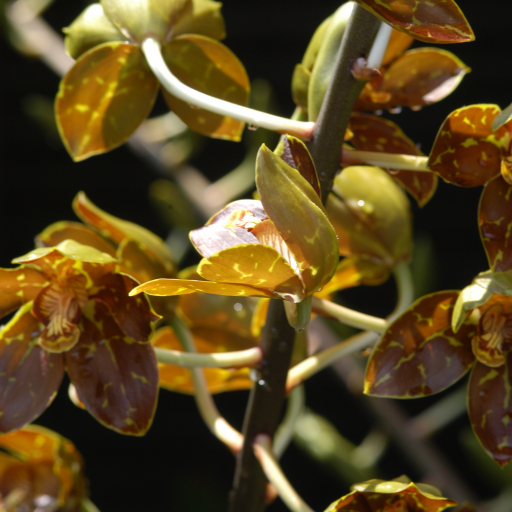
Plant Overview
Known as the "Tiger Orchid" for its striking spotted patterns, Grammatophyllum speciosum is the undisputed heavyweight champion of the botanical world. It holds the Guinness World Record for the largest orchid species on Earth, capable of growing into massive clusters that can weigh as much as a small car. In its native Southeast Asian rainforests, this giant perches high in the canopy or on rocky outcrops, commanding attention with its majestic presence and long-lasting floral displays.
🔍 How to Identify
- 🐯 The "Tiger" Blooms: It produces hundreds of large yellow or olive-green flowers (up to 4 inches wide) covered in bold maroon or dark brown spots, mimicking a tiger’s coat.
- 🦒 Staggering Scale: These aren't your average windowsill plants; their pseudobulbs can reach lengths of nearly 10 feet, resembling thick stalks of sugar cane.
- 🌿 Basket Roots: It develops specialized, upward-pointing "trash basket" roots that catch falling leaves and forest debris to create its own compost pile for nutrients.
🏡 In Your Garden
- 🏰 Space Requirements: Because of its potential for massive size, this orchid is rarely a standard houseplant. It thrives best in large tropical gardens or high-ceilinged conservatories where it has room to expand into a multi-hundred-pound specimen.
- ☀️ Light & Patience: This species demands intense, bright light to trigger blooming. Be prepared for a long-term commitment, as young plants often take several years—sometimes over a decade—to reach the maturity required for their first spectacular flowering.
- 🌬️ Air and Humidity: Native to the tropics, it craves high humidity but must have excellent air circulation to prevent rot within its dense center.
⚠️ Safety & Toxicity
- ✅ Non-Toxic: The Tiger Orchid is generally considered non-toxic to humans and common household pets like cats and dogs.
- 🧤 Physical Handling: While not chemically dangerous, the sheer weight of a mature specimen can be a physical hazard if not securely anchored. The stiff, pointed roots and large canes can also be quite scratchy during maintenance.
✨ Fun Fact
In 1851, a specimen of the Tiger Orchid was transported from Southeast Asia to the Great Exhibition in London. It was so enormous that it required its own specially built crate and weighed nearly two tons, earning it the permanent nickname "The Queen of the Orchids."

Detailed Care Instructions
| Lighting | Full Sun |
To grow Grammatophyllum Speciosum, also known as the Tiger Orchid, follow these steps:
- Choose a warm and humid environment: This orchid species thrives in tropical and subtropical climates. If you live in a region with colder or drier conditions, consider growing it indoors in a greenhouse or terrarium.
- Provide ample light: Grammatophyllum Speciosum prefers bright, indirect light. Place it in a location where it receives filtered sunlight or use artificial grow lights if growing indoors.
- Use a well-draining potting medium: Tiger Orchids require good drainage to prevent over-watering and root rot. A mix of bark chips, sphagnum moss, and perlite or charcoal can be used as a suitable potting medium.
- Water properly: Water the orchid regularly, keeping the potting medium slightly moist but not soaking wet. During the growing season (spring and summer), water more frequently, allowing the top inch of the potting medium to dry out before the next watering. Reduce watering during the dormant season (fall and winter).
- Maintain high humidity: Tiger Orchids enjoy high humidity levels. You can increase humidity by misting the leaves daily or placing the orchid on a tray filled with water and pebbles, making sure the water does not touch the bottom of the pot.
- Fertilize regularly: Apply a balanced orchid fertilizer at half the recommended strength every two weeks during the active growing season. Reduce or cease fertilization during dormancy.
- Repotting: Repot the orchid every 2-3 years, or when the potting medium breaks down and becomes too compact. Choose a pot that allows room for the orchid to grow and use fresh potting medium.
- Provide adequate airflow: Good ventilation helps prevent the onset of fungal or bacterial diseases. Avoid crowding orchids together and ensure the growing area has adequate airflow.
- Pruning and maintenance: Trim dead or damaged roots, old pseudobulbs, or discolored foliage. This helps to maintain the health and appearance of the plant.
- Patience: Growing a Grammatophyllum Speciosum plant can take time, as these orchids may take several years to mature and produce flowers.
Remember, caring for orchids requires attention to detail and regular monitoring. Be patient and adjust your care routine based on the specific needs of your orchid as it grows.

Place in a bright room that is sun drenched almost all day. Or directly in a south-facing window.

The plant should be watered regularly, ensuring that the soil is moist but not waterlogged. It is important to allow the soil to dry slightly between waterings to avoid overwatering. A good way to check if the soil is dry is to stick your finger into the soil and feel the moisture level. If it is dry about an inch below the surface, it is time to water. When watering, try to avoid getting water on the leaves and flowers as this can cause damage and encourage fungal growth. It is also recommended to use room temperature water to avoid shocking the roots with too cold or too warm water. During the winter months, the plant may require less watering as it enters a period of dormancy.
To fertilize this orchid species, use a balanced fertilizer with a ratio of 20-20-20 or 20-10-20, diluted to half strength. Apply every two weeks during active growth and reduce to once a month during the dormant period. Avoid fertilizing during periods of extreme heat or drought. Also, make sure that the roots are well-hydrated before applying the fertilizer solution.
For the Grammatophyllum Speciosum plant, it is recommended to use a well-draining soil that is rich in organic matter. The soil should be able to hold adequate moisture but should also allow excess water to drain out easily to avoid waterlogging. The plant prefers slightly acidic to neutral soil pH levels between 6.0 to 7.0. The soil mix can include ingredients such as sphagnum moss, coconut coir, fir bark, perlite, and charcoal. It is important to ensure that the soil is free from any contaminants, pests, and diseases that may harm the plant. Additionally, providing regular fertilization, adequate light, and appropriate temperatures will help the plant thrive.
Grammatophyllum Speciosum plant can be propagated through division of their pseudobulbs. First, choose a healthy and mature plant with a pseudobulb that has produced new growth. Using a sharp and sterile tool, carefully separate the pseudobulb from the main plant, making sure to leave roots attached.
Trim the roots to remove any damaged or dead parts. Prepare a pot with a well-draining soil mix, and plant the pseudobulb with its roots buried in the soil. Water it thoroughly and place it in a location with bright indirect light.
Keep the soil moist but not soggy, and avoid direct sunlight and extreme temperatures. New growth should appear within a few weeks, and the new plant can be treated as a mature plant after about a year of growth.








