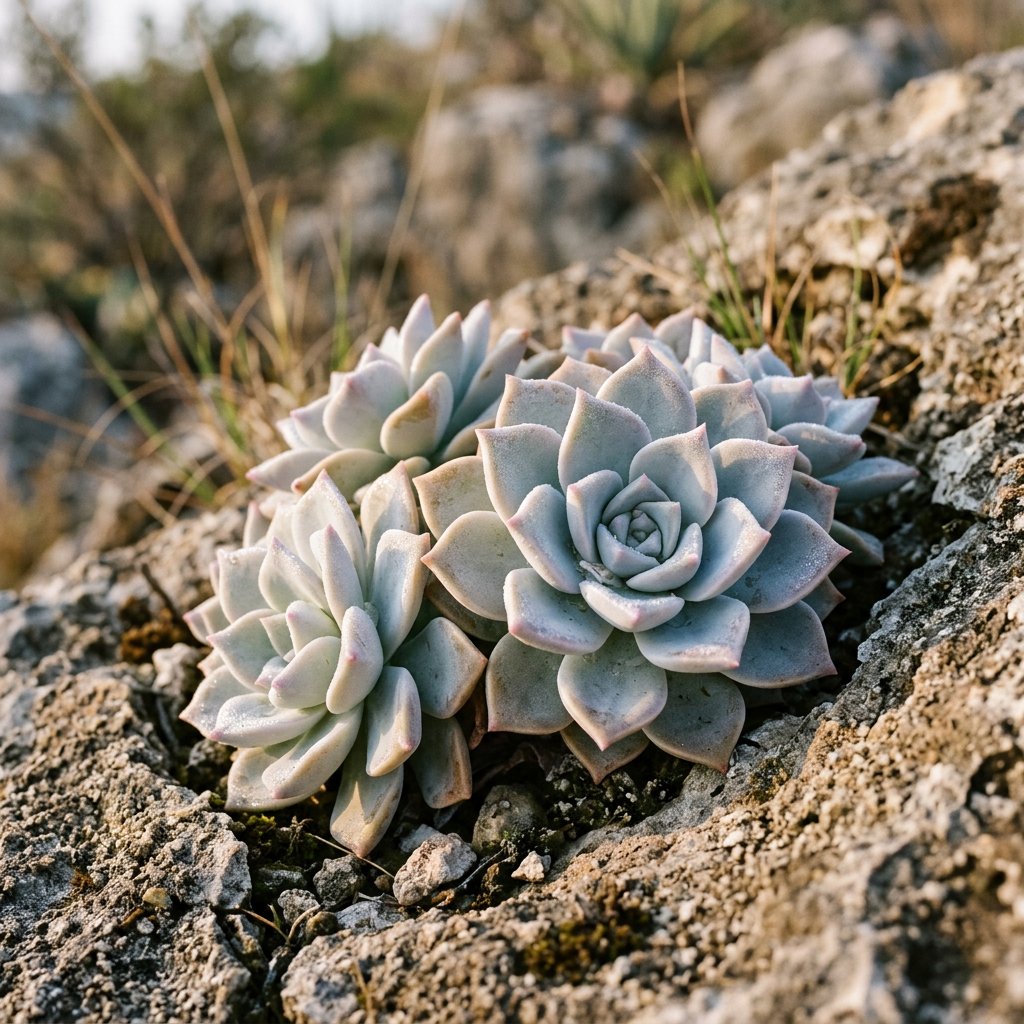
Plant Overview
Often called the Ghost Plant or Mother of Pearl Plant, this Mexican native is a masterpiece of succulent evolution. It earns its spectral nickname from the pale, opalescent coating on its leaves that gives the plant an ethereal, moonlight glow. Though it looks delicate and crystalline, it is surprisingly rugged, often seen "haunting" garden walls and rock crevices with its cascading, rosettes.
🔍 How to Identify
- 🌸 Geometric Rosettes: The leaves grow in a tight, star-like spiral pattern. As the plant ages, the stems become long and woody, allowing the rosettes to trail downward.
- 🎨 Chameleon Colors: Depending on the light, the foliage shifts between ghostly silver-grey, soft lavender, and even pale pink or yellow when "stressed" by sun or cold.
- ❄️ Powdery Coating: Each leaf is dusted with "farina," a thick layer of natural wax that gives it a matte finish. This powder acts as a built-in sunscreen and water repellent.
🏡 In Your Garden
- 💨 The "Drop and Grow" Method: This plant is famous for its brittle leaves that pop off at the slightest touch. While frustrating to some, this is a survival strategy; nearly every fallen leaf will spontaneously sprout roots and grow a new "baby" plant right where it landed.
- 🧗 Gravity-Defying Growth: Because it naturally grows on cliffsides, it hates sitting in flat, soggy soil. It thrives in hanging pots or vertical wall gardens where its stems can spill over the edges like a slow-moving waterfall.
- ☀️ Sun Exposure: To keep the rosettes tight and colorful, it needs bright light. In too much shade, the plant will "stretch," losing its compact shape as it hunts for the sun.
⚠️ Safety & Toxicity
- 🐾 Non-Toxic Status: Great news for pet owners—the Ghost Plant is generally considered non-toxic to cats, dogs, and horses.
- 🧤 Skin Protection: While not poisonous, the main "danger" is to the plant itself. Touching the leaves will rub off the powdery farina coating, leaving permanent fingerprints and making the plant more vulnerable to sunburn.
✨ Fun Fact
Despite its scientific name paraguayense, this plant has never been found growing wild in Paraguay! The botanist who first described it was mistakenly told the specimen came from South America, but its true ancestral home is actually on the rocky peaks of Tamaulipas, Mexico.

Detailed Care Instructions
| Color | Yellow |
| Soil Ph | 6.1-7.8 |
| Humidity | Dry |
| Lighting | Part Sun |
| Soil Type | Sandy Or A Light Potting Mix |
| Bloom Time | Spring |
| Difficulty | Easy |
| Plant Type | Perennial Succulent |
| Hibernation | Cold Period |
| Mature Size | Six To 12 Inches Tall; 20 Inches Wide |
| Native Area | Mexico |
| Temperature | 15°C - 30°C |
| Sun Exposure | Full To Partial Sun |
| Hardiness Zones | Usda Zones 7-11 |
To grow Graptopetalum paraguayense (also known as Ghost Plant or Mother of Pearl plant), follow these steps:
- Choose a suitable planting location: Graptopetalum paraguayense prefers bright, indirect sunlight. It can tolerate some sunlight in the morning or late afternoon, but intense, direct sunlight can scorch the leaves. If planting indoors, place the plant near a south or west-facing window.
- Use well-draining soil: Make sure the soil you use is well-draining to prevent root rot. A mix of regular potting soil, perlite, and coarse sand or pumice can work well.
- Provide adequate drainage: Use a pot with drainage holes to allow excess water to escape. If planting in the ground, make sure the soil is not heavy and retains too much water.
- Watering: Graptopetalum paraguayense is a succulent, so it stores water in its leaves. Water thoroughly but infrequently, allowing the soil to dry out completely between waterings. Overwatering can cause root rot and kill the plant. During winter or dormant periods, reduce watering frequency further.
- Temperature: Graptopetalum paraguayense prefers temperatures between 60-75°F (15-24°C). It can tolerate higher or lower temperatures for short periods, but prolonged exposure to extreme temperatures can damage the plant.
- Propagation: Graptopetalum paraguayense is relatively easy to propagate. You can propagate it from leaf cuttings or division. To propagate from leaf cuttings, gently twist off individual leaves and allow them to dry for a day or two. Then, place the leaf on top of moist well-draining soil, mist occasionally, and wait for roots and new growth to appear.
- Fertilizer: Graptopetalum paraguayense is not a heavy feeder. Fertilize sparingly with a diluted succulent or cactus fertilizer during the growing season, typically in spring and summer.
- Pruning and maintenance: Prune back leggy or overgrown stems to encourage bushier growth. Remove any dead or damaged leaves as necessary.
Remember that each plant has unique requirements, so it's essential to monitor its condition and adjust care accordingly.

Place in a window with dappled sun or a spot in the middle of a room. Or directly in a window facing west or east.

To properly water this type of plant, it is important to use a well-draining soil mix and a pot with drainage holes to prevent water from pooling in the soil. When watering, aim to saturate the soil evenly and allow excess water to drain out of the bottom of the pot. It is important to allow the top inch of soil to dry out between waterings to avoid overwatering and potentially causing root rot. As with most plants, it is best to water in the morning to avoid excess moisture sitting overnight and potentially causing fungal growth.
To fertilize your plant, start by selecting a well-balanced fertilizer with equal parts nitrogen, phosphorous, and potassium. Dilute the fertilizer according to the instructions on the package. Water your plant thoroughly before applying the fertilizer to prevent burn and run-off.
During the growing season, fertilize your plant once every four to six weeks. For best results, apply the fertilizer in the morning when temperatures are cooler, and the plant is less stressed. During the dormant season, reduce the frequency of fertilizing to every two to three months.
When applying the fertilizer, avoid getting it on the leaves or stem to prevent burning. Instead, apply the fertilizer to the soil around the base of the plant. After applying the fertilizer, water the plant thoroughly to help it absorb the nutrients.
Regularly fertilizing your plant will help it grow strong, healthy, and vibrant, with beautiful blooms and foliage.
Graptopetalum Paraguayense plant prefers a well-draining soil mix that is slightly acidic to neutral in pH. It is recommended to use a combination of coarse sand, perlite or pumice, and organic matter like peat moss or coconut coir, in equal parts to create the soil mix. The sand or pumice allows for proper drainage and aeration, while the organic matter provides nutrients and holds moisture for the plant roots. This type of soil also prevents the roots from sitting in water for too long, which can lead to root rot. It is important to avoid using heavy garden soil or soil mixes that contain a lot of clay, as they can become waterlogged and suffocate the roots.
To propagate this plant, you will need to take cuttings from a mature plant. First, identify a healthy stem that is at least 3 inches long and has several leaves attached. Using a clean, sharp blade, make a careful cut just below a node (the area where a leaf attaches to the stem).
Next, remove the lower leaves from the stem, leaving only a few at the top. This will help the cutting focus its energy on growing new roots instead of supporting a large number of leaves.
Once you have prepared your cutting, you can allow it to callus over for a few days by placing it in a dry location out of direct sunlight. After this period, you can plant the cutting in well-draining soil and water it lightly. Over the next few weeks, the cutting should begin to grow new roots and eventually establish itself as a separate plant.
Common pests of the ghostplant include Scale insect, mealybugs, thrips. Make a habit of checking your ghostplant frequently for pests so that any infestations can be caught and managed early.








