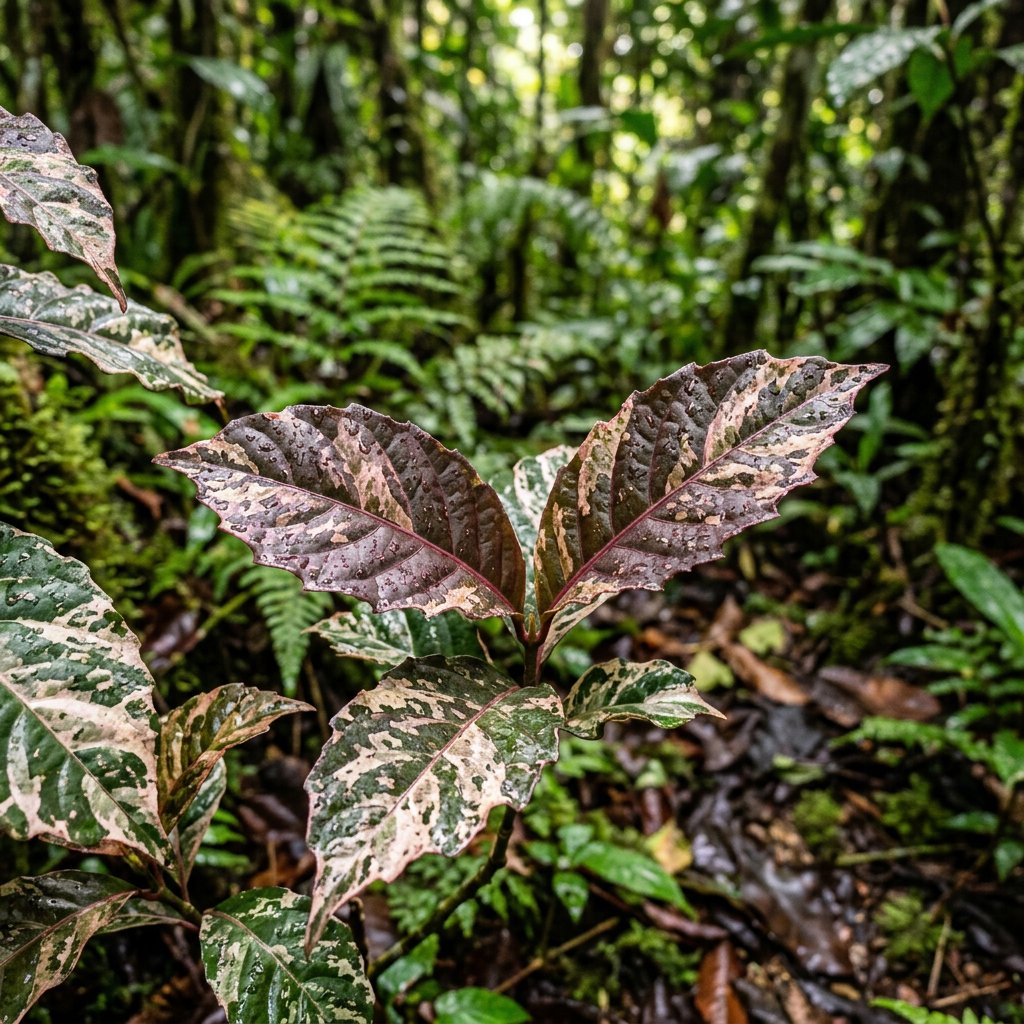
Plant Overview
Known as the Caricature Plant, this tropical evergreen is a living art piece for your home or garden. Its name comes from the peculiar, irregular variegation on its leaves, which often resembles the profile of a human face. Native to New Guinea, it has traveled the world as a prized ornamental shrub, loved for its ability to provide vibrant color even when it isn't in bloom.
🔍 How to Identify
- 🍃 Artistic Foliage: The leaves are the main attraction—broad, glossy, and oval-shaped. They feature a distinct creamy-white or pinkish center that contrasts sharply against a background of deep green or chocolate-purple.
- 📏 Growth Habit: It grows as an upright, woody shrub. In its native habitat, it can reach several feet tall, but as a houseplant, it remains a manageable, bushy companion.
- 🌸 Tubular Flowers: When it blooms, it produces small, funnel-shaped flowers, usually in shades of reddish-purple or crimson, which emerge in clusters at the tips of the branches.
🏡 In Your Garden
- ☁️ Humidity is Key: Because of its New Guinea roots, this plant craves moisture in the air. If you notice the leaf edges turning brown and crispy, it’s likely a plea for more humidity or a gentle misting.
- 🎨 Light for Color: To keep the "caricatures" on the leaves bright and distinct, the plant needs plenty of bright, indirect light. In too much shade, the vivid patterns may fade, and the plant can become leggy as it reaches for the sun.
- ✂️ Pruning for Shape: It handles pruning exceptionally well. Regular pinching of the stems encourages a fuller, bushier shape rather than a single tall stalk.
⚠️ Safety & Toxicity
- 🟢 Safe for Most: Graptophyllum pictum is generally considered non-toxic to humans and common household pets like cats and dogs.
- 🧤 Sap Caution: While not poisonous, the milky sap can occasionally cause mild skin irritation for those with very sensitive skin. It is always a good practice to wash your hands after pruning or taking cuttings.
✨ Fun Fact
The "Caricature" name isn't just a coincidence! In the 19th century, Victorian gardeners would hold competitions to see who could find the leaf with the most realistic "human profile" hidden in the variegation. Or check the leaves yourself—you might find a silhouette of a friend!

Detailed Care Instructions
| Humidity | Normal |
| Lighting | Full Sun |
| Difficulty | Medium |
| Hibernation | Cold Period |
| Temperature | 18°C - 25°C |
| Hardiness Zones | 9B - 11 |
To grow a Graptophyllum Pictum plant, follow these steps:
- Choose a suitable location: Graptophyllum Pictum plants prefer bright, indirect sunlight. Find a spot in your home or garden that receives filtered sunlight or partial shade.
- Prepare the soil: Graptophyllum Pictum plants prefer well-draining soil. Mix equal parts of potting soil, perlite, and sand to create a loose and well-aerated soil mixture. If planting directly in the ground, make sure the soil is well-drained and rich in organic matter.
- Planting in a pot: Select a pot with drainage holes that is slightly larger than the current root ball of the plant. Fill it with the prepared soil mixture and place the plant in the center. Gently firm the soil around the roots to secure it in the pot.
- Planting in the ground: Dig a hole slightly larger and deeper than the root ball of the plant. Place the plant in the hole, ensuring that the top of the root ball is level with or slightly above the ground. Backfill the hole with the prepared soil mixture and pat it down gently.
- Watering: Graptophyllum Pictum plants prefer consistently moist but not waterlogged soil. Water the plant thoroughly after planting to settle the soil. Keep the soil evenly moist, but avoid overwatering.
- Fertilizing: Feed your Graptophyllum Pictum plant with a balanced liquid fertilizer every 4-6 weeks during the growing season (spring and summer). Follow the recommended dosage on the fertilizer packaging.
- Pruning: Prune your Graptophyllum Pictum plant to maintain its shape and size and to encourage bushier growth. Remove any dead, damaged, or overgrown branches using clean and sharp pruning shears.
- Propagation: Graptophyllum Pictum plants can be propagated through stem cuttings. Take 4-6 inch cuttings from healthy stems and remove the lower leaves. Dip the cut end in a rooting hormone powder and plant it in a small pot filled with damp soil mix. Keep the cutting in a warm and humid environment until it develops roots.
- Provide humidity: Graptophyllum Pictum plants appreciate higher humidity levels. You can increase humidity by misting the leaves regularly or placing a tray filled with water near the plant.
- Protect from cold temperatures: Graptophyllum Pictum plants are not frost-tolerant. If you live in a cold climate, bring your plant indoors during winter or provide protection with frost cloth or a greenhouse.
By following these steps, you can successfully grow and care for your Graptophyllum Pictum plant.

Place in a bright room that is sun drenched almost all day. Or directly in a south-facing window.

To properly water this plant, be sure to check the top inch of soil and only water when it feels dry to the touch. Water thoroughly, allowing excess water to drain out of the bottom of the pot. Avoid letting the plant sit in standing water as it can lead to root rot. In addition, this plant prefers slightly acidic soil, so it is recommended to use rainwater or distilled water to avoid buildup of minerals from tap water. Lastly, be sure to observe the plant and adjust watering as needed based on its individual needs and environment.
To fertilize this plant, you should first select a balanced fertilizer with equal amounts of nitrogen, phosphorus, and potassium. Then, dilute the fertilizer to half strength and apply it once a month during the growing season, which is typically spring and summer. Be sure to apply the fertilizer evenly across the soil surface and avoid getting it on the leaves or stem of the plant. Additionally, it's important to water the plant regularly and maintain consistent soil moisture levels to ensure optimal growth and health.
The ideal soil for this particular plant should have a pH level between 6.0 to 7.5. It should be rich in nutrients and well-draining to prevent waterlogging. The recommended soil mixture should consist of equal parts of peat moss, perlite, and compost. The peat moss provides the necessary acidity to the soil, while perlite helps with drainage. Compost adds organic matter to the soil, which supports the growth of beneficial microorganisms. Additionally, the soil needs to be regularly fertilized during the growing season to supply essential nutrients to the plant. Overall, the soil needs to have good structure, porosity, and drainage capacity to support proper root development and overall plant health.
To propagate this plant, you first need to take stem cuttings that are about 4-6 inches long and have several sets of leaves. Remove the lower leaves on the stem and dip the cut end in rooting hormone powder. Plant the cutting in a small pot filled with well-draining soil and keep the soil moist. It is important to keep the cutting in a warm, humid environment, so cover it with a clear plastic bag or place it in a propagator. After a few weeks, the cutting should start to form roots and new growth. Once the cutting has established roots, it can be transferred to a larger pot or planted in the ground.
Common pests of the caricature-plant include Scale insect, mealybugs, spider mites, thrips. Make a habit of checking your caricature-plant frequently for pests so that any infestations can be caught and managed early.








