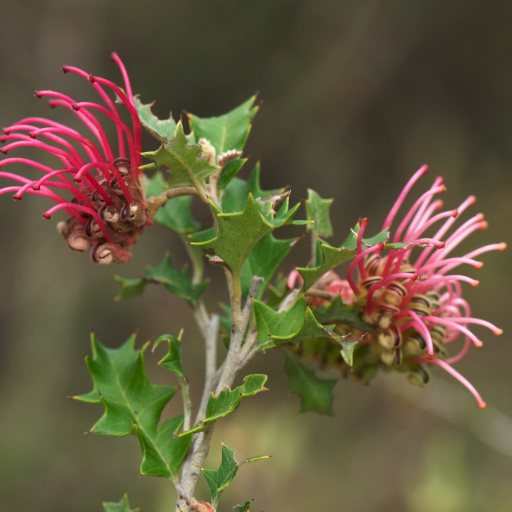
Plant Overview
Known affectionately as the Holly Grevillea or Prickly Grevillea, this Australian native is a master of defense and beauty. Its name aquifolium literally translates to "holly-leaved," a nod to its sharp, protective foliage that looks strikingly similar to the traditional Christmas Holly. In the wild landscapes of Victoria and South Australia, it serves as a vibrant "living barbed wire" that provides a safe haven for tiny nectar-feeding birds.
🔍 How to Identify
- 🍃 The Foliage: Stiff, leathery leaves with deep lobes ending in sharp, prickly points. New growth often emerges with a soft, bronze, or reddish tint.
- 🪥 The Flowers: Classic "toothbrush" style blooms. The flowers consist of bright red or pinkish styles that curve upward in dense, one-sided clusters.
- 🌿 Growth Habit: A versatile evergreen that can vary from a low-spreading groundcover to a mounding shrub reaching up to 2 meters in height.
🏡 In Your Garden
- 🦅 Wildlife Magnet: The nectar-rich flowers are a primary food source for honeyeaters and spinebills. Because the foliage is so prickly, it provides these birds with a fortress-like nesting site where cats and larger predators cannot reach them.
- 🏜️ Tough as Nails: This plant is exceptionally drought-tolerant once established. It thrives in well-draining, gritty soil and actually prefers "lean" conditions; avoid high-phosphorus fertilizers, as members of the Proteaceae family are sensitive to them.
- ✂️ Strategic Placement: Because of its sharp leaves, it is best planted away from narrow walkways or children's play areas. Instead, use it as a natural deterrent under windows or along property borders.
⚠️ Safety & Toxicity
- ✋ Skin Irritant: While not considered "poisonous" to eat, many Grevilleas contain resorcinols. Contact with the foliage or flowers can cause Grevillea dermatitis, a red, itchy skin rash similar to poison ivy in sensitive individuals.
- 🐾 Pet Safety: It is generally not toxic to cats or dogs if a small amount is nibbled, but the sharp leaves can cause physical injury to curious snouts or paws.
✨ Fun Fact
The Grevillea aquifolium is so resilient that it can survive in the "Grampians" region of Australia, growing directly out of cracks in sandstone and rocky outcrops where almost no other soil exists!

Detailed Care Instructions
| Humidity | Normal |
| Lighting | Part Sun |
| Toxicity | Poisonous |
| Difficulty | Medium |
| Hibernation | Cold Period |
| Hardiness Zones | 9 - 12 |

Place in a bright room that is sun drenched almost all day. Or directly in a south-facing window.

Some plants require more regular watering than others, which should be done every few days. It's critical to maintain the soil moist all of the time. The water requirements of the same plant placed in pots with varying sizes will differ. Because the water in the smaller pot evaporates faster than the water in the larger pot, it will require more watering. Regardless of pot size, the surface should constantly be maintained moist.
The relative humidity levels between 30 and 50 percent are ideal for these plants. They exhibit unpleasant symptoms when the moisture content in the environment is unfavorable. Avoid letting the air temperature rise too high or low and use a humidifier, whenever possible. Misting is also beneficial, although frequent watering is also necessary. The optimal relative humidity will promote plant growth.








