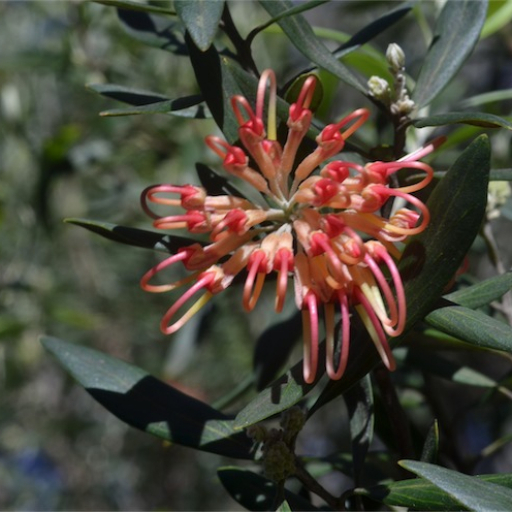
Plant Overview
Often called the Olive-leaf Grevillea, this Australian native is a coastal superstar that brings a touch of Mediterranean aesthetic to the wild bushland. It earns its name from its narrow, silvery-green foliage that looks remarkably like a traditional Olive tree, but the resemblance stops when the flowers arrive. Known as a "bird magnet," its nectar-rich blossoms act like a natural diner for honeyeaters and bees, making it a must-have for any wildlife-friendly landscape.
🔍 How to Identify
- 🌿 Silvery Foliage: The leaves are long, narrow, and have a distinct grayish-green hue with a soft, silky underside that shimmer when the wind blows.
- 🕷️ Spider Flowers: Unlike traditional petals, these flowers look like colorful "spiders" or claws, appearing in dense clusters of bright red, orange, or apricot.
- 🏗️ Dense Habit: It naturally grows as a thick, upright shrub, often reaching 2 to 4 meters in height, providing excellent cover for small nesting birds.
🏡 In Your Garden
- 🌊 Coastal Warrior: This plant is incredibly salt-tolerant and wind-resistant, making it one of the best choices for seaside gardens where salt spray usually kills more delicate species.
- ✂️ The Perfect Screen: Because it responds so well to pruning, many gardeners use it as a "living fence." Regular clipping encourages even denser growth, creating a private, bird-filled hedge.
- ☀️ Drainage is Key: While it is a rugged survivor, it has a "weak ankle" when it comes to wet feet. It requires sandy or well-drained soil; sitting in stagnant water can lead to root rot quite quickly.
⚠️ Safety & Toxicity
- 🧤 Skin Sensitivity: Like many members of the Proteaceae family, this plant contains grevilleol. Contact with the foliage or flowers can cause "Grevillea dermatitis," a bumpy, itchy rash similar to poison ivy for some people. Wearing gloves while pruning is highly recommended.
- 🐾 Pet Safety: It is generally considered non-toxic to dogs and cats if nibbled, but the scratchy texture of the leaves usually discourages pets from eating much of it anyway.
✨ Fun Fact
The flowers of the Grevillea olivacea are so full of nectar that indigenous Australians traditionally dipped the flower spikes into water to create a sweet, sugary drink, often referred to as "bush honey water."

Detailed Care Instructions
To grow Grevillea Olivacea plant, follow these steps:
- Choose a well-draining soil: Grevillea Olivacea plants prefer sandy, well-draining soil. Amend heavy clay or nutrient-poor soil with compost to improve drainage and fertility.
- Select a sunny spot: Grevillea Olivacea plants thrive in full sun, so choose a location that receives at least 6 hours of sunlight per day.
- Plant the shrub: Dig a hole twice as wide and as deep as the plant's root ball. Place the plant in the hole and backfill with soil, pressing down gently to remove air pockets. Water the plant thoroughly after planting.
- Mulch around the plant: Mulch helps to retain moisture, suppress weeds, and insulate the roots. Use organic mulch, such as wood chips or bark, and spread it around the base of the plant, leaving space around the stem to prevent rot.
- Water regularly: Grevillea Olivacea plants prefer consistent moisture, so water them regularly, especially during hot weather. Avoid overwatering, as this can lead to root rot. Allow the soil to dry out slightly between waterings.
- Fertilize sparingly: Grevillea Olivacea plants are not heavy feeders, so only fertilize them once a year in spring with a slow-release fertilizer formulated for native plants.
- Prune as needed: Prune Grevillea Olivacea plants to maintain a compact shape and encourage new growth. Remove dead or damaged branches, and trim back overgrown areas.
By following these steps, you can successfully grow Grevillea Olivacea plants and enjoy their beautiful flowers and foliage.
To water the Grevillea Olivacea plant, you should first check the soil moisture level by inserting your finger into the soil up to the first knuckle. If the soil feels dry, it is time to water the plant. Use a watering can or hose with a gentle, steady stream of water to thoroughly moisten the soil around the plant's root zone.
Avoid overwatering the Grevillea Olivacea plant, as it is sensitive to waterlogged conditions. Allow the top inch of soil to dry out between waterings to prevent root rot and other water-related issues.
During the growing season, typically in spring and summer, water the plant more frequently, especially during hot and dry periods. In the winter months, reduce watering to allow the plant to enter a dormant phase.
When watering, aim to water the soil around the base of the plant rather than directly on the foliage to prevent issues such as fungal diseases. Mulching around the plant's base can help retain soil moisture and reduce the frequency of watering.
Overall, the key to successfully watering the Grevillea Olivacea plant is to maintain a consistent watering schedule, monitor soil moisture levels, and adjust the watering frequency based on the plant's needs and environmental conditions.
To fertilize the plant, apply a slow-release fertilizer formulated for native plants in early spring. Spread the fertilizer evenly around the plant's root zone, taking care not to allow it to come into direct contact with the stems or foliage. Water the plant thoroughly after fertilizing to ensure the nutrients are absorbed properly. Repeat the fertilization process once or twice throughout the growing season, following the manufacturer's instructions for application rates.
The ideal soil for Grevillea Olivacea plants is a well-draining mix that is slightly acidic to neutral in pH. It should be composed of sandy loam or a mix of sandy and loamy soil with good aeration and drainage properties. Additionally, adding organic matter such as compost or peat moss can help improve the soil structure and fertility. This type of soil will help prevent waterlogged conditions and root rot, which can be detrimental to the health of Grevillea Olivacea plants.
Propagation of Grevillea Olivacea can be done through several methods including seed propagation, layering, and cutting propagation.
One method of propagation is by collecting seeds from mature plants and sowing them in a well-draining potting mix. Seeds should be covered lightly with soil and kept moist until germination occurs. Seedlings can then be transplanted into larger containers or directly into the garden.
Another method of propagation is through layering, where a low branch of the plant is bent down and secured to the ground. The branch is then partially buried and kept moist until roots form. Once roots have developed, the new plant can be separated from the parent plant and transferred to a new location.
Cutting propagation is also a popular method for propagating Grevillea Olivacea. Cuttings should be taken from healthy, young growth and placed in a well-draining potting mix. Cuttings can be taken at any time of the year, but are most successful when taken during the spring or summer months. It is important to keep the cutting moist and placed in a warm, humid environment to encourage root development.
Overall, propagating Grevillea Olivacea can be a rewarding process that allows for the production of new plants from existing ones. With the right care and attention, these propagation methods can be successful in producing healthy, thriving plants.








