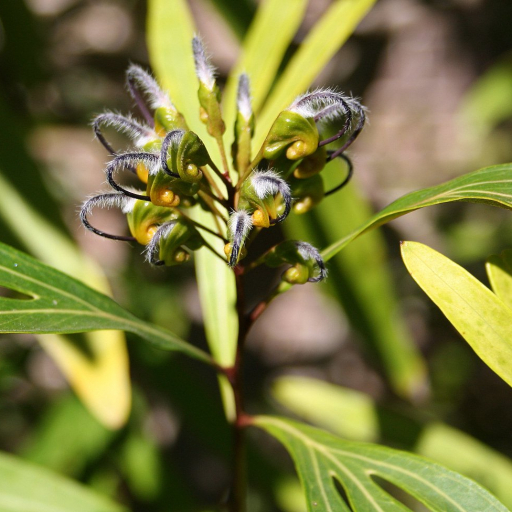
Plant Overview
Commonly known as the Byfield Spider Flower, this Australian native is a showstopper that looks like it belongs in a sci-fi film. Originating from a small coastal pocket in Central Queensland, it is prized for its "hairy" aesthetic and neon-bright, velvet flowers. It is the ultimate choice for gardeners looking to transform their backyard into a bustling sanctuary for nectar-loving birds.
🔍 How to Identify
- 🌼 The Flowers: Exotic, multi-colored blooms featuring a mix of gold, lime green, and dramatic, dark purple or black "styles" that curve outward like spider legs.
- 🍃 Foliage: The leaves are long, broad, and slightly wavy with a soft, felt-like texture on the underside, often giving the plant a silvery shimmer in the breeze.
- 🌳 Growth Habit: It typically grows as a dense, spreading shrub reaching about 2 to 4 meters high, making it an excellent choice for a natural privacy screen.
🏡 In Your Garden
- 🧪 Phosphorus Warning: Like many members of the Proteaceae family, this plant has specialized "proteoid" roots. It is highly sensitive to phosphorus; using standard garden fertilizer can actually be fatal to it. Always look for "Native-safe" blends.
- 🐦 Avian Oasis: This plant is a heavy nectar producer. Once established, it acts as a magnetic "gas station" for honeyeaters and other long-beaked birds, providing them with a reliable food source throughout the year.
⚠️ Safety & Toxicity
- 🧴 Skin Irritation: While beautiful, this species is known to cause "Grevillea dermatitis." The fine hairs on the leaves and flowers can cause an itchy red rash or skin irritation for some people.
- 🐾 Pets & Kids: It is generally considered non-toxic if accidentally nibbled, but because of the potential for skin reactions and its slightly scratchy texture, it is best planted away from narrow walkways or children's play areas.
✨ Fun Fact
The name venusta is derived from the Latin word "venustus," which translates to "charming," "lovely," or "graceful"—a tribute to the plant's unusually elegant and complex floral architecture.

Detailed Care Instructions
To grow Grevillea venusta, also known as Silky Grevillea or Hairpin Banksia, you can follow these steps:
- Location and Climate:
- Choose a location that receives full sun or partial shade. Grevillea venusta prefers a sunny spot but can tolerate some shade.
- Ensure that the climate is suitable for Grevillea venusta. They prefer mild to warm climates, and are native to regions of Australia.
- Choose a location that receives full sun or partial shade. Grevillea venusta prefers a sunny spot but can tolerate some shade.
- Soil Preparation:
- Prepare the soil by ensuring it is well-draining. Grevillea venusta does not tolerate waterlogged soil.
- Sandy or loamy soil types are ideal, but the plant can tolerate different soil types as long as they are well-draining.
- Prepare the soil by ensuring it is well-draining. Grevillea venusta does not tolerate waterlogged soil.
- Planting:
- Dig a hole that is slightly larger than the root ball of the plant to accommodate its roots.
- Place the plant in the hole, making sure it is at the same level as it was in the nursery container.
- Fill the hole with soil, gently patting it down to remove air pockets.
- Dig a hole that is slightly larger than the root ball of the plant to accommodate its roots.
- Watering:
- After planting, water the Grevillea venusta thoroughly to ensure the soil is evenly moist. This will help the plant establish its roots.
- Once established, allow the soil to dry out slightly between waterings. Grevillea venusta is drought-tolerant but benefits from occasional deep watering during dry periods.
- After planting, water the Grevillea venusta thoroughly to ensure the soil is evenly moist. This will help the plant establish its roots.
- Fertilizing:
- Apply a slow-release native plant fertilizer in spring and autumn to provide necessary nutrients. Follow the instructions on the fertilizer packaging for the correct amount.
- Apply a slow-release native plant fertilizer in spring and autumn to provide necessary nutrients. Follow the instructions on the fertilizer packaging for the correct amount.
- Pruning:
- Grevillea venusta generally requires minimal pruning. However, you can prune back any dead or damaged branches to maintain a tidy appearance.
- Prune after flowering to encourage bushier growth and remove any spent flowers.
- Grevillea venusta generally requires minimal pruning. However, you can prune back any dead or damaged branches to maintain a tidy appearance.
- Pests and Diseases:
- Monitor the plant for pests such as aphids or spider mites. If detected, treat with an appropriate insecticide.
- Grevillea venusta is generally resistant to diseases but can be prone to root rot if the soil becomes waterlogged.
- Monitor the plant for pests such as aphids or spider mites. If detected, treat with an appropriate insecticide.
- Mulching:
- Apply a layer of organic mulch around the base of the plant to conserve moisture, suppress weeds, and protect the roots from extreme temperatures.
Remember to always check specific care requirements for the variety of Grevillea venusta you are growing, as some cultivars may have slightly different needs.
- Apply a layer of organic mulch around the base of the plant to conserve moisture, suppress weeds, and protect the roots from extreme temperatures.

Place in a window with dappled sun or a spot in the middle of a room. Or directly in a window facing west or east.

To water this plant, make sure to avoid over watering as it doesn't like constantly damp soil. Allow the top two to three inches of soil to dry out before watering again. When you do water, make sure to give it a thorough soak, aiming to wet the entire root ball. Use room temperature water and avoid getting any water on the foliage. Water in the morning or early evening to reduce water loss through evaporation. Ensure the pot has good drainage to avoid waterlogging the plant.
To fertilize this plant, you should choose a balanced fertilizer with equal amounts of nitrogen, phosphorus, and potassium. Apply the fertilizer in the early spring, just as new growth begins to appear. Use a slow-release fertilizer as this plant likes to be fed gradually. Avoid applying too much fertilizer as it may damage the roots. Gradually increase the amount of fertilizer as the plant grows. Water the plant well after fertilizing.
Grevillea Venusta is a plant that requires well-draining soil, which means soil that allows water to flow easily through it. The soil should also be slightly acidic with a pH level of 6.0-6.5. It is recommended to use sandy or loamy soil, as they provide the ideal drainage and nutrient-holding properties for the plant. Additionally, adding some organic matter such as compost or leaf mold can improve the soil quality and provide some essential nutrients to the plant. It is also essential to avoid using heavy clay soils or soils that are prone to waterlogging because they may result in the roots of the plant rotting due to lack of oxygen. A high-quality potting mix can also be used if the plant is grown in containers, as it contains the necessary nutrients and drainage properties that the plant requires.
Propagation of the plant can be done through taking semi-hardwood cuttings in late summer or early autumn. Cuttings should be taken from the current season's growth and should be about 4-6 inches in length. Remove the lower leaves and dip the cutting in rooting hormone before planting it in a well-draining potting soil. It is important to keep the cutting moist and in a warm, bright location but out of direct sunlight. Once rooted, the cutting can be transplanted into a larger pot or into the ground.








