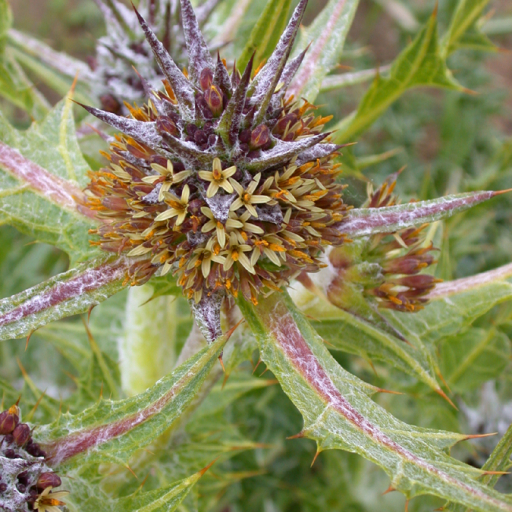
Plant Overview
Commonly known as Akkoub or the Tumble Thistle, Gundelia tournefortii is a rugged, spiny perennial that holds a legendary status in Middle Eastern culture. Part vegetable, part tumbleweed, and part formidable desert survivor, it has been harvested for thousands of years as a gourmet delicacy. In the wild, it transition from a lush green rosette to a dry, rolling ball that dances across the arid landscapes of the Levant.
🔍 How to Identify
- 🌿 Spiny Foliage: The leaves are thick, leathery, and deeply lobed, featuring sharp, needle-like spines at every tip. They often display prominent white or silver veins against a dusty green background.
- 🌸 Compound Flower Heads: Unlike a simple daisy, its flowers are packed into dense, prickly clusters that can range from yellowish-green to deep purple or maroon as they mature.
- 🌪️ The "Tumbleweed" Form: Once the plant dries out at the end of the season, the stem snaps at the base. The entire skeleton—seeds and all—rolls with the wind to distribute its offspring across the desert.
🏡 In Your Garden
- 🏜️ The Taproot Rule: This plant develops a massive, deep taproot to find water in harsh climates. Because of this, it absolutely hates being moved once established. If you plant it, ensure the spot is permanent and the soil is extremely well-draining.
- ☀️ Sun Seeker: It thrives in "neglected" spots with full, scorching sun and rocky or sandy soil. Overwatering is the quickest way to kill it, as it is highly susceptible to root rot in damp, heavy clay.
⚠️ Safety & Toxicity
- 🟢 Status: Generally non-toxic and highly valued as an edible plant.
- 🧤 Physical Hazard: While it isn't poisonous, its spines are incredibly sharp and can easily puncture skin or gardening gloves. When preparing it for food, the "cleaning" process to remove these thorns is a labor of love. It is safe for pets, though the prickles may deter them from ever going near it.
✨ Fun Fact
Gundelia tournefortii is a candidate for the "Crown of Thorns" mentioned in biblical texts. Additionally, pollen grains from this specific plant were found in high concentrations on the Shroud of Turin, leading some researchers to believe the plant was present during the Shroud's origin.

Detailed Care Instructions
To grow Gundelia Tournefortii plant, follow these steps:
- Obtain seeds or seedlings: You can purchase seeds or seedlings from garden centers or online nurseries. Make sure to choose a reputable source.
- Choose the right location: Gundelia Tournefortii prefers well-drained soil and plenty of sunlight. Select a sunny spot in your garden or balcony where the plant will receive at least 6-8 hours of direct sunlight.
- Prepare the soil: Gundelia Tournefortii plants prefer sandy or loamy soil. Before planting, loosen the soil and remove any weeds or debris. You can amend the soil with compost or organic matter to improve its fertility and drainage.
- Plant the seeds or seedlings: If using seeds, sow them directly into the soil, covering them with a thin layer of soil. If using seedlings, dig a small hole, slightly larger than the root ball, and gently place the seedling in the hole. Backfill the hole and tamp down the soil lightly.
- Watering: Water the plant thoroughly after planting to settle the soil around the roots. Afterward, water regularly to keep the soil moist but not waterlogged. Monitor the moisture levels and adjust watering as needed, especially during hot and dry periods.
- Mulching: Apply a layer of organic mulch, such as straw or wood chips, around the plant to help retain moisture, suppress weed growth, and regulate soil temperature.
- Fertilization: Gundleia Tournefortii plants are generally low-maintenance and do not require frequent fertilization. However, you can apply a balanced slow-release fertilizer once or twice a year to provide additional nutrients.
- Pruning: Prune the plant as needed to remove dead or damaged stems. This will help maintain its shape and encourage new growth.
- Pest and disease control: Monitor the plant regularly for any signs of pests or diseases. If necessary, treat the affected areas with appropriate organic or chemical controls.
- Harvesting: Depending on your desired use, carefully harvest the young shoots or leaves of the Gundelia Tournefortii plant. It is best to harvest them before they flower for optimal tenderness and flavor.
Remember to research specific care requirements for Gundelia Tournefortii as it may have additional preferences and needs depending on your location and climate.

Place in a bright room that is sun drenched almost all day. Or directly in a south-facing window.

Gundelia Tournefortii is a type of plant that requires regular watering to thrive. When watering this plant, it is important to keep a few things in mind.
Firstly, the soil should be moist but not waterlogged. This means that you should avoid watering the plant too much or too frequently. Instead, aim to water the plant deeply once or twice a week, allowing the soil to dry out slightly in between watering sessions.
Secondly, make sure to water the plant at the base rather than the leaves. This will ensure that the water is able to reach the roots where it is needed most.
Lastly, pay attention to the weather conditions and adjust your watering schedule accordingly. During hot, dry spells, you may need to water the plant more frequently to prevent it from drying out.
Overall, giving your Gundelia Tournefortii plant proper and consistent watering is key to keeping it healthy and thriving.
To fertilize this plant, begin by selecting a balanced fertilizer containing equal parts of nitrogen, phosphorus, and potassium. Apply the fertilizer once per month during the growing season. Avoid overfertilizing, as this can lead to excessive vegetative growth and reduced flowering. Instead, use a slow-release fertilizer and follow package instructions for application rates. Additionally, maintain a consistent watering schedule to avoid nutrient stress and promote healthy growth.
The ideal soil for growing this plant should be well-draining, with a neutral to slightly alkaline pH level. It should be relatively rich in nutrients, including nitrogen, phosphorus, and potassium, but not overly fertile, as this can lead to excessive vegetative growth instead of flowering. The soil should also be free of any contaminants or pollutants, as this plant is known to absorb toxins from its environment. Additionally, adding a layer of organic mulch around the base of the plant can help to retain moisture and regulate soil temperature, which can be particularly beneficial in hot, arid climates.
Propagation of this plant can be achieved through two primary methods: seed propagation and vegetative propagation.
Seed propagation: The seeds of this plant can be collected from the mature flowers or purchased from a seed supplier. The seeds should be sown in well-draining soil that is enriched with organic matter. The seeds should be sown at a depth of 1-2 cm and kept in a warm and moist environment. Germination generally occurs within 1-2 weeks. The seedlings can be transplanted into individual pots once they have developed 2-3 true leaves.
Vegetative propagation: This plant can also be propagated vegetatively through the root cuttings or stem cuttings. Root cuttings are generally taken from the mother plant in the fall or early winter when the plant is dormant. The cuttings should be taken from healthy roots and should be around 5cm long. The cuttings should be planted vertically in well-draining soil and kept in a warm and moist environment until new growth appears.
Stem cuttings can also be taken from the mother plant during the growing season. The cuttings should be taken from softwood growth and should be around 10-15cm long. The cuttings should be stripped of their lower leaves and planted in well-draining soil. The cuttings should be kept in a warm and humid environment until new growth appears.
Once the seedlings or cuttings have developed strong root systems, they can be transplanted into individual pots or directly into the garden. The plants should be grown in full sun and provided with regular watering and fertilization.








