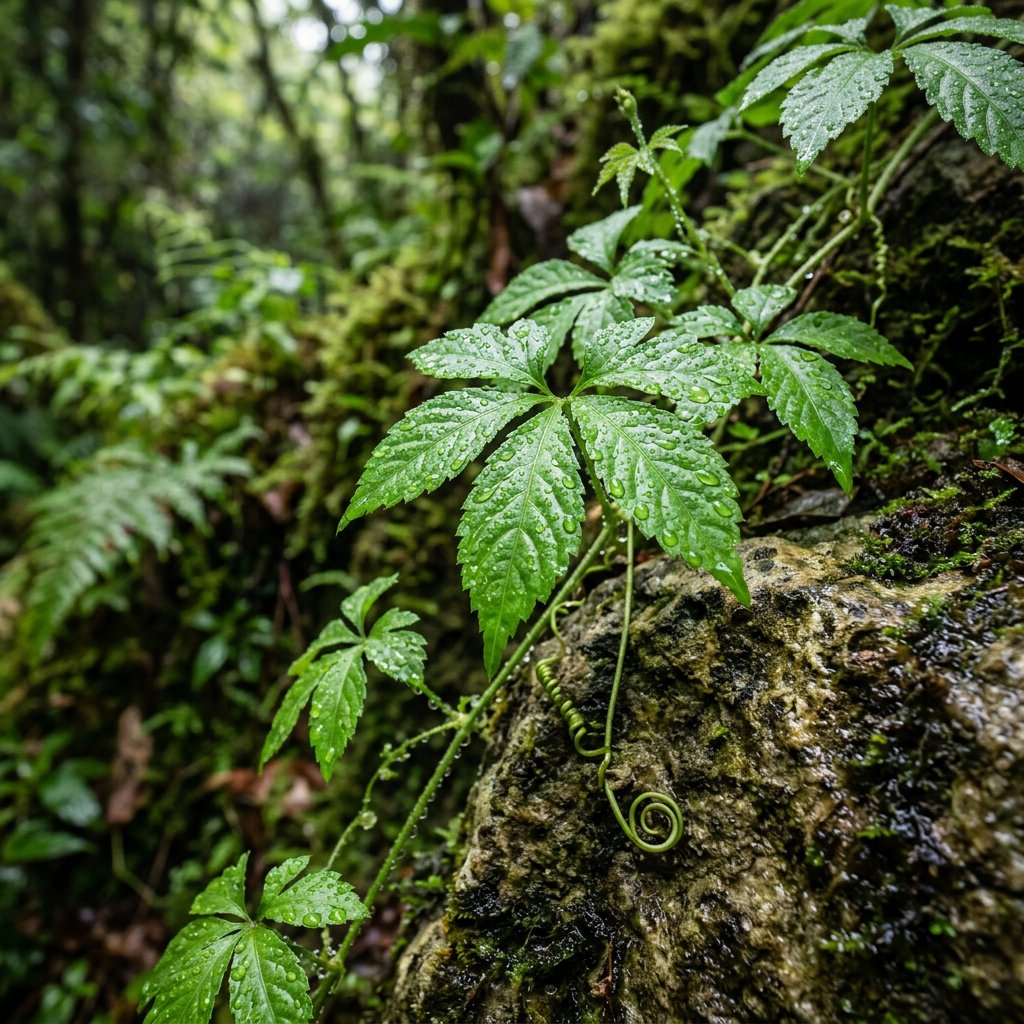
Plant Overview
Often called the "Herb of Immortality," Gynostemma pentaphyllum is a lush, climbing vine native to the misty mountains of Southern China and Japan. While it looks remarkably like a delicate ivy, it actually belongs to the cucumber family and has been brewed into longevity-boosting teas for centuries. Local legends in the Guizhou province say those who drink it daily frequently live well past 100 years.
🔍 How to Identify
- 🍃 Five-Leaf Clusters: The most common variety features leaves arranged in groups of five (sometimes seven) leaflets that fan out from a single point like a hand.
- 🪝 Coiling Tendrils: It produces thin, spring-like tendrils that emerge from the leaf axils, allowing the plant to "hook" and climb upward.
- 🪚 Serrated Margins: Each individual leaflet has finely "toothed" or saw-like edges and a soft, slightly translucent texture when held up to the light.
🏡 In Your Garden
- 🌦️ Forest Floor Preferences: In the wild, this vine grows under the canopy of large trees. In your home or garden, it craves "dappled" light; direct, hot afternoon sun will quickly scorch its delicate foliage.
- 🚀 Vigorous Growth: Because it is a member of the gourd family, it grows incredibly fast during the summer. If you don't provide a trellis or pole for it to climb, it will quickly transform into a dense, sprawling groundcover.
⚠️ Safety & Toxicity
- 🍵 Safe Assessment: It is widely recognized as a "superfood" herb for humans, commonly dried for tea or used in salads.
- 🐾 Pet Precautions: While not considered "deadly," the plant contains saponins which can cause mild digestive upset, drooling, or vomiting in curious cats and dogs if consumed in large quantities.
- 🤰 Health Note: Because it is an "adaptogen" that affects the immune and circulatory systems, pregnant women or those on blood-thinning medication should consult a professional before use.
✨ Fun Fact
Despite being nicknamed "Southern Ginseng," Gynostemma is not related to the Ginseng root at all! It earned the name because it contains the exact same active chemical compounds (ginsenosides) that make Ginseng famous, but it is much easier and faster to grow in a backyard pot.

Detailed Care Instructions
| Humidity | Normal |
| Lighting | Full Sun |
| Difficulty | Medium |
| Hibernation | Cold Period |
| Hardiness Zones | 8 - 10 |
To grow Gynostemma Pentaphyllum plant, also known as Jiaogulan or the "immortality herb," follow these steps:
- Obtain seeds or seedlings: You can purchase Gynostemma Pentaphyllum seeds or seedlings from a reputable nursery or online garden store. Choose healthy-looking plants to ensure their viability.
- Choose a suitable location: Select a spot in your garden or balcony that receives partial shade to full sun. The plant prefers well-draining soil and a warm climate.
- Prepare the soil: Gynostemma Pentaphyllum thrives in fertile, loamy soil. Add organic matter, such as compost or well-rotted manure, to improve soil quality and drainage.
- Sow seeds or transplant seedlings: If starting from seeds, sow them directly into the prepared soil, following the recommended depth and spacing. If using seedlings, dig holes big enough to accommodate the root system and gently place the plants in the holes.
- Water regularly: Keep the soil consistently moist, especially during the germination and early growth stages. Water the plant deeply but avoid waterlogging the soil.
- Provide support: Gynostemma Pentaphyllum is a vine-like plant that benefits from support structures such as trellises, fences, or other structures. Install these supports at the time of planting or as the plant grows taller.
- Fertilize occasionally: Apply a balanced slow-release fertilizer or compost every few months to provide necessary nutrients for healthy growth.
- Prune and train the plant: If the vine becomes too long or unruly, prune it back to control its growth and promote bushier foliage. Regular pruning also helps maintain the shape and health of the plant.
- Harvest leaves: Gynostemma Pentaphyllum leaves can be harvested for consumption once the plant establishes itself and grows to a reasonable size. Typically, the leaves are harvested in the morning when they are at their freshest and richest in beneficial compounds.
- Enjoy the health benefits: Gynostemma Pentaphyllum is believed to have numerous health benefits, including antioxidant, anti-inflammatory, and adaptogenic properties. Incorporate the plant's leaves into your diet by steeping them to make tea or adding them to salads and smoothies.
Remember to check the specific growing requirements and recommendations for Gynostemma Pentaphyllum in your region, as these may vary slightly.

Place in a window with dappled sun or a spot in the middle of a room. Or directly in a window facing west or east.

Watering the plant requires regular attention. Ensure that the soil is moist at all times but do not water too frequently as it may lead to waterlogging and root rot. The plant prefers well-draining soil which allows excess water to drain away. Avoid getting water on the leaves as it may promote fungal growth. The frequency of watering will depend on the plant's specific needs, the temperature, and the humidity in the environment. It is best to water the plant early in the morning or late in the evening when the temperature is cooler. Use room temperature water and avoid using hard water as it may leave mineral buildup in the soil. It is important to monitor the plant regularly and adjust the watering schedule accordingly.
To fertilize this plant, you should use a balanced fertilizer with equal parts nitrogen, phosphorus, and potassium. Apply the fertilizer during the growing season every four to six weeks. Be sure to water the plant well before and after fertilizing to ensure the nutrients are absorbed properly. Avoid over-fertilizing, as it can cause fertilizer burn and damage the plant. Follow the instructions on the fertilizer package for specific amounts and application methods.
Gynostemma Pentaphyllum plant requires a well-draining soil mix with good fertility. The soil must be a combination of nutrient-rich organic matter and sand or perlite to provide the necessary drainage. A pH level between 6.5 to 7.5 is ideal.
The plant prefers loamy, well-draining soil that is moist but not waterlogged. Soil with good drainage prevents the roots from getting oversaturated and encourages healthy growth.
The ideal soil mixture for Gynostemma Pentaphyllum should consist of one-third organic matter such as compost or coco coir, one-third sand, and one-third garden soil.
Avoid using clay soil as it holds water for longer periods and may lead to root rot. Additionally, avoid using soil that is too heavy or compacted as it may hinder the growth and development of the plant.
It is recommended to perform a soil test before planting to ensure that the soil has the right amount of nutrients. Adding organic fertilizers can help increase soil fertility and provide the necessary nutrients required for healthy plant growth.
Gynostemma Pentaphyllum plant can be propagated through stem cuttings or seeds. To propagate through stem cuttings, choose a healthy stem that is at least 4 inches long with a few leaves and no flowers. Make a clean cut at a 45-degree angle and remove all but the top few leaves. Then, dip the cut end in rooting hormone and plant it in a well-draining potting soil mix. Keep the soil moist and the cutting in bright, indirect light. After a few weeks, roots should begin to form and the cutting can be transplanted into its permanent location.
To propagate through seeds, harvest mature seeds from a healthy plant and plant them in a potting soil mix at a depth of about ¼ inch. Keep the soil moist and the seedlings in bright, indirect light until they are large enough to be transplanted into their permanent location. It may take several months for the seedlings to grow large enough to be transplanted, so patience is key when propagating through seeds.
Common pests of the gynostemma include Mealybugs, spider mites, thrips. Make a habit of checking your gynostemma frequently for pests so that any infestations can be caught and managed early.








