Plant Overview
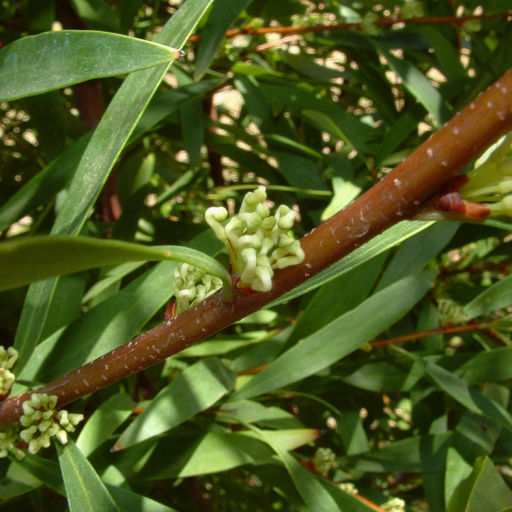
Known as the Willow-leaved Hakea, this versatile Australian native is a favorite for those seeking a fast-growing privacy screen that doesn't demand constant attention. Its elegant, drooping foliage mimics the look of a Willow tree, but with the rugged resilience of the Outback. In spring, it transforms into a haven for local pollinators, covered in delicate, lace-like white clusters.
🔍 How to Identify
- 🍃 Willow-like Foliage: The leaves are long, narrow, and lance-shaped, starting as a soft bronze-pink when young before maturing into a deep, leathery green.
- ☁️ Cluster Blooms: Small, creamy-white flowers appear in "axillary clusters" (the joints between the leaf and stem), looking like tiny, exploding stars.
- 🥜 Woody Seed Pods: Unlike many plants, its seeds are kept in hard, egg-shaped woody follicles that feature a distinct "beak" or small horns at the tip.
🏡 In Your Garden
- 🧱 The Ultimate Screen: Because of its rapid growth and dense branching habit, it is widely used as a "living wall" to block wind or noisy neighbors.
- 🦅 Wildlife Magnet: The dense structure provides excellent nesting sites for small birds, while the nectar-rich flowers are a buffet for bees and honeyeaters.
- ✂️ Pruning & Roots: It has a sensitive taproot and dislikes being moved once planted; however, it responds beautifully to light pruning, which helps maintain a bushy shape rather than letting it become "leggy."
⚠️ Safety & Toxicity
- ✅ General Safety: Hakea salicifolia is considered non-toxic to humans, dogs, and cats, making it a safe choice for family backyards.
- 🌵 Mechanical Hazards: While not "prickly" like some of its Hakea cousins, the woody seed pods are very hard and can be a tripping hazard or uncomfortable if stepped on with bare feet.
- 🧤 Skin Sensitivity: Some gardeners with very sensitive skin may experience mild irritation from the fine hairs on new growth; wearing gloves during heavy pruning is recommended.
✨ Fun Fact
The Hakea is a "serotinous" plant, meaning many species wait for the heat of a bushfire to open their woody seed pods. While the Willow-leaved Hakea can release seeds upon maturity, its "wooden vaults" are designed to protect the next generation from extreme heat and hungry insects!

Detailed Care Instructions
To successfully grow a Hakea Salicifolia plant, follow these steps:
- Climate and location: Hakea Salicifolia is native to Mediterranean climates. It grows well in areas with mild winters and moderate rainfall. Choose a spot with full sun exposure for at least 6 hours a day. Ensure the soil is well-draining.
- Soil preparation: Hakea Salicifolia prefers sandy or loamy soil. Prepare the soil by loosening it with a garden fork or tiller. Remove any weeds or debris. Incorporating organic matter, such as compost, can improve soil structure and fertility.
- Planting: Dig a hole slightly larger than the plant's root ball and place it in the hole. Ensure the top of the root ball is level or slightly above the soil surface. Firmly backfill the hole with soil, gently pressing it down around the root ball. Water thoroughly after planting.
- Watering: Hakea Salicifolia plants require regular and consistent watering, especially during the first year of growth. Water deeply but infrequently, allowing the soil to dry out slightly between waterings. Reduce watering during the plant's dormant period.
- Mulching: Apply a layer of organic mulch around the base of the plant, extending it to the drip line. Mulching helps retain moisture, suppress weeds, and regulate soil temperature.
- Pruning: Prune lightly to maintain a pleasing shape and remove any dead or damaged branches. Avoid severe pruning, as Hakea Salicifolia plants do not regenerate well from old wood.
- Fertilization: Hakea Salicifolia plants generally do not require heavy fertilization. However, you can apply a slow-release, balanced fertilizer in early spring to promote healthy growth.
- Pests and diseases: Hakea Salicifolia is generally less susceptible to pests and diseases. However, keep an eye out for common issues like aphids, scale insects, or powdery mildew. Apply appropriate treatments if necessary.
- Propagation: Hakea Salicifolia can be propagated from both seeds and cuttings. Seeds can be sown in a well-draining potting mix and kept in a warm, sunny location. Cuttings can be taken from semi-hardwood stems in summer, treated with rooting hormone, and placed in a moist rooting medium.
Remember to check for specific care requirements based on your location and climate. Regular observation of your plant's health and adaptations may be necessary to ensure its successful growth.

Place in a bright room that is sun drenched almost all day. Or directly in a south-facing window.

To water this plant, it is important to ensure that the soil is consistently moist, but not waterlogged. You can achieve this by watering deeply, enough to saturate the soil down to the roots, but avoiding standing water or excessive run-off. The frequency of watering will depend on factors such as the size and age of the plant, the time of year, and the specific soil and environmental conditions. It is important to monitor the moisture level of the soil regularly, and adjust watering as needed. In addition, it is recommended to water slowly and deeply to encourage deep root growth, which can help the plant tolerate dry conditions better.
To fertilize this plant, use a balanced fertilizer that contains nitrogen, phosphorus, and potassium. Apply the fertilizer in the early spring before new growth appears. Follow the application instructions on the fertilizer package, and water the plant immediately after fertilizing to help the nutrients penetrate the soil. Avoid over-fertilizing, as this can cause damage to the plant's roots and foliage.
Hakea Salicifolia plant requires well-draining soil that is rich in organic matter. The optimal pH range for the soil is slightly acidic to neutral, between 6.0 and 7.0. The soil should be composed of a mixture of sand, clay, and loam in order to provide proper drainage while still retaining moisture. It is recommended to use a high-quality potting mix that is designed for native Australian plants. Fertilizers, particularly those that contain phosphorus, should be applied sparingly as the plant is sensitive to high levels of phosphorus. Additionally, the plant prefers a full-sun location in order to thrive and grow well.
Hakea Salicifolia can be propagated from seeds or cuttings. To propagate from seeds, collect mature seeds from a healthy plant and sow them in a pot filled with well-draining soil. Keep the soil moist and place the pot in a warm location. Seeds usually germinate within two to four weeks.
To propagate from cuttings, take a 10-15 cm cutting from a healthy plant, making sure to include a section of the woody stem. Remove the lower leaves and dip the cut end in rooting hormone. Plant the cutting in well-draining soil, water it thoroughly and place it in a warm and bright location. Promote root growth by covering the pot with a plastic bag to trap moisture and increase humidity. Roots usually develop in about four to six weeks. After roots have formed, remove the plastic bag and continue to care for the newly propagated plant as the original plant.








