Plant Overview
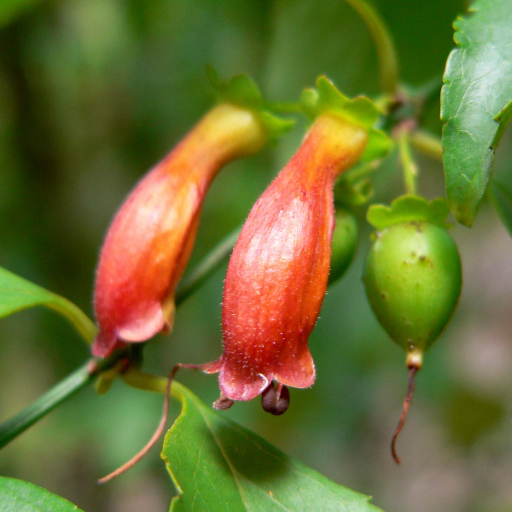
Commonly known as the Tree Fuchsia or "Notsung," Halleria lucida is a hidden gem of the Southern African landscape. Unlike many plants that hide their blooms among the leaves, this tree puts on a theatrical display by growing its bright flowers directly out of its woody trunk and thick branches. It is a cornerstone species for anyone looking to transform their outdoor space into a bustling sanctuary for nectar-seeking birds.
🔍 How to Identify
- 🌿 The Foliage: The leaves are bright green, glossy, and shaped like an elegant teardrop with finely serrated edges. They often grow in pairs along the stems.
- 🎺 The "Trunk" Flowers: Its most striking feature is "cauliflory"—the production of tubular, orange-to-brick-red flowers that sprout in clusters directly from the old wood and main trunk rather than the tips of branches.
- 🍇 The Fruit: After flowering, the tree produces small, round, fleshy berries that transition from green to a dark, purple-black color as they ripen.
🏡 In Your Garden
- 🐦 The Bird Magnet: If you plant a Tree Fuchsia, expect company. The nectar-rich flowers are irresistible to Sunbirds, while the juicy (though somewhat bland) berries act as a buffet for fruit-eating birds like Bulbuls and Turacos.
- 🌳 Versatile Growth: Because it has a naturally somewhat "scraggly" or multi-stemmed growth habit, it works beautifully as a leafy screen or a formal specimen tree if pruned early on. It is remarkably resilient, handling both deep shade and full sun.
- 💧 Adaptability Nuance: While it thrives with regular water and rich compost, it is surprisingly tough. Once its root system is established, it can survive periods of drought and moderate frost, though it may drop some leaves to protect itself.
⚠️ Safety & Toxicity
- ✅ Safe for Wildlife: This plant is entirely non-toxic to birds and local wildlife, who rely on it for sustenance.
- 👶 Human Interaction: The berries are technically edible and have a sweet, albeit watery and slightly "green" taste, but they are not a culinary staple. There are no known reports of toxicity to dogs or cats, making it a safe choice for family gardens.
✨ Fun Fact
The Halleria lucida is a master of disguise; in a deep, moist forest, it can grow into a massive 15-meter canopy tree, but in a dry, rocky garden, it may remain a compact, charming shrub for its entire life!

Detailed Care Instructions
To grow Halleria Lucida, also known as the Tree Fuchsia, follow these instructions:
- Climate and soil: Halleria Lucida is native to South Africa and prefers a warm and subtropical climate. It can be grown in USDA hardiness zones 9-11. The plant thrives in well-draining soil with a pH level between 6.0 and 7.5. Ensure that the soil is rich in organic matter.
- Planting: Choose a sunny spot in your garden to plant the Halleria Lucida. Dig a hole that is twice the width and depth of the plant's nursery container. Carefully remove the plant from its container, gently loosen the roots, and place it in the hole. Backfill the hole with soil, firming it gently around the plant.
- Watering: Provide regular water to your Halleria Lucida, especially during dry spells or its first year of growth. The plant prefers evenly moist soil, so water deeply but infrequently rather than frequent shallow watering. Utilize mulch around the base to help retain moisture.
- Pruning: At the beginning of spring, before new growth occurs, remove any dead or damaged branches. Light pruning can be done throughout the year to maintain a desired shape and encourage bushier growth.
- Fertilization: Feed the Halleria Lucida with a slow-release fertilizer in early spring. Make sure to follow the instructions on the fertilizer package for the appropriate dosage. Additional applications may not be required unless the plant appears nutrient deficient.
- Propagation: Halleria Lucida can be propagated by seeds or semi-hardwood cuttings. Seeds should be sown in a well-draining mix and kept moist until they germinate. Semi-hardwood cuttings with a length of 4-6 inches can be taken in late summer or early autumn. Dip the cut ends in a rooting hormone and plant them in a well-draining mix. Keep the cuttings in a warm, bright location, and they should root in a few weeks.
Remember to keep an eye out for pests or diseases and take appropriate measures if necessary. Regular care, including watering, pruning, and fertilizing, will help your Halleria Lucida plant thrive.

Place in a window with dappled sun or a spot in the middle of a room. Or directly in a window facing west or east.

Watering Halleria Lucida requires providing moist soil conditions for the plant to thrive. Regular watering routine should be followed, which involves watering the plant once or twice a week depending on the humidity level of the environment. It is recommended to let the soil partially dry in between watering to avoid waterlogging. Also, using lukewarm water is preferred over using cold water, as it can shock the roots. It is essential to avoid overwatering as it can lead to root rot and other fungal diseases. A well-draining soil is recommended to avoid water accumulation at the bottom. In summary, appropriate watering of Halleria Lucida requires a balance between frequent watering to keep the soil moist and letting the soil dry partially before the next watering.
- Choose a balanced fertiliser with equal amounts of nitrogen, phosphorus, and potassium.
- Mix the fertiliser with water according to the package instructions.
- Apply the fertiliser solution to the base of the plant, avoiding the leaves and stems.
- Use a slow-release fertiliser for longer-lasting effects.
- Fertilize the plant once every two weeks during the growing season.
- Stop fertilizing during the winter months when the plant is dormant.
Halleria Lucida plant prefers a well-draining loamy soil with pH slightly on the acidic side, ideally between 6.0 and 6.5. The soil should be a mixture of sand, silt, and clay, with good airflow and moisture retention capacity. The soil must not be heavy or clayey, as it can cause waterlogging and eventually rot the roots. Adding some organic matter such as compost or leaf mold can help improve soil nutrition and structure. The plant also benefits from regular feeding with a balanced liquid fertilizer, especially during the growing season and flowering period. Overall, a well-draining and nutrient-rich soil with good aeration is crucial for the healthy growth and development of Halleria Lucida plant.
The propagation of this plant is typically done through softwood cuttings taken during the early summer months. To do so, select a healthy stem with new growth and cut it off just below a node. Remove the lower leaves, leaving only a few at the top, and dip the cut end in rooting hormone. Plant the cutting in a pot with well-draining soil, and place it in a warm, bright location. Water the cutting regularly, but avoid over-watering. Eventually, the cutting should develop roots and begin to grow into a new plant.








