Plant Overview
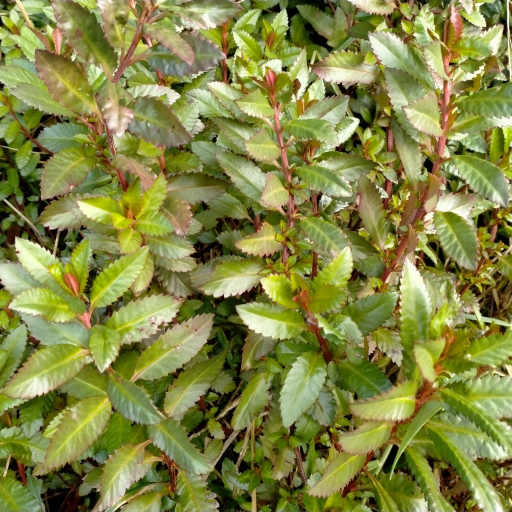
Known in its native New Zealand as Toatoa, Haloragis erecta is the ultimate "tough guy" of the plant world. With its distinctively jagged, saw-toothed leaves and often bronze-tinted foliage, it adds a moody, architectural texture to any landscape. It is famously a "pioneer species," often the first to sprout in broken or disturbed ground, acting as nature’s first responder to help heal the earth.
🔍 How to Identify
- 🍃 Toothed Leaves: The most striking feature is the sharply serrated, lance-shaped leaves that look like miniature saw blades.
- 🪵 Square Stems: If you roll the stems between your fingers, you will notice they are distinctly four-angled or square-ish, often turning a deep reddish-brown as they mature.
- 🌸 Inconspicuous Blooms: It produces very tiny, understated yellow-green or reddish flowers that huddle at the tips of the branches, eventually turning into small, nut-like fruits.
🏡 In Your Garden
- 🏗️ The Pioneer Spirit: Because this plant is a natural colonizer, it is incredibly hardy and fast-growing. It’s perfect for filling gaps quickly or stabilizing soil, but keep an eye on it—it can be a bit of a "space hog" if left entirely to its own devices.
- 🌊 Coastal Warrior: This plant is exceptionally tolerant of salt spray and wind, making it a go-to choice for seaside gardens where more delicate plants might wither.
- ☀️ Color Control: To get that signature metallic bronze look (especially in the 'Wellington Bronze' variety), give it plenty of sunlight. In deep shade, the plant will revert to a more standard forest green.
⚠️ Safety & Toxicity
- 🐾 Low Risk: Haloragis erecta is generally considered non-toxic to common household pets like cats and dogs.
- 🧤 Skin Sensitivity: While not poisonous, the "toothed" margins of the leaves can be quite coarse. If you have very sensitive skin, you might find the foliage slightly abrasive during heavy pruning.
✨ Fun Fact
The name Haloragis comes from the Greek words for "salt" and "berry," a nod to its love for coastal environments. Despite its rugged appearance, it belongs to the same family as the delicate Water Milfoil!

Detailed Care Instructions

Place in a bright room that is sun drenched almost all day. Or directly in a south-facing window.

Haloragis erecta is a species of plant that belongs to the family Haloragaceae. It is a small-sized plant that can grow up to 50 cm tall and is commonly found in coastal areas, wetlands, and swamps. The plant requires a moderate amount of water to survive and grow properly.
To water the Haloragis Erecta plant, you should take the following steps:
1. Check the soil moisture: Before watering the plant, you should always check the soil moisture level. Stick your finger into the soil up to your knuckle. If the soil feels dry, it needs watering. If it feels moist, you can hold off watering for a few more days.
2. Watering frequency: Haloragis Erecta plant requires watering once a week during the growing season. This can be reduced to once every two weeks during the dormant period.
3. Watering amount: When watering the plant, make sure you provide enough water to moisten the soil to a depth of at least 2-3 inches. Avoid overwatering as it can cause root rot.
4. Watering method: It is recommended to water the Haloragis Erecta plant at the base of the plant and avoid getting water on its leaves to prevent the growth of fungal diseases.
5. Consider the environment: If the plant is grown in a hotter and drier environment, it may require more frequent watering, and if grown in a more humid environment, it may require less watering.
By following these steps, you can provide adequate water to your Haloragis Erecta plant and ensure its healthy growth.
The best type of soil to use for this plant would be a well-draining soil that is rich in organic matter. It should have a pH between 6.0 and 7.0 and be able to retain moisture without becoming waterlogged. Sandy soils should be amended with compost or loam to improve their water-holding capacities. Additionally, adding some perlite or vermiculite to the soil can improve drainage and prevent the roots from becoming waterlogged. As a general rule, this plant prefers slightly acidic to neutral soils and does not do well in highly alkaline soils.








