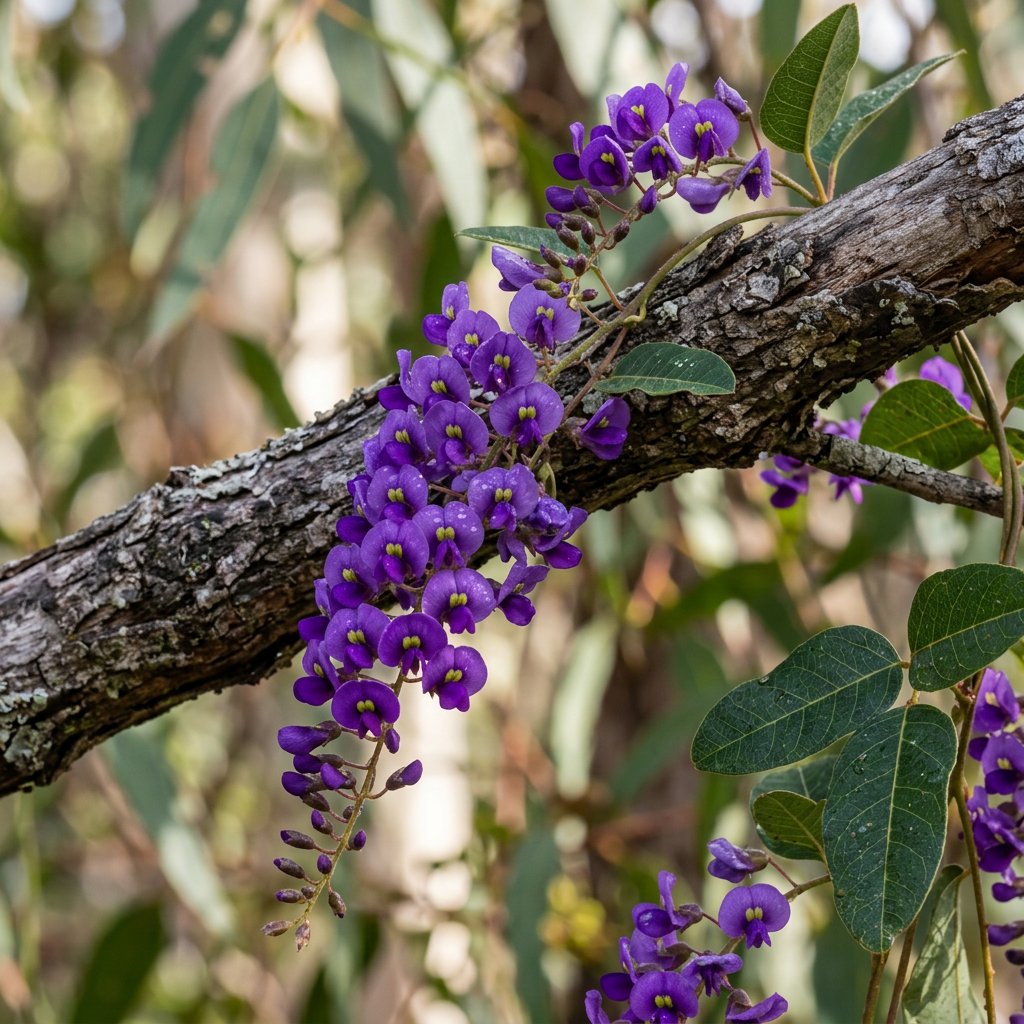
Plant Overview
Known affectionately as the "Happy Wanderer" or "False Sarsaparilla," this Australian native is a vibrant climber that signals the transition from winter to spring with an explosion of color. It is celebrated for its ability to transform a drab fence or trellis into a cascading curtain of deep violet. Despite its delicate, pea-like appearance, it is a rugged survivor, embodying the resilient spirit of the Australian bush.
🔍 How to Identify
- 💜 The Blooms: Small, classic pea-shaped flowers that grow in dense, drooping clusters (racemes). While typically a rich violet-purple, they often feature a tiny neon-yellow or green "eye" at the center.
- 🍃 The Foliage: Leathery, dark green leaves that are long and narrow (lance-shaped). They have a distinct, slightly net-like vein pattern that remains attractive even when the plant isn't flowering.
- 🧗 The Habit: A vigorous twining climber that uses its stems to wrap around supports. If no support is provided, it will happily act as a dense, mounding groundcover.
🏡 In Your Garden
- 🧱 Structural Support: The "Happy Wanderer" lives up to its name and needs a firm hand. It doesn't have tendrils, so it requires a trellis, wire, or fence to "twine" its woody stems around.
- ☀️ Sun & Drainage: To get that signature carpet of purple, find the sunniest spot possible. It is highly sensitive to "wet feet," so ensuring your soil is sandy or well-draining is more important than regular watering.
- ✂️ Post-Bloom Pruning: This plant can become "leggy" or woody over time. Pruning it back significantly right after the flowers fade encourages fresh, lush growth and a more compact shape for the following season.
⚠️ Safety & Toxicity
- ✅ Status: Generally considered non-toxic and safe for home gardens.
- 🐾 Details: While not listed as a high-risk plant for pets or children, any plant material can cause mild stomach upset if ingested in large quantities. It is always best to discourage curious pets from snacking on the leathery leaves.
✨ Fun Fact
The nickname "False Sarsaparilla" isn't just for show—early European settlers in Australia actually used the roots of this plant as a substitute for sarsaparilla to create a medicinal, tea-like tonic!

Detailed Care Instructions
| Color | Green Stems And Leaves With Purple To Mauve Blooms |
| Soil Ph | 5.5-6.0 |
| Lighting | Full Sun |
| Toxicity | Toxic |
| Soil Type | Well-Draining, Loam, Sand |
| Bloom Time | Winter To Spring |
| Plant Type | Climbing Subshrub |
| Mature Size | Up To 8 Feet Tall And 3 Feet Wide |
| Native Area | Australia |
| Sun Exposure | Full Sun To Partial Shade |
| Hardiness Zones | 9-11 |
To successfully grow Hardenbergia Violacea, also known as the Happy Wanderer or Purple Coral Pea, follow these steps:
- Select a suitable location: Hardenbergia Violacea thrives in well-drained soil and full sun or partial shade. Choose a spot with good air circulation.
- Prepare the soil: Hardenbergia prefers moderate fertility, so mix organic compost or well-rotted manure into the soil before planting to improve drainage and promote healthy growth.
- Planting: Hardenbergia can be grown from seeds or propagated from cuttings. If starting from seeds, sow them 1/4 inch deep in the prepared soil during spring. Transplant the seedlings when they are about 4-6 inches tall. If using cuttings, take 4-6 inch long cuttings from a healthy plant, strip off the lower leaves, and plant them in a well-draining potting mix.
- Watering: Hardenbergia prefers regular watering to keep the soil consistently moist, but not waterlogged. Deep watering once a week should be sufficient, but adjust according to the soil and weather conditions. During hotter months, increase watering frequency.
- Mulching: Apply a layer of organic mulch around the base of the plant to help retain moisture and suppress weed growth. This will also keep the roots cool during hot weather.
- Support: Hardenbergia is a climbing plant, so provide a sturdy trellis or support structure for the vine to grow upon. Regularly train the plant to climb up the support to prevent it from sprawling on the ground.
- Pruning: Prune Hardenbergia after the flowering season ends, usually in late spring or early summer, to remove any dead or damaged growth and to maintain the desired shape. You can trim back the tips to encourage bushier growth.
- Fertilizing: Feed Hardenbergia with a balanced, slow-release fertilizer in early spring and again in late summer. Follow the manufacturer's instructions for application rates.
- Pest and Disease Control: Hardenbergia is generally resistant to pests and diseases but can occasionally be affected by aphids, caterpillars, or powdery mildew. Treat any infestations with appropriate organic or chemical treatments as needed.
- Propagation: If you want to propagate more Hardenbergia plants, take semi-hardwood cuttings in early summer. Dip the cut ends in rooting hormone and plant in a well-draining potting mix. Keep the cuttings in a warm, humid environment until they develop roots.
Remember to regularly monitor the plant's health and adjust watering, fertilizing, and care practices accordingly. With proper care, Hardenbergia Violacea can provide a beautiful display of purple flowers on a climbing vine.

Place in a bright room that is sun drenched almost all day. Or directly in a south-facing window.

To water this plant, you should first check the soil to make sure it is dry to the touch before watering. Use a watering can or hose to water the soil around the base of the plant, being careful not to get water on the leaves or flowers. Water deeply enough so that the water reaches the root system, but do not overwater as this can lead to root rot. It is recommended to water this plant once per week or more frequently during hot, dry weather.
Hardenbergia Violacea prefers a well-draining soil with a slightly acidic pH between 6.0 and 7.0. Fertilize with a balanced fertilizer in the spring and summer months, ensuring that the nitrogen content is no higher than the other two macronutrients. Slow-release fertilizers or organic blends are best, as they provide a steady source of nutrients over time. Always follow the package instructions and avoid over-fertilizing, as this can lead to nutrient burn and damage to the plant's roots.
Hardenbergia Violacea requires well-draining soil that is rich in organic matter and nutrients. The ideal soil should have a pH between 6.5 and 7.5, should be loamy or sandy in texture, and should not be compacted. The soil should ideally be amended with organic matter such as compost or well-rotted manure to improve drainage and to add nutrients to the soil. It is important to avoid using heavy, clay soils that can become waterlogged and cause root rot. Additionally, the plant prefers a soil that is slightly acidic to neutral, so alkaline soils should be avoided if possible.
To propagate this plant, first select a healthy stem cutting from a mature plant. Make a clean cut at a 45-degree angle using sharp, sterile pruning shears. Remove any leaves from the lower half of the stem.
Next, dip the cut end of the stem into rooting hormone powder to promote root growth. Plant the stem cutting in a pot filled with well-draining soil. Water the soil lightly, being careful not to over-water.
Place the pot in a warm and bright location, but not in direct sunlight. Keep the soil moist but not waterlogged.
After several weeks, the stem cutting should begin to form roots. You can gently tug on the stem to check for resistance, which indicates that the roots are growing.
Once the plant has established a good root system, it can be transplanted into a larger pot or directly into the ground.
Common pests of the coral-pea include Larvae. Make a habit of checking your coral-pea frequently for pests so that any infestations can be caught and managed early.








