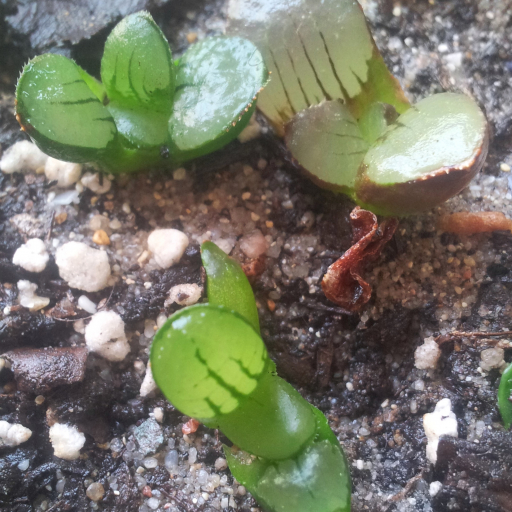
Plant Overview
Known as the "King of Retuse Haworthias," the Haworthia springbokvlakensis is a true crown jewel of the succulent world. Named after the vast Springbok Flats (Springbokvlakte) in South Africa, this plant looks more like a polished gemstone or a piece of frosted sea glass than a living organism. It is highly prized by collectors for its incredibly clear "windows" and its extremely slow, deliberate pace of life.
🔍 How to Identify
- 🪟 Crystal Windows: The top surface of each leaf is a translucent "window" designed to let sunlight reach deep into the plant's body while it stays buried in the soil.
- 🎨 Intricate Veining: Look for delicate, silvery-white or dark green lines etched across the windows, which often resemble frozen lightning or a topographical map.
- 🌑 Rounded Rosette: Unlike its pointier cousins, this Haworthia has very rounded, convex leaf tips that form a tight, solitary rosette that rarely produces "pups."
🏡 In Your Garden
- 🏜️ Mineral Soil is Key: This species is a specialist that "hates" wet feet. It thrives in very gritty, inorganic soil (think pumice and lava rock) because its thick roots are prone to rot if kept in standard potting mix.
- ⛅ The Goldilocks Light: In its natural habitat, it hides under the shade of desert shrubs. In your home, it needs bright, filtered light. Too much sun will turn the windows a stressed reddish-brown, while too little will make the plant "stretch" and lose its compact beauty.
- ⏳ Patience Required: Do not expect rapid results! This is a slow-motion grower that can take years to reach its full 3-to-4-inch diameter. Because it rarely offsets, it is usually grown from seed, making it a rare find in big-box nurseries.
⚠️ Safety & Toxicity
- 🐾 Pet Friendly: Like most members of the Haworthia genus, this plant is considered non-toxic to cats, dogs, and humans.
- 🌵 Delicate Roots: While not poisonous, the plant is physically sensitive. It has a heavy, succulent root system that can be easily damaged during transplanting, so it’s best to leave it in the same pot for several years.
✨ Fun Fact
In the wild, these plants are "cryptic" masters of disguise. During the dry season, the plant actually retracts into the ground, pulling itself down so that only the very tops of its windows are level with the soil, hiding it from hungry animals and the scorching sun!

Detailed Care Instructions

Place in a window with dappled sun or a spot in the middle of a room. Or directly in a window facing west or east.

When the top few inches of soil dry out, water your plants. If the top few inches of soil are still moist, do not water your plant. Wait a few days, then poke your finger into the soil to see if anything has changed. Overwatering poses a disease risk, such as the development of fungal diseases in the roots. These plants have adaptations in there leaves that allow them to survive in low water supply.
These plants can thrive without taking help from any fertilizer. However, if the medium of growth is something other than soil for instance sand then you may need to add little fertilizer. The best way to know if your plants need fertilizer or not is to check for yellowing of leaves. If the leaves start to turn yellow it’s fertilizing time.
You may use All Purpose Plant Food or Green Plant Food for your Haworthia 'Springbokvlakensis'
Common pests of the haworthia 'springbokvlakensis' include Mealybugs, thrips. Make a habit of checking your haworthia 'springbokvlakensis' frequently for pests so that any infestations can be caught and managed early.








