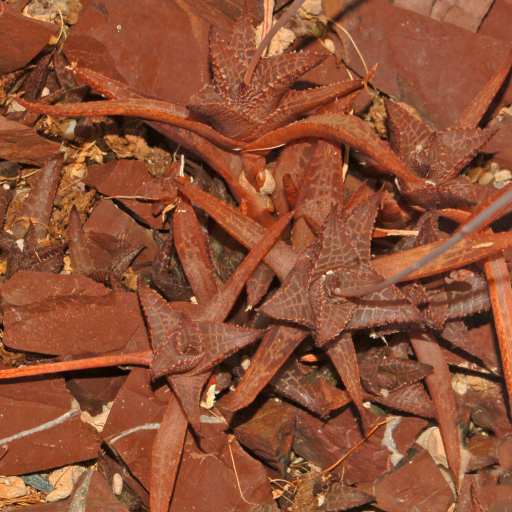
Plant Overview
Often called the "Veined Haworthia" or the "Star Window Plant," this architectural succulent looks like it was designed by a mathematician. Native to the arid regions of Southern Africa, it is a master of camouflage, blending into rocky crevices with its dark, mosaic-patterned leaves. Its rugged beauty and extreme resilience make it a favorite for "forgetful" gardeners who want a plant with a prehistoric edge.
🔍 How to Identify
- 📐 Geometric Patterns: The upper leaf surface features a striking translucent grid of pale lines against a dark olive or brownish-green background, resembling a mosaic or stained-glass window.
- 🦎 Reptilian Texture: The leaves are thick, triangular, and recurved (curving backward), with a firm, slightly rough texture that feels like lizard skin.
- 🦷 Jagged Edges: Look closely at the leaf margins; they are often lined with tiny, white, saw-like teeth that add to its rugged, desert-hardy appearance.
🏡 In Your Garden
- 🧊 Underground Runners: Unlike many succulents that grow "pups" right at the base, this species sends out underground stolons. You might find a baby plant popping up an inch or two away from the mother in the same pot!
- 🌥️ Light Adaptability: Because it naturally grows under the shade of desert shrubs, it handles indoor light better than most succulents. However, if it turns a deep reddish-bronze, it’s telling you it’s getting a "sun tan" from high light intensity.
- 💧 Drought Strategy: Its thick leaves are essentially water storage tanks. If the plant looks like it is shrinking or the leaves are curling inward, it is simply using its reserves; a small drink will plump it back up within days.
⚠️ Safety & Toxicity
- 🐾 Pet Friendly: Great news for animal lovers! This species is generally considered non-toxic to cats and dogs, making it a safe choice for a low-level coffee table or shelf.
- 👶 Child Safe: While the leaf edges are a bit "toothy," they aren't sharp enough to draw blood, and the plant contains no known irritants for humans.
✨ Fun Fact
The name Tessellata comes from the Latin word "tessella," which refers to the small square tiles used to create ancient Roman mosaics—a perfect description of the checkered pattern on its leaves!

Detailed Care Instructions
To grow a Haworthia Tessellata plant, you can follow these steps:
- Choose a suitable container: Select a small pot with drainage holes at the bottom to ensure proper water drainage and prevent root rot.
- Soil: Use a well-draining cactus or succulent potting mix. You can also make your own by mixing equal parts of regular potting soil, perlite, and sand.
- Planting: Gently remove the plant from its existing container and place it in the new pot. Ensure that the plant sits at the same depth as it did in the previous pot. Avoid burying the leaves in the soil.
- Light: Place the pot in a spot with bright, indirect sunlight. Haworthia plants thrive in bright but filtered light. Avoid exposing them to direct sunlight as it can burn the leaves.
- Watering: Haworthias are succulent plants and have low water requirements. Water the plant when the top 1-2 inches of soil feel dry. During summer, water approximately once every two weeks, and during winter, reduce watering to once every 3-4 weeks.
- Temperature and Humidity: Haworthias prefer temperatures between 65-80°F (18-26°C). They can tolerate lower temperatures but not below 50°F (10°C). They also prefer low to moderate humidity levels.
- Fertilizer: Use a balanced, water-soluble fertilizer formulated specifically for succulents or cacti. Dilute the fertilizer to half strength and apply it once every 2-3 months during the growing season (spring and summer).
- Repotting: Haworthias have a slow growth rate and generally don't require frequent repotting. However, if the plant becomes root-bound or the soil becomes compacted, repot it in a slightly larger pot with fresh soil.
- Propagation: Haworthias can be propagated through offsets, which are small baby plants that grow at the base of the parent plant. Gently separate the offset from the parent plant and plant it in a separate pot. Allow the newly planted offset to establish root before watering.
By following these steps, you can successfully grow and care for a Haworthia Tessellata plant.

Place in a window with dappled sun or a spot in the middle of a room. Or directly in a window facing west or east.

Haworthia Tessellata plant belongs to the genus Haworthia and is a type of succulent plant that requires infrequent watering. As a general rule, you should only provide water when the soil is completely dry. To do this, test the moisture levels of the soil by lightly pressing your finger into the soil. If it feels dry to the touch, it’s time to water your plant.
When watering, be sure to use room temperature water and avoid using cold water as it can shock the roots of the plant. Water the plant gently, making sure to only water the soil and avoid getting water on the leaves or stem of the plant. It’s best to water in the morning or early evening when the temperature and sunlight levels are lower.
To prevent overwatering, make sure that the pot has proper drainage and avoid letting the plant sit in standing water. Succulent plants are well adapted to dry and arid conditions, and too much water can cause the roots to rot and the plant to die.
In addition to proper watering, Haworthia Tessellata plants thrive in bright, indirect sunlight and well-draining soil. Fertilize the plant once a month during the growing season with half-strength, balanced fertilizer to provide essential nutrients. With proper care and attention, your Haworthia Tessellata plant can thrive and grow into a beautiful, healthy plant.
To fertilize the Haworthia Tessellata plant, use a balanced fertilizer with an NPK ratio of 10-10-10 once a month during the growing season (spring and summer). Dilute the fertilizer solution to half strength. Water the plant thoroughly before applying the fertilizer to avoid burning the roots. Apply the fertilizer solution evenly around the base of the plant. Do not fertilize during the dormant season (fall and winter) as the plant is not actively growing and does not need as many nutrients.
The optimal soil for Haworthia Tessellata plant should be well-draining and fertile. It should have a pH level between 6.0-7.5 and a texture that allows for air circulation and water retention. The soil should contain a mixture of organic and inorganic materials, such as sand, perlite, peat moss, and compost. It is important to avoid using heavy clay soils or soils with high levels of salts or fertilizers, as this can damage the plant's roots and inhibit growth. Additionally, it is recommended to add a layer of mulch to the surface of the soil to help retain moisture and control weeds.
To propagate this plant, first you will need to find a mature plant with healthy, established roots. Using a clean, sharp knife or scissors, carefully remove a small offset or division from the parent plant. Ensure that there is a portion of the stem attached to the offset, and that it has its own roots.
Next, prepare a well-draining potting mix in a small pot or container. You can use a mix of cactus soil, sand, and perlite for this purpose. Moisten the soil and create a small hole in the center to place the offset in.
Place the offset in the soil, covering the roots and the base of the stem. Gently press the soil around the plant to anchor it in place. Water lightly and place the pot in a bright, but indirect light location.
Keep the soil moist but not too wet, as the plant may rot if over-watered. Within a few weeks, the plant should begin to establish roots and may also produce new growth. After a few months, you can transplant the propagated plant into a larger pot or even container garden, as it grows and thrives.
Common pests of the window haworthia include Mealybugs, thrips. Make a habit of checking your window haworthia frequently for pests so that any infestations can be caught and managed early.








