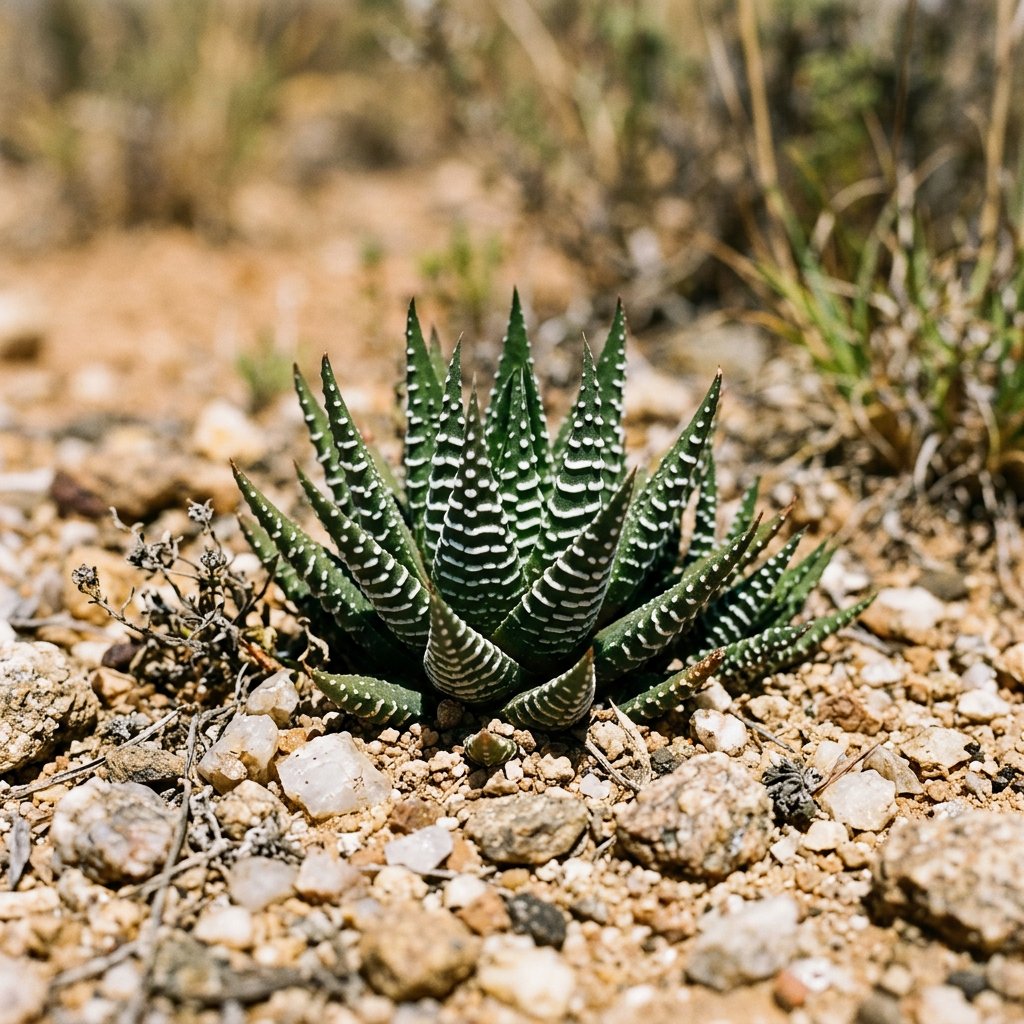
Plant Overview
Known as "Zebra Plants" or "Window Succulents," Haworthias are the tiny, rugged jewels of the succulent world. Native to the rocky landscapes of South Africa, these resilient plants have evolved to survive in the shade of larger bushes, making them one of the few succulents that truly thrive in indoor environments. Their architectural shapes and intricate patterns make them a favorite for desktop gardens and terrariums.
🔍 How to Identify
- 🦓 The Foliage: Most species feature thick, fleshy leaves arranged in a tight rosette. Depending on the variety, these can be pointed and upright or rounded and translucent.
- ⚪ The Tubercles: A signature trait of many Haworthias (like H. attenuata) is the presence of white, raised pearly bumps or "stripes" that feel like sandpaper to the touch.
- 🪟 Leaf Windows: "Windowed" varieties have specialized translucent tips that allow sunlight to penetrate deep into the body of the leaf for photosynthesis.
🏡 In Your Garden
- ☀️ Light Nuance: Unlike their desert-dwelling cousins, Haworthias are sensitive to intense, direct midday sun, which can cause them to turn a stressed reddish-brown. They prefer "bright indirect" light, making them perfect for east or west-facing windowsills.
- 🪴 The Taproot: These plants grow thick, fleshy roots that store water. Because of this, they require very gritty, fast-draining soil. They are prone to root rot if left in standing water, so it is always better to underwater than to overwater.
- 👶 Clumping Habit: Haworthias are "social" growers. Over time, they produce "pups" or offsets around the base, eventually filling a pot with a beautiful colony of miniature stars.
⚠️ Safety & Toxicity
- 🐾 Pet Safe: Haworthias are generally considered non-toxic to cats, dogs, and horses. They are an excellent "worry-free" choice for households with curious nibblers.
- 🌵 Physical Touch: While not venomous or toxic, the pointed tips of some varieties can be quite sharp. Handle with care during repotting to avoid minor skin pricks.
✨ Fun Fact
In their native South African habitat, "windowed" Haworthias often grow almost entirely buried underground during droughts. Only the clear, translucent tips of their leaves peek above the soil, acting like biological fiber optics to funnel light down to the rest of the plant buried in the cool earth.

Detailed Care Instructions
| Color | White |
| Soil Ph | 6.6 To 7.5 |
| Humidity | Dry |
| Lighting | Full Sun |
| Toxicity | Non-Toxic |
| Soil Type | Sandy |
| Bloom Time | Summer |
| Difficulty | Medium |
| Plant Type | Succulent |
| Hibernation | Warm Period |
| Mature Size | Varies By Species, 3 To 5 Inches, Up To 20 Inches |
| Native Area | Southern Africa |
| Temperature | 15°C - 30°C |
| Sun Exposure | Part Sun |
| Hardiness Zones | 11 |
To grow a Haworthia plant, follow these steps:
- Choose the right location: Haworthia plants prefer bright, indirect light. Place them near a window where they can receive plenty of filtered sunlight. Avoid direct exposure to intense afternoon sunlight.
- Use well-draining soil: Haworthia plants require well-draining soil to prevent root rot. Ensure the pot has drainage holes and use a cactus or succulent soil mix, or a combination of potting soil, perlite, and sand.
- Watering: Haworthia plants are drought-tolerant and should be watered sparingly. Wait for the soil to completely dry out between waterings. Overwatering can lead to root rot, so it's better to underwater and gradually increase watering frequency if needed.
- Humidity: Haworthias prefer low to moderate humidity levels. They can tolerate dry indoor conditions, but occasional misting can help provide some moisture if the air is too dry.
- Temperature: Haworthia plants thrive in average room temperatures ranging from 65-80°F (18-27°C). Protect them from extreme temperatures and drafts.
- Fertilization: Haworthias are not heavy feeders and can survive without frequent fertilization. However, you can provide a diluted succulent fertilizer once or twice during the growing season (spring and summer).
- Repotting: As the Haworthia plant outgrows its current pot, you can repot it into a slightly larger container. Repotting is typically done every 2-3 years. Use fresh, well-draining soil and handle the plant gently during the process.
- Propagation: Haworthias can be propagated through offsets or leaf cuttings. To propagate an offset, wait until it has developed roots and a small rosette of leaves, then carefully separate it from the parent plant. For leaf cuttings, take a healthy leaf, let it dry out for a day or two, and then place it on top of slightly moist soil. New plants will grow from the base of the leaf after a few weeks.
- Pests and diseases: Haworthias are generally resistant to pests and diseases. However, they may occasionally be susceptible to mealybugs or spider mites. Inspect the plant regularly and treat any pests promptly using an appropriate insecticidal soap or neem oil.
Remember to research and understand the specific care requirements of the particular Haworthia species you have, as care can differ slightly between varieties.

Place in a bright room that is sun drenched almost all day. Or directly in a south-facing window.

Watering this type of plant requires attention to detail and proper technique. Start by moistening the soil without soaking it completely, being sure to avoid getting water on the leaves or stem. Use a watering can or gentle stream of water to slowly saturate the soil until it is damp but not soggy. Allow the water to drain freely, ensuring that no excess water remains in the pot. It is important to water this plant only when the soil has completely dried out, as overwatering can cause root rot and other issues. In addition, it is best to use distilled or filtered water to avoid hard water build-up and other mineral imbalances. With proper care and attention, this type of plant can thrive and add beauty to any indoor or outdoor space.
To fertilize this plant, use a well-balanced fertilizer with equal parts nitrogen, phosphorus, and potassium. Apply the fertilizer once every month during the growing season (spring and summer). Dilute the fertilizer to half of its recommended strength and apply it to the soil around the base of the plant. Water the plant thoroughly afterwards to help distribute the fertilizer. Avoid fertilizing the plant during the dormant season (fall and winter).
When choosing soil for Haworthia, it is important to select a medium that provides adequate drainage and air circulation. The ideal soil should be well-draining and porous, allowing excess water to escape quickly to prevent root rot. A mix of coarse sand, perlite, and peat moss is often recommended, to create an airy, lightweight mixture that promotes healthy root development. Additionally, it is important to avoid using soil mixes that are overly rich or dense, as these can lead to waterlogged roots and other issues. When selecting a soil mix for Haworthia, it is also important to consider the plant's natural habitat and growing conditions, as this can guide your selection of appropriate ingredients and ensure optimal plant health.
Haworthia plants can be propagated by using offsets or by leaf cuttings.
To propagate using offsets, select a healthy plant with multiple offsets, and remove the offsets with a clean, sharp knife. Leave the offsets to dry for a few days, and then plant them in a potting mix suitable for succulent plants. Water the new plants lightly, and provide them with bright, indirect light to help them establish roots.
To propagate using leaf cuttings, select a healthy leaf and remove it from the plant with a clean, sharp knife. Be sure to remove the entire leaf, including its base. Allow the leaf to dry out for a few days, and then plant it in a potting mix suitable for succulent plants. Water the cutting sparingly, and provide it with bright, indirect light.
Both methods of propagation should result in new plants that will grow into mature Haworthia plants with proper care.
Common pests of the haworthias include Mealybugs, thrips. Make a habit of checking your haworthias frequently for pests so that any infestations can be caught and managed early.







