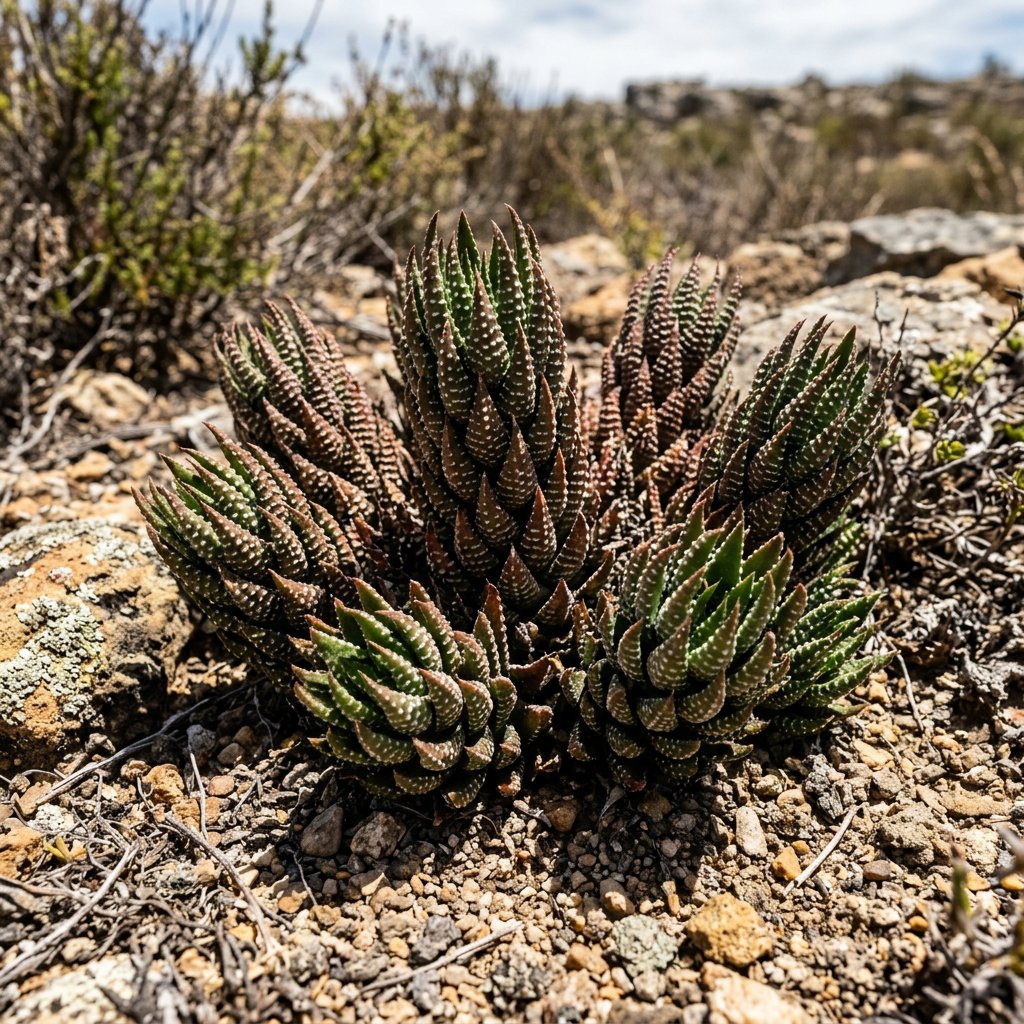
Plant Overview
Often called the "Crowded Haworthia," this South African succulent looks like a series of tiny, scaly towers rising from the desert floor. Unlike many of its flat-rosette cousins, it grows upward in a columnar fashion, creating a dramatic architectural look for any succulent collection. It is a slow-growing, resilient survivor that has mastered the art of living in rocky crevices under the harsh Cape Province sun.
🔍 How to Identify
- 🌿 Columnar Growth: Unlike the flat "star" shapes of other Haworthias, this species grows into tall, upright stems that can reach up to 8 inches, often clumping together at the base to form a mini forest.
- 🐚 Leaf Texture: The dark green leaves are thick, fleshy, and curve inward. They are covered in small, raised white "warts" or tubercles that feel like tiny pearls under your fingertips.
- 🎨 Sun Stressing: While naturally deep green, the plant acts like a mood ring; when exposed to bright light or cold, the foliage shifts into beautiful shades of bronze, copper, or deep purple.
🏡 In Your Garden
- 🪴 The "Snug" Factor: These plants actually enjoy being slightly root-bound. If you provide a pot that is too large, the excess soil holds onto moisture longer than the plant can drink, which often leads to root rot.
- 🌤️ Light Nuance: Its inward-curving leaves are a natural defense mechanism against the sun. If the leaves start closing tighter like a fist, the plant is protecting its core from too much light. If the stem begins to "stretch" and show pale green gaps between leaves, it is hungry for more sunshine.
⚠️ Safety & Toxicity
- 🐾 Pet Friendly: Good news for animal lovers! Haworthiopsis coarctata is considered non-toxic to cats, dogs, and horses.
- 👶 Child Safe: Because it lacks the sharp, needle-like spines found on many cacti and doesn't produce irritating sap, it is an excellent "first plant" for a child’s windowsill.
✨ Fun Fact
The name coarctata is Latin for "crowded" or "pressed together," perfectly describing how the leaves hug the central stem. For decades, it was classified under the genus Haworthia, but botanists recently moved it to Haworthiopsis because its leaves are tougher and more "leathery" than those of its softer-leaved relatives!

Detailed Care Instructions
To grow Haworthiopsis coarctata plants, follow these steps:
- Choose a suitable pot: Select a small, well-draining pot with drainage holes. The pot should be slightly larger than the size of the plant.
- Soil mix: Use a well-draining succulent or cactus potting mix. You can also mix regular potting soil with perlite or pumice to improve drainage.
- Planting: Place a layer of small rocks or gravel at the bottom of the pot for additional drainage. Gently remove the plant from its nursery container and place it in the prepared pot. Make sure the roots are spread out evenly, and the plant is centered.
- Light: Haworthiopsis coarctata requires bright, indirect light. Place the plant near a window with filtered sunlight, or you can even grow it under artificial grow lights if natural light is limited.
- Temperature and humidity: These plants thrive in average room temperatures of 65-80°F (18-27°C). They prefer low to moderate humidity levels. Avoid sudden temperature fluctuations and drafty areas.
- Watering: Allow the soil to dry completely between watering the plant. Water sparingly, only when the top 1-2 inches of soil are dry. Be cautious not to overwater, as it can lead to root rot.
- Fertilizing: Haworthiopsis coarctata does not require frequent fertilizing. You can use a diluted, balanced houseplant fertilizer once or twice a year during the growing season (spring and summer).
- Propagation: These plants can be propagated through offsets or leaf cuttings. To propagate offsets, gently remove the small plants that develop around the base of the mother plant and plant them individually. For leaf cuttings, carefully remove a healthy leaf and allow it to dry for a day or two before placing it on a well-draining soil mix until roots develop.
- Pruning: Trim off any dead or damaged leaves using clean and sterile pruning shears. This will help maintain the appearance and health of the plant.
- Pests and diseases: Haworthiopsis coarctata is relatively resistant to pests and diseases. However, keep an eye out for common succulent pests like mealybugs and scale insects. Treat the infestation with appropriate organic insecticide or by wiping the pests off with a cotton swab dipped in alcohol.
Remember to research and cater to the specific needs of your particular Haworthiopsis coarctata plant, as care requirements may vary slightly between individual specimens.

Place in a window with dappled sun or a spot in the middle of a room. Or directly in a window facing west or east.

To water this plant, begin by checking the soil to ensure it has dried out completely before watering it again. When the soil is dry, thoroughly water the plant, allowing excess water to drain out of the bottom of the pot. Avoid getting water on the leaves or crown of the plant, as this can cause rot or other damage. During the winter months when the plant is dormant, reduce watering frequency to prevent overwatering.
To properly fertilize this plant, use a balanced fertilizer with equal amounts of nitrogen, phosphorus, and potassium. Dilute the fertilizer to half strength and apply it once a month during the growing season, which is typically from spring to summer. Be sure to water the plant thoroughly before fertilizing and avoid getting the fertilizer on the leaves or stem to prevent burning the plant. Additionally, do not fertilize during the plant's dormant season, which is typically in the fall and winter.
Haworthiopsis Coarctata is a type of succulent plant that requires well-draining soil for optimal growth. The ideal soil mixture should be a combination of peat moss, coarse sand, and perlite to ensure good drainage and prevent water from accumulating around the roots. The soil should also contain adequate amounts of nutrients to support the plant's growth. It is recommended to use a cactus or succulent soil mix, which is specially formulated for these types of plants. When planting Haworthiopsis Coarctata, it is important to ensure that the soil pH is neutral to slightly acidic, which will enable the plant to absorb nutrients effectively. The soil should also be free of pests and diseases to prevent them from affecting the plant's growth. Regular soil amendment with organic matter can improve the soil quality over time, providing the plant with the necessary nutrients for healthy growth.
To propagate this plant, you need to take a cutting of a healthy stem. Use clean and sharp pruning shears, cut a few inches-long stem from the mother plant, making sure that the cut is at a 45-degree angle. Allow the cutting to dry for a day or two in a shaded, dry area until a callus forms over the cut end.
Fill a small pot or container with well-draining cactus or succulent soil mix. Make a small hole in the center of the soil and place the callused end of the cutting in the hole. Gently press the soil around the base of the cutting to support it.
Water the soil lightly, just enough to moisten it, and place the pot in a well-lit area, but not in direct sunlight. Ensure that the soil stays moist, but not waterlogged, until the plant has established a root system.
In a few weeks, the cutting should begin to root and show signs of growth. After a few months, the new plant can be transferred to a larger pot or planted in the garden.
Common pests of the cowhorn haworthia include Mealybugs, thrips. Make a habit of checking your cowhorn haworthia frequently for pests so that any infestations can be caught and managed early.








