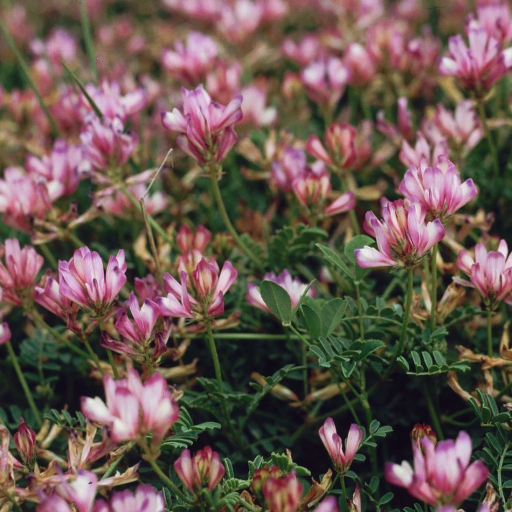
Plant Overview
Commonly known as the Spiny Sweetvetch or "Hedgehog Vetch," this resilient Mediterranean native is a master of survival in harsh, rocky terrains. Unlike its taller cousins in the pea family, it stays low to the ground, hugging the sun-drenched cliffs of North Africa and Southern Europe. Its botanical name, spinosissimum, is a literal warning—meaning "most spiny"—referring to its uniquely prickly seed pods.
🔍 How to Identify
- 🌸 Pea-Like Blooms: It produces delicate, butterfly-shaped flowers that range from pale pink to deep magenta, usually clustered in small groups (racemes) at the end of long stalks.
- 🍃 Silvery Foliage: The leaves are "pinnate," meaning they look like small feathers. They are often covered in fine, silvery hairs that help the plant trap moisture and reflect the intense Mediterranean sun.
- 🦔 Prickly Pods: The most iconic feature is the seed pod. It is a "lomentum" (a pod that breaks into joints) covered in tiny, stiff, hooked prickles designed to hitchhike on the fur of passing animals.
🏡 In Your Garden
- 🏜️ Rocky Resilience: This plant thrives in poor, alkaline soils where other plants struggle. It is an "extremophile" of the garden world, preferring limestone-heavy or sandy substrates that mimic its native coastal cliff origins.
- 🌱 Soil Enrichment: Like most members of the legume family, it possesses a hidden superpower: it works with soil bacteria to pull nitrogen from the air and "fix" it into the ground, naturally fertilizing the soil for its neighbors.
⚠️ Safety & Toxicity
- 🟢 Generally Safe: There are no widespread reports of chemical toxicity for Hedysarum spinosissimum regarding humans or common household pets.
- 🌵 Mechanical Irritation: While not poisonous, the "spinosissimum" part of its name is no joke. The dried seed pods are very sharp and can cause skin irritation or get painfully stuck in a pet's fur. It is best to wear gloves when clearing away old growth.
✨ Fun Fact
The genus name Hedysarum comes from the Greek words hedys (sweet) and aroma (smell). While this specific spiny variety isn't the most fragrant of the bunch, it is a close relative of plants once grown specifically to create "sweet-scented" honey for ancient Mediterranean civilizations!

Detailed Care Instructions

Place in a bright room that is sun drenched almost all day. Or directly in a south-facing window.

Hedysarum spinosissimum is a plant that requires careful attention when it comes to watering. The plant should be watered deeply but infrequently, taking care not to let the soil become too wet or too dry. This can be achieved by giving the plant a good soaking every few days rather than a light watering every day. It is important to monitor the moisture content of the soil by checking the top inch or two, as this will give a good indication of whether the plant needs watering. In addition, it is important to avoid standing water around the roots, as this can lead to root rot and other problems. It is also best to avoid overhead watering, as this can increase the risk of fungal diseases. Instead, consider using a drip irrigation system or watering from the base of the plant. Overall, the key to watering Hedysarum spinosissimum is to find a balance between providing enough moisture for the plant to thrive while avoiding overwatering and other issues.
The ideal soil for this plant should be a well-draining mixture of sand, loam, and organic matter. It should have a pH level of 6.0-7.5 and be enriched with nutrients such as potassium, nitrogen, and phosphorus. The soil should also be fertile, moist, and not waterlogged. The plant thrives best in full sun to partial shade and can tolerate various soil types, including clay and rocky soil. It is necessary to avoid the use of soil that is too compacted or heavy, as this can hinder root growth and lead to drainage problems. The addition of organic matter such as compost or leaf mould can help to improve soil structure and fertility.








