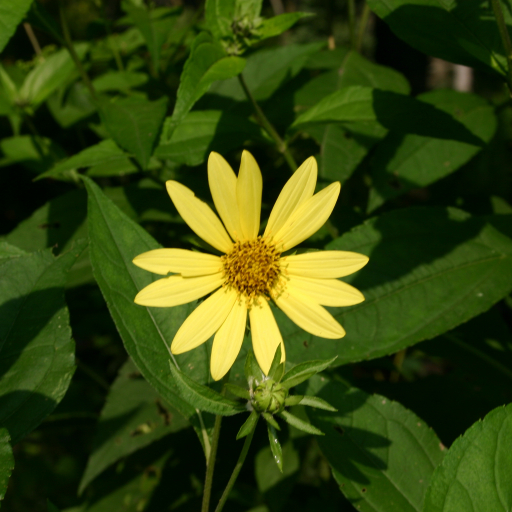
Plant Overview
Often called the Showy Sunflower or the Cheerful Sunflower, this plant is the charismatic "love child" of the botanical world—a natural hybrid between the Stiff Sunflower and the Jerusalem Artichoke. It is beloved by gardeners for its ability to produce an explosion of golden blooms late in the season when other plants are beginning to fade. In folklore, sunflowers are often seen as symbols of loyalty and longevity, and this perennial variety lives up to that reputation by returning year after year with more vigor than the last.
🔍 How to Identify
- 🌻 The Blooms: Features classic sunflower heads about 3-4 inches wide, consisting of bright golden-yellow "petals" (ray florets) surrounding a slightly darker yellow-to-brown central disc.
- 🌿 The Foliage: The leaves are notably rough to the touch, almost like sandpaper, with a lance-like shape and prominent veins. They usually grow in opposite pairs along the lower stem.
- 📏 The Stems: These are stout, stiff, and often tinged with a reddish-purple hue, covered in tiny bristly hairs that help the plant stand tall without much support.
🏡 In Your Garden
- 🏃♂️ The Great Spreader: Unlike the common annual sunflower, this hybrid is a perennial that spreads via underground rhizomes. Give it plenty of "elbow room," or it might decide to take over your entire flower bed!
- 🐝 Pollinator Party: This plant is a high-traffic hub for native bees, butterflies, and even late-season hummingbirds. Because it blooms in late summer and autumn, it provides a vital nectar source when other food is scarce.
- 💪 Resilient Roots: It is remarkably drought-tolerant once established. It prefers "lean" soil—if you feed it too much fertilizer, it may grow too tall and floppy, requiring you to stake it up.
⚠️ Safety & Toxicity
- ✅ Pet & Human Safe: Helianthus × laetiflorus is generally considered non-toxic to dogs, cats, and humans. It is a safe choice for family-friendly landscapes.
- 🧤 Skin Sensitivity: Because the stems and leaves are covered in stiff, bristly hairs, some gardeners may experience mild skin irritation (contact dermatitis) after handling the plant. Wearing gloves during pruning is recommended.
✨ Fun Fact
Because this plant is a hybrid, it is often "naturally sterile." While it produces beautiful flowers, it rarely produces viable seeds, choosing instead to put all its energy into spreading through its roots to create massive, golden colonies!

Detailed Care Instructions
To grow Helianthus x laetiflorus (commonly known as the Swamp Sunflower), follow these steps:
- Location: Choose a sunny spot for your plant, as it requires at least 6-8 hours of direct sunlight daily. Ensure that the soil is well-draining and fertile.
- Planting: Dig a hole twice as wide and deep as the plant's root ball. Place your helianthus in the hole, making sure the top of the root ball is level with or slightly above the soil surface. Backfill the hole with soil, gently firming it around the roots.
- Watering: Water thoroughly after planting to settle the soil and help the roots establish. Keep the soil consistently moist, particularly during dry spells, but avoid overwatering, which can cause root rot.
- Mulching: Apply a layer of organic mulch around the plant to retain moisture, prevent weed growth, and regulate soil temperature. Leave a small gap between the mulch and the plant's stem to prevent stem rot.
- Fertilizing: Apply a balanced, slow-release fertilizer in spring and early summer to promote vigorous growth. Follow the instructions on the fertilizer package for application rates.
- Pruning: Cut back the plant to about half its height in late spring, just before the new growth begins. This will help maintain its shape and encourage branching, resulting in denser foliage and more flowers.
- Support: If your helianthus becomes tall and starts to lean, provide support by staking it with a strong garden stake or using a plant support ring. This will prevent the plant from flopping over and breaking.
- Pests and Diseases: Monitor your plant regularly for pests like aphids, caterpillars, or powdery mildew. If detected, treat accordingly with insecticidal soap or an appropriate fungicide.
- Division: Every few years, when the plant becomes overcrowded, consider dividing it in early spring or after flowering. Dig up the clump and separate it into smaller sections before replanting. This will help rejuvenate the plant and promote better growth.
By following these steps, you should be able to successfully grow Helianthus x laetiflorus in your garden or landscape. Remember to provide adequate care and enjoy the beautiful yellow flowers it produces!

Place in a bright room that is sun drenched almost all day. Or directly in a south-facing window.

To water this particular species of plant, it is recommended to water deeply but infrequently. Allow the top inch of soil to dry out before watering again. When watering, direct the water towards the base of the plant rather than watering the foliage. Avoid overwatering as this can lead to root rot and other fungal diseases. During periods of drought or high temperatures, the plant may require more frequent watering. It is also important to ensure that the soil has good drainage to prevent waterlogging.
To fertilize this plant, use a balanced, all-purpose fertilizer with equal amounts of nitrogen, phosphorus, and potassium. Apply the fertilizer in the spring and again in midsummer, following the instructions on the package for your specific plant. Avoid over-fertilizing, as it can lead to excessive growth and reduced flowering. Water the plant well after applying fertilizer to help the nutrients reach the roots.
Helianthus x laetiflorus is a plant that requires well-draining, neutral to slightly alkaline soil with a pH between 6.0 and 7.5. The ideal soil type is loamy soil, which contains equal parts of sand, silt, and clay. It prefers a soil that is rich in organic matter, such as compost or well-rotted manure, which will provide the necessary nutrients for the plant's growth. The plant also requires full sun to thrive. It is important to avoid planting the plant in heavy clay soils that retain moisture as this can cause root rot and damage to the plant. Additionally, the plant should not be planted in soil that is too acidic as it will not be able to uptake the necessary nutrients. To improve soil drainage, it is recommended to add perlite or coarse sand to the soil mixture.
To propagate this plant, you can take stem cuttings from the parent plant and root them in a rooting hormone. Make sure to use a sharp, clean blade to make a clean cut at a node where there are leaves. Remove any leaves from the bottom half of the cutting that will be placed in the rooting hormone. Dip the cutting into the rooting hormone and firmly plant it in a well-draining soil mix. Keep the soil moist and place the cutting in a bright but indirect light. After a few weeks, roots should start to form and the new plant can be transplanted into a larger pot or directly into the ground.
Common pests of the perennial sunflower include Spider mites, thrips, whiteflies. Make a habit of checking your perennial sunflower frequently for pests so that any infestations can be caught and managed early.








