Plant Overview
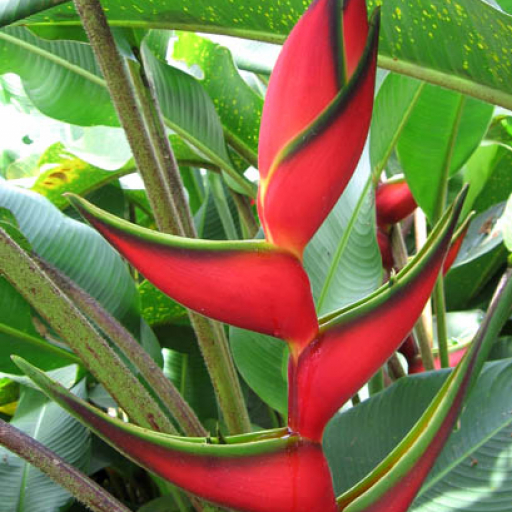
Often called the "Macaw Flower" or "Red Palulu," Heliconia bihai is a flamboyant tropical giant that looks like it stepped straight out of a prehistoric rainforest. Native to the Caribbean and northern South America, this relative of the banana plant is a staple of exotic landscaping, prized for its architectural foliage and gravity-defying, claw-like blooms that stay vibrant for weeks.
🔍 How to Identify
- 🌿 The Foliage: Large, leathery, paddle-shaped leaves that look almost identical to a banana plant, often reaching 3 to 5 feet in length on long, sturdy stalks.
- 🦀 The Bracts: The "flower" is actually a stack of boat-shaped bracts. These are typically fiery red with a thin yellow or green border, arranged in an upright, alternating zig-zag pattern.
- 🌼 The True Flowers: If you peek inside the colorful bracts, you will find the tiny, inconspicuous true flowers, which are usually white or pale yellow and filled with sweet nectar.
🏡 In Your Garden
- 💧 Thirsty Giants: These plants are incredibly "hungry" and "thirsty." Because they grow from thick underground rhizomes, they require consistently moist, nutrient-rich soil to support their heavy, waxy structures.
- ☀️ Shelter from the Storm: While they crave bright light to produce those iconic red claws, their massive leaves are prone to shredding in high winds. They perform best in a "jungle-like" pocket of the garden that offers protection from the breeze.
- ✂️ Pruning Logic: Once a stalk has finished flowering, it will never bloom again. Cutting the spent stalk right down to the soil line isn't just for aesthetics—it signals the plant to send its energy into fresh, new shoots.
⚠️ Safety & Toxicity
- 🐾 Pet Safety: Heliconia bihai is generally considered non-toxic to cats and dogs. However, the fibrous leaves and sap can cause mild digestive upset if a curious pet decides to have a snack.
- 👶 Kid-Friendly: There are no known toxins for humans. However, the flower bracts are very rigid and heavy; in a garden setting, ensure they are staked properly so they don't tip over onto smaller explorers.
✨ Fun Fact
🦜 The Lock and Key: The curve of the Heliconia bihai bloom is perfectly "engineered" to match the beak shape of the Purple-throated Carib hummingbird. They have a specialized relationship where the bird is the plant's primary pollinator, effectively acting as a living "key" to the flower's nectar!

Detailed Care Instructions
| Humidity | Normal |
| Lighting | Part Sun |
| Difficulty | Medium |
| Temperature | 21°C - 28°C |
| Hardiness Zones | 10 - 11 |
To grow a Heliconia Bihai plant, you can follow these steps:
- Climate and location: Heliconia Bihai grows best in tropical or subtropical climates. Choose a location that receives partial shade, as too much direct sunlight can scorch the leaves. Additionally, make sure the planting area has well-drained soil.
- Propagation: Heliconia Bihai can be propagated through seeds or rhizomes. Seeds should be planted in a well-draining potting mix and kept consistently moist until they germinate. Rhizomes can be divided and planted directly into the soil or pots.
- Planting: Dig a hole in the ground or choose a pot large enough to accommodate the size of the plant's root system. Place the rhizome or young plant in the hole, ensuring that the top is level with or slightly above the soil surface. Backfill with soil, gently firming it around the roots.
- Watering: Keep the soil consistently moist but not waterlogged. Water regularly, especially during dry spells or hot weather. Use a watering can or a hose with a gentle spray to avoid damaging the plant.
- Fertilizing: Apply a slow-release fertilizer specifically formulated for tropical plants. Follow the recommended dosage and timing provided on the fertilizer package. Additionally, you can supplement with a liquid fertilizer every two to three weeks during the growing season.
- Mulching: Apply a layer of organic mulch around the base of the plant to retain moisture, suppress weeds, and add nutrients. Good mulch options include dried leaves, wood chips, or compost.
- Pruning: Remove any dead or damaged leaves to maintain the plant's appearance. Cut the stalks just above the soil surface when they have finished blooming or if they become unattractive. New shoots will emerge from the rhizomes.
- Protection: If your climate experiences cold temperatures or frost, provide protection by covering the plant or moving it indoors. Heliconia Bihai is sensitive to cold and can be damaged in temperatures below 50°F (10°C).
- Pests and diseases: Monitor the plant regularly for pests like aphids, mealybugs, or spider mites. If you notice them, treat the plant with an appropriate organic or chemical insecticide. Pay attention to any signs of diseases like leaf spot or root rot and take immediate action to prevent their spread.
By following these steps and providing your Heliconia Bihai plant with proper care, you should be able to see it grow and flourish.

Place in a window with dappled sun or a spot in the middle of a room. Or directly in a window facing west or east.

The best way to water this particular plant is to regularly check the soil for moisture levels and water accordingly. Ensure that the soil is moist but not waterlogged, as Heliconia Bihai plants prefer well-draining soil. You can use a watering can or hose with a gentle flow to provide moisture to the soil around the plant. It's important to avoid watering the leaves or flowers directly, as this can cause damage to the plant and make it more susceptible to disease and pests. Additionally, consider using a fertilizer to provide the plant with additional nutrients, but avoid over-fertilizing which can harm the plant. Overall, monitoring soil moisture and providing gentle, consistent watering will help keep your Heliconia Bihai healthy and thriving.
To fertilize the Heliconia Bihai plant, use a slow-release fertilizer with an N:P:K ratio of 3:1:2. Apply the fertilizer every two to three months during the growing season, starting in spring and ending in autumn. Scatter the fertilizer on the soil's surface and water it in thoroughly. Avoid getting the fertilizer on the foliage, and refrain from over-fertilizing, which can lead to leaf burn.
When it comes to growing Heliconia Bihai plants, the soil type is crucial for healthy growth and development. These plants prefer well-drained soil that is rich in nutrients and organic matter. The ideal pH level of the soil should be slightly acidic to neutral, ranging from 5.5 to 7.0.
When selecting the soil for Heliconia Bihai plants, it is essential to ensure that it can hold moisture without becoming waterlogged. This can be achieved by adding a layer of organic matter such as compost, leaf litter, or well-rotted animal manure to the soil. This will help to improve soil structure and promote healthy root growth.
It is also crucial to avoid using heavy clay soils as they can become compacted, making it difficult for the roots to penetrate and absorb the necessary nutrients and water. Sandy soils, on the other hand, can drain too quickly, resulting in a lack of moisture and nutrients for the plant.
To summarize, the best soil for Heliconia Bihai plants should be a well-drained soil with good moisture retention and moderate nutrient levels. The addition of organic matter can help to improve the soil's structure and provide essential nutrients for healthy growth.
Heliconia Bihai plant can be propagated through division and rhizomes. To propagate through division, the plant should be separated into smaller sections with a sharp, sterile cutting tool. Each section should have several healthy leaves and a few roots. The new sections can be planted in soil and kept in a warm, humid environment until they develop new roots and begin to grow.
To propagate through rhizomes, the plant should be dug up and the rhizomes should be separated. The rhizomes should be cut into sections that are at least 3 inches long and have several new shoots. The new sections can be planted in soil and kept in a warm, humid environment until they develop new roots and begin to grow.
It's important to ensure that the new sections are planted in a suitable location with proper drainage, sufficient sunlight, and regular watering. With proper care and attention, the new plants should grow into healthy, thriving specimens.








