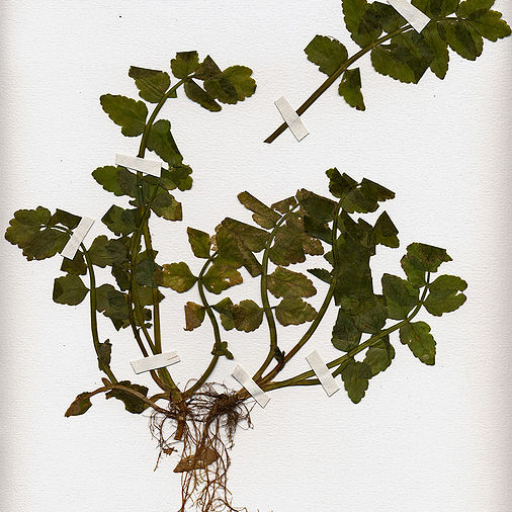
Plant Overview
Known commonly as Fool's Watercress, this semi-aquatic perennial is a master of disguise. It frequently carpets the shallow edges of streams and ditches across Europe and North Africa, looking almost identical to the edible watercress at first glance. While it lacks the peppery bite of its namesake, it plays a vital role in stabilizing muddy banks and providing shelter for small aquatic life.
🔍 How to Identify
- 🌿 Leaf Structure: The leaves are bright green and pinnate, meaning they grow in pairs along a central stalk with one terminal leaflet. They have distinctively toothed edges, which helps distinguish them from some of their smoother relatives.
- 🌼 Clustered Blooms: It produces tiny, star-shaped white flowers arranged in "umbels" (umbrella-like clusters). Unlike many similar plants, these clusters sit very close to the stem or appear stalkless (sessile).
- 🌱 Creeping Stems: The stems are hollow and tend to sprawl across the mud or water surface. If a stem node touches the damp ground, it will quickly sprout new roots, allowing the plant to form dense, lush mats.
🏡 In Your Garden
- 💧 The "Wet Feet" Rule: This plant is a true water-lover and will not survive in dry borders. It is perfect for the "marginal" zone of a garden pond or a consistently boggy patch where other plants might rot.
- 🚜 Spreading Habit: Because it roots at every joint, it can become quite enthusiastic in its growth. If you are planting it in a small pond, consider keeping it in a mesh aquatic basket to prevent it from colonizing the entire shoreline.
⚠️ Safety & Toxicity
- 🚫 The Great Deceiver: While Helosciadium nodiflorum is not considered toxic to humans or pets, it is famously difficult to tell apart from the deadly poisonous Hemlock Water-dropwort (Oenanthe crocata) and Lesser Water-parsnip.
- 🌾 Foraging Warning: Never harvest or consume this plant from the wild. Because it grows in slow-moving or stagnant water, it can also carry the larvae of the Sheep Liver Fluke, which can cause serious illness if ingested.
✨ Fun Fact
The name "Fool's Watercress" wasn't just a jab at its lack of flavor; it was a literal warning to foragers! In the past, many "fools" would accidentally pick this plant thinking they had found a wild salad green, only to realize their mistake when it lacked the signature spicy kick of true Watercress.

Detailed Care Instructions
To grow Helosciadium Nodiflorum, also known as Fool's Parsley or European Marshwort, follow these steps:
- Start with seeds: Purchase seeds from a reputable nursery or online store. It's usually best to start them indoors in small pots or trays. The ideal time to sow the seeds is in late winter or early spring.
- Soil preparation: Fill pots or trays with a well-draining potting mix that is rich in organic matter. Ensure the soil is moist but not waterlogged.
- Seed sowing: Sow the seeds on the surface of the potting mix and gently press them down. Avoid burying them too deeply. Lightly sprinkle some potting mix over the seeds to cover them.
- Provide light: Place the pots or trays in a bright location where they can receive indirect sunlight. Avoid placing them in direct sunlight as it may scorch the young plants.
- Maintain moisture: Keep the soil consistently moist but not soggy. Water the pots or trays whenever the top inch of soil feels dry. Be careful not to overwater, as it may cause rot.
- Transplanting: Once the seedlings have grown a couple of true leaves and are sturdy enough to handle, transplant them into larger pots or directly into the garden. Maintain a spacing of about 6 inches between plants.
- Outdoor planting: Choose a location in your garden with full to partial sunlight, and preferably near a water source. Helosciadium Nodiflorum thrives in moist to wet soil conditions, so consider planting it in a low-lying area or near a pond.
- Watering and care: Keep the soil consistently moist throughout the growing season. Regularly water the plants, especially during dry spells. Mulching the soil can help retain moisture and suppress weed growth.
- Fertilization: Fertilize the plants with a balanced, water-soluble fertilizer every four to six weeks during the growing season. Follow the instructions on the fertilizer packaging for proper dilution rates.
- Pruning and harvesting: Prune any dead or damaged foliage to maintain the plant's appearance. Harvest the leaves sparingly as needed, being careful not to strip the plant excessively, as it needs leaves for growth.
Remember, Helosciadium Nodiflorum is often considered an invasive plant in some regions, so it's important to check the regulations and guidelines specific to your area before growing it.

Place in a bright room that is sun drenched almost all day. Or directly in a south-facing window.

Helosciadium Nodiflorum plant requires regular watering but be careful not to overwater it as it can cause root rot. The soil should be kept moist but not soaking wet. It is best to water it in the morning so that the leaves and soil have time to dry out before nightfall. The best method of watering is to use a watering can or hose with a gentle spray so that the water does not flood the soil or damage the foliage. Additionally, water the plant more frequently during hot and dry periods and decrease the frequency during colder and wet seasons. It is also important to ensure there is proper drainage in the soil, which can be achieved through using well-draining soil and a pot with a drainage hole.
- Choose a liquid fertilizer with an N-P-K ratio of approximately 10-10-10.
- Dilute the fertilizer in water according to the instructions on the packaging.
- Water the plant with the diluted fertilizer solution every two weeks during the growing season.
- Avoid over-fertilization, which can cause damage to the plant.
- Monitor the plant for signs of nutrient deficiency or excess, such as yellowing of leaves or stunted growth.
When planting Helosciadium Nodiflorum, it is recommended to use a well-draining soil that is rich in organic matter and nutrients. The soil should have a pH level of around 6.0 to 7.5, which is slightly acidic to neutral. This plant prefers a soil that is moist but not waterlogged, so it is important to ensure proper drainage. A loamy soil with good drainage properties is ideal for this plant. The use of a slow-release fertilizer can also be beneficial in providing the necessary nutrients for healthy growth. Overall, selecting the right soil for Helosciadium Nodiflorum is essential for proper growth and development.
Helosciadium Nodiflorum is a perennial plant that can be propagated through stem cuttings. To do this, select a healthy stem with at least two nodes. Cut the stem at an angle just below a node. Remove the leaves from the bottom half of the stem.
Dip the cut end of the stem in rooting hormone and plant the stem in a pot filled with moist potting soil. Make sure that the bottom half of the stem is buried in the soil. Cover the pot with a plastic bag to increase humidity and place it in a bright, but indirect, location.
Water the soil regularly to keep it moist but not waterlogged. After a few weeks, new growth should appear on the stem. This is a sign that the stem has taken root. At this point, gradually expose the plant to less humidity by allowing air to circulate inside the bag. When the plant has acclimated to normal indoor conditions, remove the bag and continue to care for the plant as usual.








