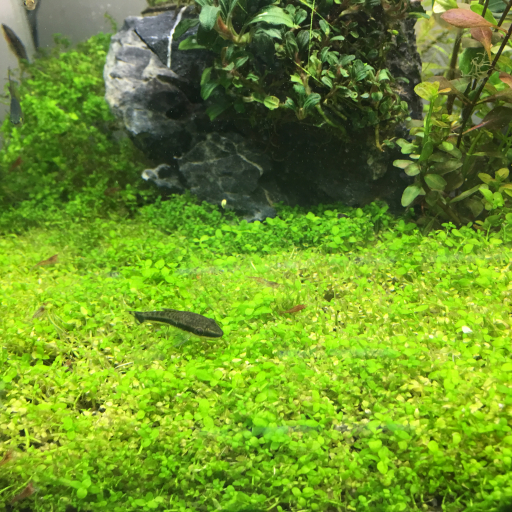
Plant Overview
Often called the "Holy Grail" of aquascaping, Hemianthus callitrichoides (commonly known as "Dwarf Baby Tears") is one of the world’s smallest flowering aquatic plants. Native to the rocky riverbeds of Cuba, it creates a lush, vibrant green carpet that looks like a miniature rolling meadow under the water. It’s the ultimate choice for hobbyists looking to master the "Iwagumi" or "Nature Aquarium" styles.
🔍 How to Identify
- 🌿 Microscopic Leaves: It features incredibly tiny, round-to-oval leaves that are only a few millimeters wide, giving it a delicate, "pixie-like" appearance.
- 📗 Bright Coloration: The foliage is a consistent, bright lime-green that sparkles when the plant "pearls" (releases oxygen bubbles).
- 🌱 Creeping Growth: Unlike taller stems, this plant grows horizontally, sending out thin runners that interweave to form a dense, thick mat over the substrate.
🏡 In Your Garden (Aquarium)
- ☀️ Light & CO2 Nuance: While many plants survive in low light, Dwarf Baby Tears will "reach" upward and become leggy or melt without high-intensity lighting and pressurized CO2. It needs these tools to stay compressed and carpet-like.
- 🧪 Substrate Sensitivity: Because its roots are hair-thin and shallow, it struggles in coarse gravel. It thrives best in fine-grained "aquasoil" where it can easily anchor its tiny root system.
- ✂️ The Dry Start Method: Many hobbyists prefer the "Dry Start Method," planting it in damp soil without filling the tank for several weeks. This allows the roots to establish firmly before water is added, preventing the dreaded "floating carpet" disaster.
⚠️ Safety & Toxicity
- ✅ Fish & Shrimp Safe: This plant is completely non-toxic and is a favorite among shrimp keepers.
- 🦐 The Nursery Effect: The dense mat provides a perfect hiding spot for tiny shrimp larvae and fish fry, protecting them from larger tank mates.
- 🐶 Pet Safety: It is generally safe for household pets, though it is exclusively grown submerged or in high-humidity terrariums where cats and dogs are unlikely to graze on it.
✨ Fun Fact
Dwarf Baby Tears was only "discovered" for the aquarium hobby in 2003 by the founder of Tropica, who found it growing in a riverbed in Havana, Cuba. In just two decades, it has become the most famous carpeting plant in the world!

Detailed Care Instructions
To successfully grow Hemianthus callitrichoides (also known as dwarf baby tears or HC), follow these tips:
- Lighting: Provide intense lighting with a color temperature of 6500K to 10000K. Use LED lights or high-quality fluorescent lights for around 10 to 12 hours per day.
- Substrate: Use a nutrient-rich substrate that is compact and fine-grained. HC requires a substrate with good water retention and nutrient availability. Some popular options include aquasoil, nutrient-rich sand, or fine-grained gravel.
- CO2 injection: HC grows best in a high CO2 environment. Supplementing with CO2 will greatly enhance its growth and promote carpet formation. Use a CO2 injection system to maintain a level of 30 to 40 ppm.
- Fertilization: HC is a demanding plant that requires regular fertilization. Use a balanced liquid fertilizer or root tabs to provide essential nutrients. Add the recommended dosage as per the product instructions.
- Water parameters: Keep the water temperature in the range of 75-82°F (24-28°C) with a pH level between 6-7.5. Soft to moderately hard water is preferable.
- Planting: Prepare the HC plant by carefully separating the individual stems. Plant them into the substrate, leaving a spacing of 1.5 to 2 inches (4-5 cm) between each stem. Press the plant gently into the substrate so the roots are in contact with it.
- Growth: Initially, HC may experience a melting phase due to the change in conditions, but new growth should emerge within a few weeks. Regularly trim and replant any excessive growths to encourage compactness.
- Maintenance: Regular maintenance is crucial to ensure a healthy growth of HC. Regularly remove any dead or decaying plant material, as it can negatively affect the growth of the carpet.
Remember that growing HC can be challenging and may require some trial and error to find the right balance for your specific setup. Patience and regular monitoring are key to achieving a lush and healthy carpet of Hemianthus callitrichoides.
Watering of this plant involves providing moisture to its root system in a controlled manner. This can be achieved by carefully pouring water over the soil media where the plant is growing. It is important to ensure that the water does not accumulate on the surface of the leaves or stems, as this can promote the growth of harmful microorganisms and lead to plant diseases. Watering should be done regularly, but not excessively, as this can also cause root rot and other problems. The amount and frequency of watering will depend on various factors such as the size of the plant, the environmental conditions, and the soil type and texture. In general, it is best to keep the soil moist but not wet, and to avoid allowing the plant to dry out completely between watering sessions.
To provide the best fertilizer for this plant, use a nutrient-rich substrate and liquid fertilizer. Apply the fertilizer once a week at half the recommended dose to prevent over-fertilization. Co2 injection can also be helpful for optimal growth. Finally, make sure to do regular water changes to avoid excess nutrients.
Hemianthus Callitrichoides thrives in nutrient-rich soil that is well-draining. The soil should be slightly acidic, with a pH range of 6.0 to 7.0, and should have a good balance of organic matter and minerals. It is important to choose a substrate that is not too compact, as the plant requires oxygen to thrive. A fine-grained substrate consisting of a mix of vermiculite and peat moss is ideal for Hemianthus Callitrichoides. This type of soil will provide enough support for the plant's delicate roots while allowing it to absorb nutrients and water easily. It is also important to keep the soil moist but not waterlogged, as this can lead to root rot. To promote healthy growth, it is recommended to add liquid fertilizers to the soil regularly.
To propagate this plant, you will need to carefully separate the individual stems from the parent plant. These stems can then be planted into a nutrient-rich substrate with good water flow. It is important to ensure that the stems are planted deeply enough to allow the roots to anchor into the substrate, but not so deep that the delicate stems are damaged. Additionally, it is important to maintain the proper water conditions and lighting to encourage healthy growth. With proper care, the stems will quickly develop strong roots and spread, allowing for the creation of a lush carpet of this beautiful plant in your aquarium.







