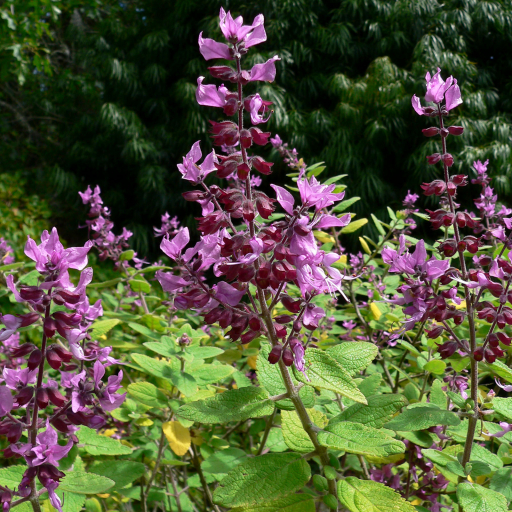
Plant Overview
Often called the "Cape Sage" or "Marble Pink," Hemizygia is a vibrant South African gem that brings a splash of neon to the garden. It belongs to the mint family, making it an extravagant cousin to the common Salvia. Its most striking feature isn't just the flower itself, but the brightly colored, petal-like leaves (bracts) that crown the top of every flower spike like a colorful toupee.
🔍 How to Identify
- 🌸 Showy Bracts: The very top of the flower spikes features bright pink, purple, or white leaf-like structures that are often more vividly colored than the actual blossoms.
- 🍃 Toothed Foliage: The leaves are typically dark green, oval-shaped, and have distinct "saw-tooth" serrations along the edges.
- ⏹️ Square Stems: True to its Lamiaceae (mint) lineage, the stems are distinctly four-sided and feel square when rolled between your fingers.
🏡 In Your Garden
- ✂️ The "Haircut" Rule: This plant has a biological urge to become "leggy" and woody. To prevent it from looking sparse, you must prune it back by about a third after every flowering flush to encourage fresh, bushy growth.
- ⛰️ Mimic the Hillside: In the wild, they grow on rocky slopes. They hate "wet feet," so if your garden has heavy clay, plant them in raised beds or containers with plenty of perlite to ensure the roots never sit in stagnant water.
⚠️ Safety & Toxicity
- ✅ Low Risk: Hemizygia is generally considered non-toxic to humans and is not listed as a primary threat to household pets.
- 🐱 Essential Oils: Like many aromatic plants in the mint family, the leaves contain natural oils. While not poisonous, frequent nibbling by curious cats or dogs might cause minor stomach upset or drooling.
✨ Fun Fact
- 🐝 Neon Navigation: Those bright pink bracts at the top of the stem don't actually produce seeds! They act as "landing lights" for pollinators, using their high-contrast color to flag down passing bees and butterflies from a distance.

Detailed Care Instructions
To help grow a Hemizygia plant, follow these steps:
- Choose the right location: Hemizygia plants prefer bright but indirect sunlight. Place them in an area that receives partial shade, such as under a tree or in a spot with filtered sunlight.
- Soil requirements: Hemizygia plants thrive well in well-draining soil with organic matter. Use a mix of potting soil and perlite or sand to ensure good drainage.
- Watering: Water the plant deeply but allow the topsoil to dry out slightly before the next watering. Overwatering can lead to root rot, so make sure not to keep the soil constantly wet.
- Fertilizer: Use a balanced water-soluble fertilizer during the growing season (spring and summer) to promote healthy growth. Avoid over-fertilizing as it can cause burnt leaves.
- Pruning: Regularly prune the plant to maintain its shape and encourage bushier growth. Pinch back the tips of the stems to promote branching.
- Propagation: Hemizygia plants can be propagated from stem cuttings. Take a 4-6 inch cutting below a leaf node and remove the lower leaves. Dip the cutting in rooting hormone and plant it in a pot filled with moist, well-draining soil. Keep the cutting warm and humid, and it should root within a few weeks.
- Pests and diseases: Hemizygia plants are generally resistant to pests and diseases. However, watch out for common issues like aphids or fungal infections. Treat any problems promptly with appropriate insecticides or fungicides.
- Winter care: Hemizygia plants are not frost-tolerant. If you live in an area with cold winters, consider growing them as annuals or bring them indoors during the winter. Place them in a well-lit area away from drafts.
Following these guidelines should help you successfully grow and care for a Hemizygia plant.

Place in a window with dappled sun or a spot in the middle of a room. Or directly in a window facing west or east.

To water this plant, it is important to first check the soil moisture level. Stick your finger into the soil up to the first knuckle. If the soil feels dry, it is time to water. Use a watering can or hose with a gentle stream of water to thoroughly saturate the soil, ensuring that water reaches the roots. Allow excess water to drain out of the pot or container. Avoid getting water on the leaves, as this can promote fungal growth. Water regularly, but do not overwater, as this can lead to root rot. Adjust watering frequency according to the plant's needs and the environmental conditions.
Hemizygia is a unique plant that requires specific fertilizing instructions to thrive. To ensure that your Hemizygia plant receives the nutrients it needs, you should fertilize it every two weeks during the growing season. Use a balanced fertilizer with equal parts of nitrogen, phosphorus, and potassium. Avoid using fertilizers that are high in nitrogen, which can cause excessive leaf growth at the expense of flower production.
Mix the fertilizer according to the package directions, and pour it over the soil around the base of the plant. Be sure not to get any fertilizer on the foliage, as this can cause burning and damage. Water the plant after fertilizing to ensure that the nutrients penetrate deeply into the soil.
During the winter months, when the plant is dormant, you can cut back on fertilization to once a month. Be sure to adjust the amount of fertilizer you use based on the size of your plant and the size of its container. With the right fertilization and care, your Hemizygia plant will thrive and produce vibrant flowers year after year.
The ideal soil for this plant should be well-draining and rich in nutrients. It is recommended to use a mixture of soil, vermiculite, and perlite in equal proportions to promote proper drainage. The pH level of the soil should be between 5.5 and 7.5 for optimum growth. The soil should be kept moist but not waterlogged to prevent root rot. It is also recommended to fertilize the plant with a balanced fertilizer every 4-6 weeks during the growing season.
Hemizygia plant propagation can be done through stem cuttings. The stem cuttings can be taken from the parent plant during the growing season and should be about 4-6 inches long. The leaves should be removed from the lower part of the stem, leaving only a few at the top. Then, the stem cutting should be dipped into rooting hormone powder and planted in well-draining soil. The soil should be kept moist and the cutting should be placed in a bright, but indirect, sunlight. After four to six weeks, roots should begin to grow and the cutting can be transplanted into a larger container or planted in the garden outside.
Common pests of the sagebushes include Mealybugs, spider mites, thrips. Make a habit of checking your sagebushes frequently for pests so that any infestations can be caught and managed early.







