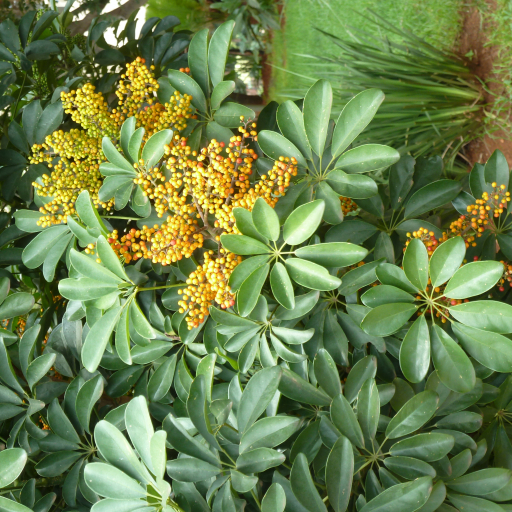
Plant Overview
Known widely as the Dwarf Umbrella Tree, this resilient evergreen is a favorite for those who want a touch of the tropics without the high-maintenance drama. Native to the lush forests of Taiwan, it earned its nickname because its leaflets radiate outward from a central point, mimicking the ribs of a tiny umbrella. It is a versatile survivor, often seen as a tabletop accent, a tall braided floor specimen, or even a miniature bonsai.
🔍 How to Identify
- 🌿 The "Umbrella" Leaf: Look for compound leaves where 7 to 9 oval-shaped leaflets sprout from a single stalk, creating a circular, parasol-like canopy.
- ✨ Glossy Texture: The foliage is naturally waxy and shiny; in healthy plants, the leaves have a deep forest-green hue, though variegated versions feature creamy yellow splashes.
- 🪵 Woody Stems: Unlike many soft-stemmed houseplants, this species develops a flexible, woody trunk over time that can be pruned or trained into various shapes.
🏡 In Your Garden
- ☀️ Light Logic: While it craves bright, indirect light, it is one of the more tolerant "low light" tropicals. However, if the light is too dim, the plant will become "leggy" as it stretches its stems to find the sun.
- ✂️ Pruning for Density: To prevent it from looking like a thin stick, you should "pinch" the growing tips. This forces the plant to branch out, resulting in a much fuller, bushier appearance.
- 💧 Thirsty but Sensitive: It prefers its soil to dry out significantly between waterings. It is highly susceptible to root rot, so if the leaves start dropping suddenly, it’s usually a sign the roots are sitting in too much water.
⚠️ Safety & Toxicity
- 🐾 Toxic to Pets: This plant is considered toxic to both cats and dogs.
- 👄 Irritation Details: It contains insoluble calcium oxalate crystals. If a leaf is chewed or swallowed, it can cause intense burning of the mouth, excessive drooling, and swelling of the throat. Always keep it on a high shelf away from curious nibblers.
✨ Fun Fact
In its native tropical habitat, the Dwarf Umbrella Tree often grows as an epiphyte. This means it can grow high up in the crooks of other trees, sending "aerial roots" down to the ground for stability, much like a jungle orchid or a strangler fig!

Detailed Care Instructions
To grow Heptapleurum arboricola, also known as Schefflera arboricola or umbrella tree, here are some tips:
- Light: Place the plant in bright, indirect light. It can tolerate some shade but will grow best with bright light. Avoid direct sunlight, as it can scorch the leaves.
- Temperature: Heptapleurum arboricola prefers a warm environment with temperatures between 60°F (15°C) and 75°F (24°C). Avoid exposing it to cold drafts or extreme temperature fluctuations.
- Watering: Water the plant when the top inch of soil feels dry to the touch. Ensure that the pot has good drainage to prevent waterlogging. Avoid overwatering, as this can lead to root rot. Mist the leaves occasionally to increase humidity.
- Soil: Use well-draining soil that retains some moisture. A mix of peat-based potting soil with perlite or sand works well.
- Fertilizer: Feed the plant with a balanced, water-soluble fertilizer once a month during the growing season (spring and summer). Follow the package instructions for appropriate dilution and application.
- Pruning: Heptapleurum arboricola can benefit from regular pruning to maintain shape and encourage bushier growth. Trim back any leggy or overgrown branches using clean and sharp pruning shears. Pruning also helps to promote better air circulation, preventing pest infestations.
- Propagation: The plant can be propagated through stem cuttings. Take a 4-6 inch cutting from a healthy and mature stem, remove lower leaves, and place it in a container with moist soil. Keep it in bright, indirect light and maintain soil moisture until roots develop.
- Repotting: Heptapleurum arboricola should be repotted every 2-3 years or when it outgrows its current pot. Choose a pot slightly larger than the current one and use fresh potting soil. Repot during spring or summer when the plant is actively growing.
Remember to monitor the plant regularly for signs of pests, such as spider mites or aphids, and take necessary action to control them.

Place in a window with dappled sun or a spot in the middle of a room. Or directly in a window facing west or east.

To take care of a Heptapleurum Arboricola plant, you need to ensure it receives the right amount of water. Here are some guidelines on watering this plant:
1. Observe the soil: Before watering, check the moisture level of the soil. Insert your finger about an inch deep into the soil. If it feels dry, it's time to water the plant.
2. Use the right watering technique: To avoid overwatering, which can lead to root rot and other problems, water the Heptapleurum Arboricola plant slowly and evenly. Ensure that water is reaching the root zone and not just running off the top.
3. Water thoroughly: When watering, apply enough water to thoroughly moisten the soil. Water until you see water coming out of the drainage holes at the bottom of the pot. This ensures that the entire root ball is adequately hydrated.
4. Frequency of watering: It's important to strike a balance when it comes to the frequency of watering. While Heptapleurum Arboricola plants enjoy slightly moist soil, they don't tolerate waterlogged conditions. Allow the top inch or so of soil to dry out before watering again. This usually translates to watering every 7-10 days, but it may vary depending on environmental factors such as temperature and humidity.
5. Consider environmental factors: Adjust your watering schedule based on external factors such as temperature and humidity. During hot summer months, the plant may require more frequent watering as the soil dries out faster. Conversely, reduce watering during cooler months or in areas with lower humidity.
6. Avoid water stagnation: Ensure proper drainage by using a well-draining potting mix. Additionally, ensure there are drainage holes at the bottom of the pot. This prevents water from accumulating at the roots and causing issues.
7. Use room temperature water: Water your Heptapleurum Arboricola plant with room temperature water rather than cold water from the tap. This prevents shocking the roots and maintains the overall health of the plant.
8. Observe the plant's response: Keep an eye on your plant's response to watering practices. If you notice wilting, yellowing leaves, or signs of root rot, it may be an indication that you are either overwatering or underwatering the plant. Adjust your watering routine accordingly.
Remember, the key is to maintain consistent moisture levels without allowing the plant to sit in overly wet conditions. Regularly monitoring the soil moisture and adjusting watering practices accordingly will help keep your Heptapleurum Arboricola plant healthy and thriving.
Fertilizing instructions for a certain plant species, commonly known as Heptapleurum Arboricola, are as follows:
- Select a balanced, water-soluble fertilizer specifically formulated for indoor plants.
- Dilute the fertilizer according to the instructions provided on the fertilizer packaging. Typically, a ratio of 1/4 to 1/2 teaspoon of fertilizer per gallon of water is recommended.
- Use the diluted fertilizer solution to water the plant's soil. Ensure the solution evenly covers the soil and reaches the plant's root system.
- It's advisable to fertilize the Heptapleurum Arboricola plant every two to four weeks during the growing season, which typically spans from spring to summer.
- During the dormant period in fall and winter, reduce the frequency of fertilization to once every two months.
- Avoid over-fertilizing, as it may lead to salt buildup in the soil, causing damage to the plant. Always follow the recommended dosage guidelines.
- Alternating between using fertilizer and plain water while watering the plant can help prevent salt accumulation in the soil.
- Additionally, carefully read and follow any specific fertilizer instructions provided by the manufacturer for optimal results.
- Monitor the plant for any signs of nutrient deficiencies or excesses, such as yellowing leaves or stunted growth. Adjust the fertilization accordingly if needed.
- Remember to also provide regular watering and proper light conditions to support the overall health and growth of your Heptapleurum Arboricola plant.
The ideal soil for Heptapleurum Arboricola plant is a well-draining, fertile soil mixture. It should provide a balance between moisture retention and aeration. The soil should be rich in organic matter to promote healthy root growth and nutrient uptake.
A recommended soil mix includes a combination of sandy loam or garden soil, perlite or pumice for improved drainage, and peat moss or well-rotted compost for moisture retention and nutrient enrichment. This mixture ensures that excess water drains away quickly, preventing waterlogging and root rot, while retaining the necessary moisture for the plant's well-being.
Avoid using heavy clay soils or those with poor drainage, as these can lead to waterlogging, depriving the roots of oxygen and causing root rot. Additionally, using pure sand or solely organic materials like peat moss or compost can result in inadequate drainage or nutrient deficiencies.
It is important to regularly check the moisture levels in the soil by inserting a finger or a moisture meter around two inches deep. Water the plant only when the top inch of soil feels dry to the touch. Overwatering should be avoided as it can lead to root rot and other fungal diseases.
To maintain optimal soil health and prevent nutrient deficiencies, it is recommended to fertilize the Heptapleurum Arboricola plant with a balanced, slow-release fertilizer formulated for houseplants. Follow the manufacturer's instructions for application rates and frequency.
Regularly repotting the plant every one to two years in fresh soil not only helps refresh the soil and remove any depleted nutrients but also allows the plant to grow and thrive in a suitable environment.
Providing a suitable soil mix for your Heptapleurum Arboricola plant will create conditions that promote healthy root development, essential nutrient uptake, and overall plant growth and vitality.
To propagate Heptapleurum arboricola, follow these steps:
- Select a healthy parent plant: Choose a mature Heptapleurum arboricola plant that is disease-free and exhibits vigorous growth. Ensure that it has several healthy branches or stems.
- Prepare the cutting tools: Sterilize a sharp, clean pair of pruning shears or garden scissors by wiping them with rubbing alcohol or dipping them in a mixture of one part bleach to ten parts water. This prevents the transmission of diseases.
- Identify suitable stems for propagation: Look for stems that are approximately 4 to 6 inches long, with a few leaves at the top. These stems should be flexible and not too woody.
- Take cuttings: Position the blades of the sterilized cutting tool just below a leaf node, which is the point where the leaf joins the stem. Make a clean diagonal cut through the stem. Aim to collect multiple cuttings to increase your chances of successful propagation.
- Remove lower leaves: Trim off the leaves from the lower half of each cutting, leaving the top foliage intact. This reduces water loss and redirects energy towards root development.
- Apply rooting hormone (optional): Although not necessary, applying a rooting hormone on the exposed part of the stem can help stimulate faster root growth. Dip the bottom inch of each cutting into powdered rooting hormone or use a gel form of the hormone.
- Prepare the propagation medium: Prepare a well-aerated and well-draining potting mix. Use a combination of sterile peat moss, perlite, or vermiculite. Moisten the mix, but make sure it is not waterlogged.
- Plant the cuttings: Create holes in the propagation medium with a pencil or your finger. Insert the cuttings into the holes, ensuring at least half of the stem is submerged in the medium, and gently press the medium around the base of each cutting for stability.
- Maintain proper humidity and temperature: Cover the cuttings and the container with a clear plastic bag or dome to create a humid environment. Place the container in a warm location with indirect light, ideally around 70-75°F (21-24°C). Avoid direct sunlight as it may scorch the cuttings.
- Provide adequate moisture: Check the moisture level of the propagation medium regularly. Mist the cuttings with water when needed to maintain a slightly moist environment. Avoid overwatering, as this may lead to rot.
- Monitor the progress: After a few weeks, you may see new growth or signs of rooting. Gently tug on the cuttings to check for resistance, indicating the development of roots. Once the roots are around an inch long, it's time to transplant the cuttings into individual pots filled with a well-draining potting mix.
- Care for the new plants: Place each new plant in a bright location, away from direct sunlight. Water the plants regularly, allowing the top inch of the soil to dry out before watering again. Maintain humidity by misting the foliage occasionally or placing a water-filled tray nearby.
By following these steps, you can successfully propagate Heptapleurum arboricola and grow new plants from cuttings.
Common pests of the dwarf umbrella-tree include Scale insect, mealybugs, thrips. Make a habit of checking your dwarf umbrella-tree frequently for pests so that any infestations can be caught and managed early.








