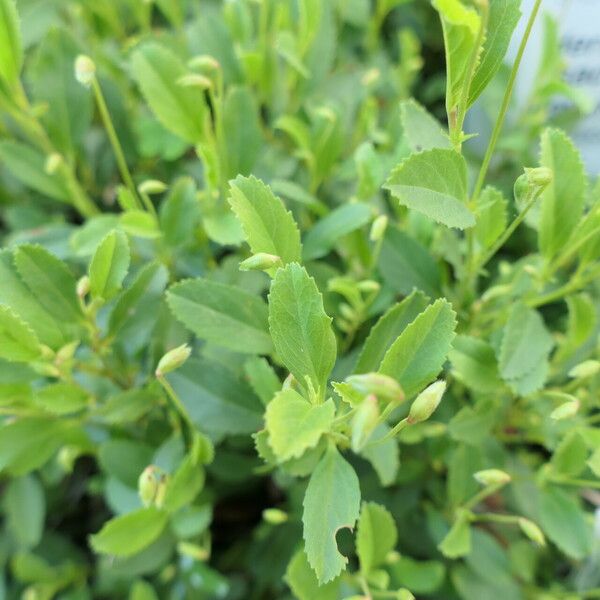
Plant Overview
Known affectionately as "Honey-Bells" or the "Doll’s Rose," Hermannia saccifera is a charming South African native that transforms dry patches into a vibrant golden carpet. Its delicate, drooping flowers look like tiny Victorian lanterns hanging from a dense green tapestry. It is a favorite for rock gardens and slopes where its trailing habit can truly be appreciated.
🔍 How to Identify
- 🔔 The Flowers: Distinctive bright yellow, bell-shaped blooms that hang downward. They are slightly inflated and often appear in pairs along the creeping stems.
- 🍃 The Foliage: Small, bright green leaves with slightly lobed or "toothed" edges that provide a dense, mat-like texture.
- 📉 The Habit: A prostrate (ground-hugging) shrublet that stays very low to the ground but spreads outward to cover bare soil.
🏡 In Your Garden
- 🧱 Rockery Specialist: Because of its trailing nature, this plant thrives when allowed to spill over the edges of containers, stone walls, or terrace pockets.
- 💧 Water Wisdom: It is exceptionally drought-tolerant once established. It prefers a "soak and dry" approach; overwatering or soggy soil can quickly lead to root rot, as it is adapted to the arid Karoo regions.
- ☀️ Sun Worship: To produce a heavy "carpet" of yellow bells, it requires full sun. In too much shade, the plant becomes leggy and the flowering will be sparse.
⚠️ Safety & Toxicity
- 🌿 Safe Status: Hermannia saccifera is generally considered non-toxic and safe for home gardens.
- 🐾 Pet Friendly: There are no known reports of toxicity toward cats, dogs, or horses, making it a "worry-free" groundcover for active backyards.
- 🚶 Fragility: While not toxic, the stems are quite brittle. It should be planted away from heavy foot traffic, as the delicate branches break easily if stepped on.
✨ Fun Fact
The genus is named in honor of Paul Hermann, a 17th-century physician and botanist who was one of the very first collectors to send plant specimens from the Cape of Good Hope back to Europe!

Detailed Care Instructions

Some plants require more regular watering than others, which should be done every few days. It's critical to maintain the soil moist all of the time. The water requirements of the same plant placed in pots with varying sizes will differ. Because the water in the smaller pot evaporates faster than the water in the larger pot, it will require more watering. Regardless of pot size, the surface should constantly be maintained moist.








