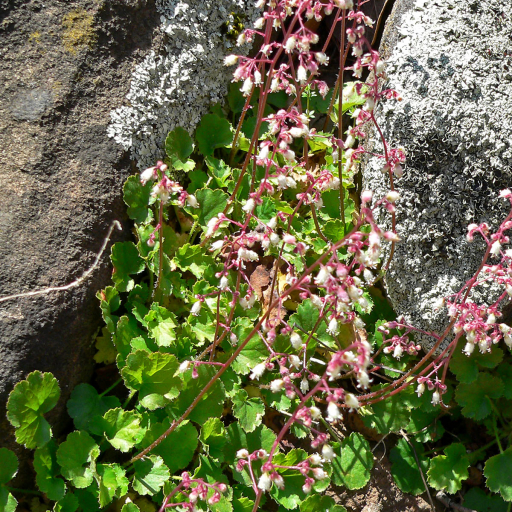
Plant Overview
Commonly known as the Pink Alumroot, this rugged beauty is a native of the rocky cliffs and mountain slopes of the Western United States. Unlike its flashy, neon-colored hybrid cousins found in garden centers, Heuchera rubescens offers a more delicate, wild elegance. Often nicknamed the "Mountain Alumroot," it is celebrated for its ability to thrive in high-altitude crevices where few other perennials can survive.
🔍 How to Identify
- 🍃 Scalloped Foliage: The leaves are heart-shaped or rounded with distinct lobed edges, forming a dense, low-growing rosette that hugs the earth.
- 🌸 Airy Blossoms: In late spring, tiny, bell-shaped flowers emerge on slender, wiry stems. These delicate blooms range from creamy white to a soft, dusty pink.
- 📏 Stature: While the leafy base stays compact (usually under 6 inches), the flowering stalks can reach up to 15 inches, appearing to "hover" above the plant.
🏡 In Your Garden
- ⛰️ The Drainage Master: Because it originates in rocky crevices, this plant is an expert at surviving in thin soil. It is highly sensitive to "wet feet"; if the soil stays soggy for too long, the roots will likely rot.
- 🧗 Rock Garden Hero: It develops a woody base called a caudex, which helps it grip onto slopes. This makes it a perfect choice for "crevice planting" or tucking into the gaps of a stone wall where other plants would struggle.
- 🌓 Light Balance: While it loves the cool mountain air, it prefers a bit of afternoon shade in a backyard setting, especially in hotter climates, to prevent its leaves from scorching.
⚠️ Safety & Toxicity
- 🐾 Pet Friendly: Heuchera rubescens is generally considered non-toxic to cats, dogs, and humans, making it a "worry-free" addition to family landscapes.
- 🧤 Maintenance Safety: While not poisonous, the woody base can become quite tough and "leggy" over time. It is best to wear gloves when dividing or pruning the plant every few years to protect your hands from the rough, fibrous stems.
✨ Fun Fact
The common name "Alumroot" is no accident—the roots are incredibly rich in tannins. Historically, various indigenous groups used the mashed roots as a powerful astringent to stop bleeding and treat sore throats, similar to how a modern alum block is used!

Detailed Care Instructions
| Humidity | Dry |
| Lighting | Part Sun |
| Difficulty | Easy |
| Hardiness Zones | 4 - 9 |
To successfully grow Heuchera Rubescens (known as coral bells or alumroot), follow these steps:
- Choose the right location: Coral bells prefer partial shade to full sun, but they can tolerate shade. Ensure they receive at least 4-6 hours of sunlight daily.
- Prepare the soil: Coral bells thrive in well-draining soil. Improve drainage by mixing compost or organic matter into the soil. It should be moist but not waterlogged.
- Planting: Dig a hole slightly larger than the plant's root ball. Place the plant, level with the soil surface, and backfill with soil. Space multiple plants 12-18 inches apart.
- Watering: Keep the soil consistently moist but not soggy. Water deeply when the top inch of soil feels dry. Avoid overwatering, as it can lead to root rot.
- Mulching: Apply a layer of organic mulch, such as wood chips or shredded leaves, around the plants to conserve moisture and suppress weeds.
- Fertilizing: Use a balanced, slow-release fertilizer in spring. Avoid excessive nitrogen, as it can promote foliage growth at the expense of flowering.
- Pruning: Remove spent flowers and foliage to encourage new growth and prolong flowering. Prune back faded leaves in early spring before new growth emerges.
- Protection: If your area experiences severe winters, provide mulch or cover the plants to protect them from freezing temperatures. Heuchera Rubescens is hardy to USDA zones 4-9.
- Division: Every 2-3 years, divide the plants in early spring or late fall to maintain their vigor. Lift the clump, separate the healthy sections, and replant them.
- Pest and disease control: Heuchera Rubescens is generally resistant to pests and diseases. However, occasional issues like powdery mildew or vine weevils may occur. Monitor the plants regularly and take appropriate action if needed.
Remember, each plant has its unique requirements, so adjust your care accordingly. Regular monitoring, proper watering, and occasional grooming will keep your Heuchera Rubescens healthy and thriving.

Place in a window with dappled sun or a spot in the middle of a room. Or directly in a window facing west or east.

To water this specific plant, it is important to first consider the surrounding environment. The plant prefers a moist but well-draining soil, with regular watering during hot or dry periods. It is important to avoid overwatering, as this can lead to root rot and other complications. The ideal method of watering is to soak the soil thoroughly and allow it to drain, rather than giving the plant frequent, light waterings. It may be helpful to mulch around the base of the plant to help retain moisture in the soil. Additionally, it is important to monitor the plant for signs of stress or dehydration, and adjust watering accordingly.
- Choose a balanced fertilizer that contains equal amounts of nitrogen, phosphorus, and potassium.
- Apply the fertilizer in the early spring when new growth begins to emerge.
- Follow the manufacturer's instructions for application rates and methods.
- When applying the fertilizer, be sure to distribute it evenly around the base of the plant.
- Water the plant immediately after applying the fertilizer to help it absorb the nutrients.
- Repeat the fertilizer application every six to eight weeks throughout the growing season, or as recommended by the manufacturer.
Heuchera Rubescens is a flowering perennial plant that requires well-draining, moist soil that is rich in organic matter. Ideally, the soil for this plant should have a pH level between 5.5 and 7.5 and should be slightly acidic. The soil should also be porous, allowing for good air circulation and water drainage. It is recommended to avoid heavy clay and waterlogged soils as they can cause root rot. Loamy and sandy soils that are low in nutrients should be amended with organic matter such as peat, compost, or aged manure to improve soil fertility and structure. Additionally, a layer of mulch around the base of the plant can help to retain moisture and prevent weeds from growing. Overall, the soil for Heuchera Rubescens should be well-prepared and fertile to ensure optimal growth and development of the plant.
To propagate this plant, you will need to take stem cuttings:
- Firstly, choose a healthy-looking parent plant with no signs of disease or pests.
- Next, select a stem that has at least four nodes (where new growth appears) and cut it using a sharp, clean pair of scissors or pruning shears.
- Remove any leaves from the bottom 2 inches of the stem to prevent them from rotting when planted.
- Dip the end of the stem cutting in rooting hormone powder. This will help the stem develop roots more quickly.
- Plant the stem cutting in a well-draining soil mix, ensuring that it is planted deeply enough to cover the lower nodes.
- Keep the soil moist but not soaking wet. Cover the cutting with a clear plastic bag to create humidity and keep the soil moist.
- Keep the cutting in a warm, bright location away from direct sunlight.
- Check the cutting daily and remove any yellowing or decaying leaves.
- Once roots appear, after about 4-6 weeks, remove the plastic bag and begin to acclimatize the new plant to normal conditions.
- After a few weeks of acclimatization, transplant the new plant to its permanent location in your garden or a container.








