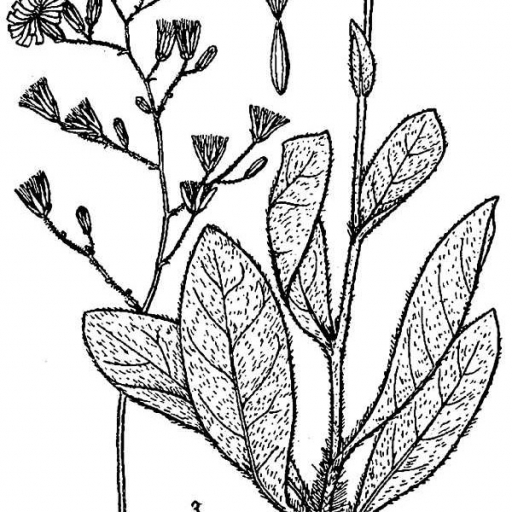
Plant Overview
Often called Beaked Hawkweed, this slender North American native is a quiet staple of sunny woodlands and sandy meadows. It belongs to a group of plants steeped in ancient folklore; the Greeks believed that hawks would tear open the stems and use the milky sap to sharpen their eyesight. While it might look like a simple wildflower, its rugged nature allows it to thrive in "difficult" soils where more delicate garden plants might wither.
🔍 How to Identify
- 🌼 The Flowers: Small, bright yellow flower heads that resemble miniature dandelions, usually clustered at the very top of a tall, thin stalk.
- 🌿 The "Beard": The stems and leaves are covered in distinct, long, stiff hairs, giving the plant a fuzzy or "shaggy" texture that helps it retain moisture.
- 🍃 Leaf Arrangement: Most leaves are concentrated in a rosette at the base of the plant. These basal leaves are often tinged with purple or deep red along the central vein.
🏡 In Your Garden
- 🏜️ Tough as Nails: This plant is an "extremophile" for the backyard; it actually prefers nutrient-poor, sandy, or acidic soil. If your garden has a dry spot where nothing else grows, the Beaked Hawkweed will likely feel right at home.
- 🌬️ Wind-Borne Wanderer: Like its dandelion cousins, it produces fluffy seeds that travel on the breeze. It is a great choice for "rewilding" a space, but be mindful that it may pop up in unexpected places next season.
⚠️ Safety & Toxicity
- ✅ Safe Status: Generally considered non-toxic to humans, cats, and dogs.
- 🖐️ Skin Sensitivity: While not poisonous, the milky white latex (sap) inside the stems can be a mild irritant. People with sensitive skin or known allergies to the Daisy (Asteraceae) family should wear gloves when weeding or pruning.
✨ Fun Fact
The "Beaked" part of its name comes from the shape of its tiny seeds. Unlike other hawkweeds, the seeds of Hieracium gronovii have a distinctively narrowed, beak-like neck at the top where the fluffy "parachute" attaches!

Detailed Care Instructions
To grow Hieracium Gronovii, also known as Gronovius hawkweed or grono hawkweed, you can follow these steps:
- Obtain seeds or plants: You can either purchase seeds from a gardening store or online, or look for young plants at a local nursery.
- Choose a suitable location: Gronovius hawkweed is native to North America and thrives in full sun or partial shade. Select a location in your garden that receives at least 6 hours of sunlight per day.
- Prepare the soil: Gronovius hawkweed prefers well-draining and slightly acidic soil with a pH of around 6.0-6.7. You can improve the soil by adding organic matter like compost or well-rotted manure.
- Plant the seeds or young plants: If using seeds, sow them directly into the soil in spring or early summer. Ensure the seeds are placed at the recommended depth mentioned on the seed packet. If using young plants, dig a hole slightly larger than the plant's root ball, place it in the hole, and backfill with soil.
- Water regularly: Keep the soil consistently moist but not waterlogged. Water the plants regularly, especially during dry periods, to help establish healthy growth.
- Mulch around the plants: Apply a layer of organic mulch, such as wood chips or straw, around the plants to help conserve moisture, suppress weed growth, and insulate the roots.
- Control weeds: Regularly remove any competing weeds around the plants to minimize competition for nutrients and water.
- Fertilize sparingly: Gronovius hawkweed generally doesn't require heavy fertilization. However, if the soil is poor or lacking in nutrients, you can lightly fertilize with a balanced organic fertilizer once or twice a year.
- Prune as needed: Though not necessary, you can trim back the plant after flowering to encourage bushier growth and prevent self-seeding if desired. Additionally, remove any dead or damaged foliage throughout the growing season.
- Monitor for pests and diseases: Keep an eye out for common garden pests like aphids or slugs, and take appropriate measures to prevent or control infestations. Also, watch for any signs of diseases, such as fungal infections, and address them promptly if detected.
By following these steps, you should be able to successfully grow Hieracium Gronovii in your garden. Happy gardening!

Place in a bright room that is sun drenched almost all day. Or directly in a south-facing window.

To water this plant, make sure to give it a thorough watering but only when the soil is dry to the touch. Avoid over-watering as this plant can be sensitive to excessive moisture. It is also important to avoid letting water collect in the crown of the plant as this can encourage rot. If possible, water this plant in the morning to allow any excess moisture to evaporate before nightfall.
To promote healthy growth of this plant, apply a balanced fertilizer with equal parts nitrogen, phosphorus, and potassium in the early spring before new growth begins. Use a slow-release fertilizer or apply smaller amounts of fertilizer on a monthly basis throughout the growing season. Water the plant thoroughly after fertilizing to prevent burning the roots.
The soil that is best suited for growing the Hieracium Gronovii plant is a well-draining soil that is rich in nutrients. The pH level of the soil should be neutral to slightly acidic, with a range of 6.0 to 7.0 being ideal. The soil should have good water retention capacity but should not be waterlogged as this can cause root rot.
The soil should be a mixture of organic matter such as compost or leaf mold, sand, and clay in equal parts. This will ensure that the soil is well balanced and has good drainage while retaining moisture. The soil should be prepared before planting by adding any necessary amendments such as lime, sulfur, or fertilizer.
It is recommended to plant the Hieracium Gronovii plant in a location that receives partial shade or full sun. The plant prefers moist soil but can tolerate periods of drought once established. It is important to water the plant regularly during the growing season to ensure healthy growth.
In summary, the Hieracium Gronovii plant prefers a well-draining, nutrient-rich soil with a neutral to slightly acidic pH level. The soil should have good water retention capacity but should not be waterlogged. It is best to plant the Hieracium Gronovii plant in partial shade or full sun and water it regularly during the growing season.
There are several methods to propagate this plant, including seed propagation, stem cuttings, and division.
Seed propagation involves collecting the seeds from the plant and sowing them in a suitable growing medium. The seeds should be sown in early spring or late fall, as they require a cold period in order to germinate. After sowing, the medium should be kept moist and placed in a bright, but not direct, sunlight.
Stem cuttings can be taken in late spring or early summer, when the plant is actively growing. Cut a 4-6 inch section of stem from the plant, making sure to remove any leaves from the bottom 2 inches of the stem. Dip the cut end in rooting hormone and place it in a rooting medium, such as perlite or vermiculite. Keep the cutting in a humid environment and in bright, but not direct, sunlight until it has rooted.
Division can be done in the spring or fall. Dig up the plant and gently separate the roots into smaller sections. Replant the sections in new, well-draining soil and water thoroughly.
Regardless of the method used, be sure to keep the plant in a suitable growing environment, including bright, but not direct, sunlight and well-draining soil.








