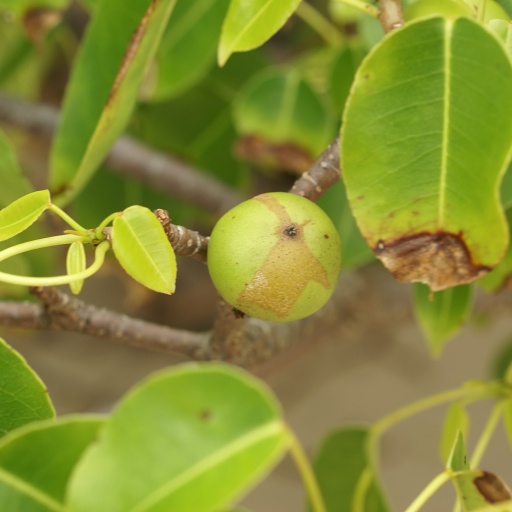
Plant Overview
The Manchineel tree, famously known by its Spanish name Manzanilla de la muerte ("Little Apple of Death"), holds the grim title of the world’s most dangerous tree. Native to the tropical beaches of the Caribbean, Florida, and Central America, it looks like a standard, inviting shade tree, but it hides a cocktail of toxins so potent it is often marked with red "X"s or warning signs to protect tourists.
🔍 How to Identify
- 🍎 The Fruit: It produces small, round fruits that look and smell exactly like crabapples, turning from bright green to a soft yellow when ripe.
- 🍃 Glossy Foliage: The leaves are simple, shiny, and heart-shaped (or oval) with finely serrated edges, often appearing in a vibrant, healthy green.
- 🌳 The Bark & Sap: It has thick, greyish-brown bark that, when nicked, oozes a thick, milky white latex sap that is the source of its most immediate danger.
🌊 Habitat & Coastal Ecology
- 🏖️ Beach Protector: You will almost exclusively find this tree along coastal shorelines and in brackish swamps, where its deep roots help prevent beach erosion and provide a windbreak against tropical storms.
- 🌦️ The Rainfall Risk: In its native habitat, locals know never to stand under a Manchineel during a rainstorm; the water mixing with the tree's sap can cause the skin to blister as if it were splashed with acid.
⚠️ Safety & Toxicity
- 🚫 DEADLY WARNING: Every part of this tree is extremely toxic. Ingesting the fruit is frequently fatal, causing the throat to swell shut and severe gastrointestinal bleeding.
- 🔥 Invisible Threat: Do not touch any part of the tree. Even the smoke from burning Manchineel wood can cause severe eye irritation and permanent blindness, and the sap can cause skin to peel in painful sheets.
✨ Fun Fact
The Manchineel's reputation is legendary; it is said that the Spanish explorer Juan Ponce de León died after being struck by an arrow that had been poisoned with the tree's caustic sap during a battle in Florida.

Detailed Care Instructions
To grow a Hippomane Mancinella plant, also known as the Manchineel tree, follow these steps:
- Obtain seeds or young seedlings: You can try to find seeds or young seedlings from a reputable nursery or supplier that specializes in rare or exotic plants. Note that it may be difficult to find this specific plant due to its toxic properties.
- Choose a suitable location: The Manchineel tree thrives in tropical or subtropical regions, so ensure you live in an appropriate climate. It prefers sandy soils and coastal areas, as it can tolerate saline conditions. Make sure you have enough space since it can grow up to 15 meters in height.
- Planting: Select a planting location with well-draining soil. Dig a hole slightly larger than the root ball of the seedling. Place the seedling in the hole, ensuring the top of the root ball is level with the ground's surface. Backfill the hole with soil, gently firming it around the seedling. Water thoroughly after planting.
- Provide proper care: Manchineel trees require regular watering, especially during dry spells, to establish strong root systems. Keep the soil consistently moist but not waterlogged. Applying a layer of organic mulch around the base of the tree can help retain moisture and suppress weeds.
- Protect from frost: If you live in an area susceptible to frost, consider protecting your Manchineel tree during cold winters. Use frost cloth or other appropriate coverings to shield it from freezing temperatures.
- Pruning: Minimal pruning is usually required for Manchineel trees. However, if you need to shape or reduce the size of the tree, do so during the dormant season (winter) to avoid the risk of tree bleeding sap.
Caution: It's essential to note that the Manchineel tree is highly toxic, especially the sap and fruit. Avoid direct contact with any part of the plant as it can cause severe skin burns and other adverse effects. Keep distance from the tree and ensure safety measures are followed.

Place in a bright room that is sun drenched almost all day. Or directly in a south-facing window.

To water this particular species of plant, it is important to ensure that the soil is consistently moist but not waterlogged. This plant prefers well-draining soil, so be sure to avoid watering to the point of creating standing water. Monitor the moisture level of the soil regularly and only water when the top inch of soil feels dry to the touch. It is also important to avoid getting water on the leaves or stem of this plant, as it may cause skin irritation. Instead, water at the base of the plant using a gentle stream of water or a watering can with a spout.
To fertilize this plant, you should use a balanced fertilizer with equal amounts of nitrogen, phosphorus, and potassium. Apply the fertilizer once every three to four months during the growing season and be careful not to over-fertilize, as this can damage the plant. Water the plant thoroughly after applying the fertilizer to help it absorb the nutrients.
The plant requires a well-draining soil that is rich in nutrients. It prefers a slightly acidic soil with a pH range of 6.0-6.5. A mix of sandy soil and loam soil with a little bit of organic matter is ideal. It's important that the soil is not compacted or heavy, as this can cause issues with drainage and root development. Once planted, it's also important to keep the soil consistently moist but not waterlogged. A balanced fertilizer can also be applied to the soil every 2-3 months to provide the plant with additional nutrients.
To propagate this plant, select healthy stem cuttings from the parent plant. The stem cuttings should be about 6-8 inches long and have a few leaves. Remove the lower leaves from the stem cutting and dip the cut end into rooting hormone powder.
Prepare the potting soil by mixing equal parts of sand and perlite. Insert the stem cutting into the potting soil up to the first set of leaves. Water the cutting and place the pot in a warm, bright location, but keep out of direct sun.
Water the cutting regularly to keep the soil moist but not waterlogged. After 4-6 weeks, the stem cutting should start producing new growth, indicating that it has successfully rooted.
Once the roots have established, transplant the new plant into a larger pot or into the ground, ensuring it has plenty of space to grow. With the right care and conditions, the new plant will grow into a healthy specimen just like the parent plant.








