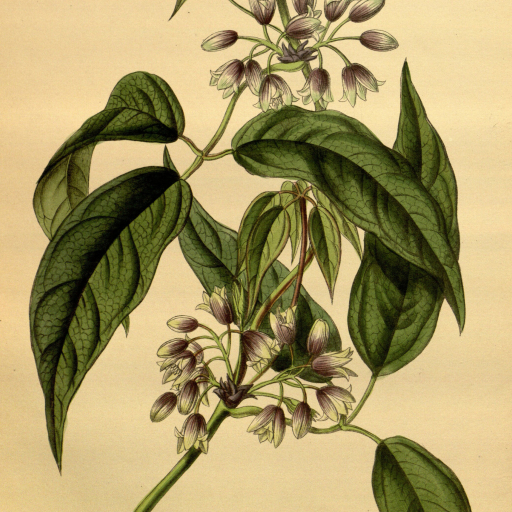
Plant Overview
Often called the Sausage Vine or the Broad-leafed Holboellia, this vigorous evergreen climber hails from the misty mountain forests of the Himalayas and Western China. It is a favorite among "secret garden" enthusiasts for its ability to quickly wrap a trellis in lush green leaves and its unexpectedly powerful, honey-sweet fragrance that drifts through the air in early spring.
🔍 How to Identify
- 🍃 The Leaflets: It features leathery, dark-green leaves that are "palmately compound," meaning 3 to 7 leaflets radiate from a single point like the fingers of a hand.
- 🌸 Dual Flowers: This plant is monoecious, bearing both male and female flowers in the same cluster. The male flowers are usually a pale, greenish-white, while the female flowers are a deeper, dusty purple.
- 🌭 The Fruit: In late summer, it produces fleshy, sausage-shaped pods that turn a purplish-pink hue when ripe, hanging like strange ornaments from the vines.
🏡 In Your Garden
- 🧗 Structural Support: This is a twining climber that grows with great speed. It doesn't have "suction cups" like ivy, so it requires a sturdy trellis, pergola, or a large host tree to wrap its stems around.
- ⛅ The "Woodland" Rule: Like many Himalayan plants, it prefers its "feet" (roots) in the cool shade and its "head" (foliage) in partial sun. It thrives in moist but well-drained soil and resents drying out completely during the summer heat.
⚠️ Safety & Toxicity
- ✅ Non-Toxic: Holboellia latifolia is generally considered safe and is not known to be toxic to humans, dogs, or cats.
- 👅 Edible Fruit: The "sausage" fruits are technically edible and have a sweet, mealy white pulp. However, they are full of many small black seeds and are often considered an "acquired taste" rather than a kitchen staple.
✨ Fun Fact
The scent of the Sausage Vine is so potent that in its native habitat, it is used to attract specific night-flying moths. Many gardeners claim a single mature vine can perfume an entire city backyard on a still spring evening!

Detailed Care Instructions
To water this particular plant, it is important to take into consideration the environment in which it is growing. The amount and frequency of watering is dependent on factors such as the humidity of the air, the temperature, and the soil moisture.
One way to determine if the plant needs watering is to check the soil moisture level. This can be done by sticking your finger into the soil about one inch deep. If it feels dry, it's time to water. If the soil feels moist or damp, it is recommended to hold off on watering.
When watering, it is important to avoid getting the leaves or flowers wet to prevent any fungal or bacterial diseases. A good technique is to water the soil directly at the base of the plant, specifically targeting the root ball area.
Additionally, it is important not to overwater this plant as it prefers well-drained soil. Overwatering can lead to root rot and ultimately harm the plant. It is better to water deeply but less frequently to allow the roots to receive enough moisture without being saturated.
Overall, monitoring the soil moisture level and watering appropriately based on the environment will help ensure the health and growth of this plant.
The ideal soil for this plant is one that is rich in organic matter and well-draining. It should have a pH level between 6.5 and 7.5. The soil should be moist, but not waterlogged, as this can lead to root rot. A soil that is slightly acidic to neutral is recommended. It is also important to ensure that the soil is not compacted, as this can also prevent proper drainage. A mixture of peat moss, perlite, and compost can be a good option for providing the necessary nutrients and drainage for Holboellia Latifolia.








