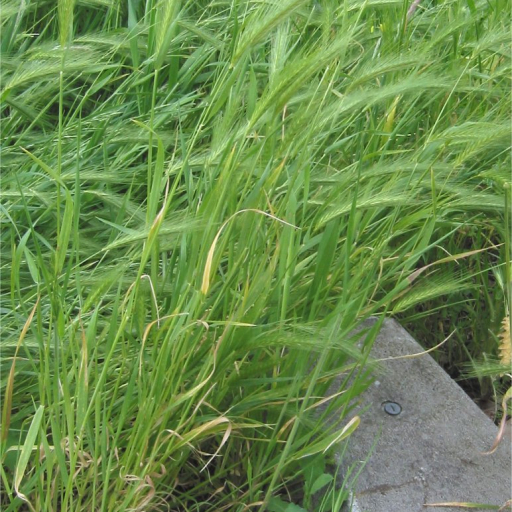
Plant Overview
Often called Wall Barley or Mouse Barley, this hardy annual grass is a master of urban survival. While it looks like a miniature version of the grain used to brew beer, this "false barley" is more of a hitchhiker than a harvest crop. It has spent centuries following human paths, thriving in the dry soil alongside stone walls, pavement cracks, and waste grounds.
🔍 How to Identify
- 🌾 The Seed Head: It features dense, bristly spikes that look like miniature brushes or flattened squirrel tails, typically appearing from late spring through summer.
- 🪝 Barbed Awns: Each seed is equipped with long, stiff bristles (awns) covered in microscopic, one-way barbs that allow them to cling stubbornly to fur, clothing, and skin.
- 🌱 Growth Habit: It grows in tufted clumps, usually reaching about 30 cm (12 inches) in height, with flat, light-green leaves that feel slightly rough to the touch.
🏡 In Your Garden
- 🧱 Urban Specialist: True to its name, Wall Barley thrives in the heat-retaining gaps near brickwork, pavement edges, and dry, compacted soil where other plants would wither.
- 📦 Colonization Strategy: It doesn't need high-quality soil; instead, it looks for "disturbed" ground. If you find it in your garden, it’s a sign of dry, nitrogen-rich soil, often appearing where pets or foot traffic have cleared other vegetation.
⚠️ Safety & Toxicity
- 🐕 Major Pet Hazard: While the plant is not chemically toxic, it is physically dangerous for dogs and cats. The barbed seeds (often called "grass seeds" by vets) are designed to move forward but never backward.
- 🩹 Physical Injury: These seeds easily get lodged in a pet's ears, between toes, or in their nostrils. Once stuck, the barbs cause the seed to burrow deeper into the flesh, often requiring surgical removal to prevent serious infection.
✨ Fun Fact
Because of those one-way barbs, children often play a game called "darts" with Wall Barley. If you place a seed head on your clothing and move, the barbs act like a ratchet, causing the seed to "walk" across your sweater or up your sleeve with every movement you make!

Detailed Care Instructions
To grow Hordeum murinum (wild barley), follow these steps:
- Seed selection: Obtain Hordeum murinum seeds from a reputable source, such as a garden center or online supplier.
- Choose a suitable location: Hordeum murinum is a tough plant that can grow in various conditions, but it does best in well-drained soil that receives full sun or partial shade.
- Soil preparation: Ensure the soil is fertile, loose, and free of weeds. Add organic matter like compost if necessary to improve soil fertility and drainage.
- Planting: Hordeum murinum can be directly sown in the planting area after the last frost, or started indoors 4-6 weeks before the last frost and transplanted once the seedlings are large enough to handle. Sow the seeds about 1/4 inch deep and space them 2-4 inches apart.
- Watering and maintenance: Keep the soil evenly moist until the seeds germinate, usually within 7-14 days. Once the plants are established, they are relatively drought-tolerant and do not require frequent watering. Monitor the soil moisture and water when needed.
- Weeding and thinning: Remove any competing weeds that may hinder the growth of Hordeum murinum. If the plants become overcrowded, thin them out by gently removing excess seedlings, leaving adequate space for the remaining plants to grow.
- Fertilization: While Hordeum murinum can grow in relatively poor soil, providing a balanced organic fertilizer or compost during the growing season can help enhance its growth and productivity.
- Harvesting: Hordeum murinum produces seed heads, which can be harvested when they are fully mature and dry. Cut the seed heads and place them in a paper bag or another container to collect the seeds. Store the seeds in a cool, dry place for future use or to plant again.
Note: Keep in mind that Hordeum murinum is considered a weed in some regions due to its aggressive growth and potential to overrun desired plants. Therefore, it is essential to check local regulations and consult with gardening experts before growing this plant.

Place in a bright room that is sun drenched almost all day. Or directly in a south-facing window.

To properly water this plant, first check the moisture level of the soil by inserting your finger into the top layer. If the soil feels dry, it is time to water. Use a watering can or hose with a gentle flow to avoid disturbing the soil. Slowly pour water around the base of the plant until the soil is thoroughly moistened, but avoid over-watering and causing standing water. Depending on the climate and conditions, this plant may require watering every few days or once a week. It is important to monitor the soil moisture level and adjust the watering schedule as needed.
For optimal growth and health, use a balanced fertilizer with a ratio of N-P-K of 10-10-10 or 12-12-12. Apply the fertilizer evenly around the base of the plant, making sure not to come in contact with the foliage. Water the plant thoroughly after fertilizing to help the nutrients penetrate the soil. Avoid over-fertilizing, as this can cause burn and damage to the plant.
To successfully grow Hordeum murinum plants, it is recommended to use well-draining soil that is rich in organic matter. The ideal pH range for the soil is neutral to slightly alkaline, with a range of 6.0-7.5. In general, this plant thrives in soils that are fertile, deep and loamy, with plenty of nutrients and a good structure that provides both water and air circulation. It is important to avoid using heavy clay soils or soils that have poor drainage. The soil should be kept moist but not waterlogged, and it is advisable to add compost or other organic matter regularly to maintain good soil fertility. Overall, it is important to provide a nutrient-rich soil environment that encourages healthy growth and development of Hordeum murinum plants.
Hordeum Murinum plants can be propagated through the use of seeds or by division of the root systems. To propagate using seeds, it is recommended to harvest seed heads from mature plants and allow them to dry before collecting the seeds. The seeds can then be planted directly into the soil in the desired location. To propagate through root division, mature plants can be dug up and the roots separated into smaller sections, each containing a portion of the plant and a portion of the root system. These sections can be replanted in new locations to grow new plants. It is important to ensure that each new plant has a sufficient amount of both plant and root material to successfully establish itself. The best time to propagate Hordeum Murinum plants is in the spring or fall, when the weather is mild and there is adequate moisture to support new growth.
Common pests of the mouse barley include Spider mites, aphids, thrips. Make a habit of checking your mouse barley frequently for pests so that any infestations can be caught and managed early.








