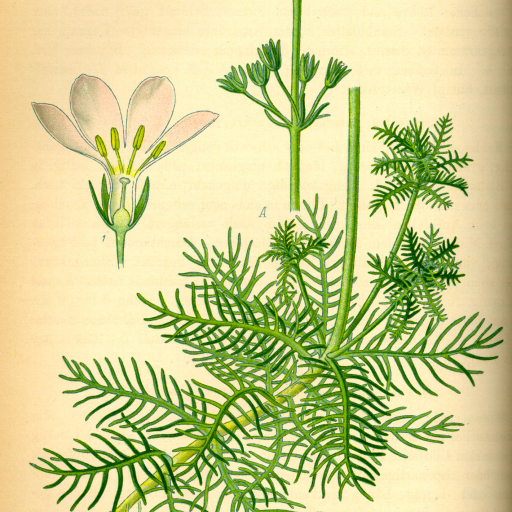
Plant Overview
Often called the Water Violet or "Featherfoil," Hottonia palustris is a stunning aquatic perennial that behaves like a delicate underwater forest. Despite its name, it isn't a violet at all but a relative of the primrose. In folklore, its ghostly pale flowers rising from dark pond waters were often associated with purity and quiet reflection.
🔍 How to Identify
- 🌿 The Foliage: Submerged leaves are deeply divided into fine, comb-like segments, giving the plant a soft, feathery appearance beneath the water's surface.
- 🌸 The Bloom: In late spring, a hollow, leafless stalk rises above the water, carrying tiers (whorls) of five-petaled flowers that range from pale lilac to white with a bright yellow "eye."
- 💧 The Growth Habit: It is a true hydrophyte, meaning its roots are usually tucked into the mud at the bottom of shallow water, while the rest of the plant floats or stands submerged.
🏡 In Your Garden
- 🦆 The Oxygenator: In a garden pond, this plant is a powerhouse for health. Its feathery submerged leaves release high amounts of oxygen into the water, helping to keep the pond clear and providing a perfect nursery for tadpoles and small fish.
- 🌡️ Temperature Sensitive: This plant is a "cool-water" lover. It thrives in temperate climates and may struggle or die back if the water temperature stays too high for extended periods during the summer.
- ✨ Water Quality: It acts as a natural bio-indicator; if your Water Violet is lush and blooming, it means your pond water is clean and relatively low in pollutants.
⚠️ Safety & Toxicity
- 🟢 Safe for All: Hottonia palustris is generally considered non-toxic to humans, dogs, cats, and horses.
- 🦆 Wildlife Friendly: It is a favorite hiding spot for aquatic life and does not pose a threat to the birds or local wildlife that might visit your pond.
✨ Fun Fact
Even though it lives entirely in the water, the Water Violet belongs to the Primulaceae (Primrose) family. It is one of the very few members of this family that has evolved to live a completely aquatic lifestyle!

Detailed Care Instructions
To grow Hottonia Palustris, commonly known as water violet or featherfoil, follow these steps:
- Select the right location: Water violets thrive in moist or semi-aquatic environments, such as ponds, marshes, or boggy areas. For cultivation, choose a location with full to partial sun exposure.
- Prepare the planting medium: Water violets prefer a highly organic and slightly acidic planting medium. Mix equal parts of peat moss and sand to create a suitable soil mix. Avoid using regular potting soil, as it may retain too much water.
- Planting: Fill a planting container, such as a pond basket or a container with drainage holes, with the prepared soil mix. Place the water violet rhizomes gently on top of the soil and cover them lightly with more soil, ensuring the crown is just above the surface.
- Watering: Submerge the container in water, making sure that the water level is a few inches above the crown of the water violet. Maintain this water level throughout the growing season. If grown indoors, use a deep tray filled with water and place the container in the tray so that the roots can reach the water.
- Maintain temperature and lighting: Water violets prefer cooler temperatures, ideally between 50°F to 70°F (10°C to 21°C). They also require ample lighting, so place them where they can receive at least 6-8 hours of sunlight per day. If growing indoors, consider providing supplemental artificial lighting.
- Fertilization: Apply a slow-release aquatic plant fertilizer according to the manufacturer's instructions, as excess nutrients may promote algae growth. Only fertilize during the growing season, typically from spring to fall.
- Managing pests: Monitor for pests such as aphids or snails, which can cause damage to the plant. Use appropriate organic or chemical controls to keep pests in check.
- Pruning: Trim off any dead or decaying foliage regularly to maintain plant health and appearance. Remove any debris that accumulates in the water to prevent it from suffocating the plant.
- Propagation: Water violets can be propagated by dividing the rhizomes during the early spring or split off the plantlets that develop on the roots. Gently separate these young plants and replant them into individual containers.
- Winter care: In colder climates, bring your water violets indoors before the first frost. Place them in a cool area with bright, indirect light. Reduce watering during the winter, allowing the soil to dry out slightly between waterings.
With proper care and maintenance, your Hottonia Palustris plant should thrive and produce beautiful foliage and delicate white flowers.

Place in a bright room that is sun drenched almost all day. Or directly in a south-facing window.

To properly water this plant, it is important to take into consideration the environment in which it naturally grows. This plant is often found in wetlands and marshy areas, so it requires soil that is consistently moist but not waterlogged.
When watering, aim to keep the soil evenly moist by lightly watering the plant every few days. Additionally, make sure the pot it is planted in has adequate drainage to prevent water from sitting in the soil. If the leaves begin to wilt or appear dry, this is a sign that the plant needs more water.
As with any plant, it is important to monitor the soil moisture regularly to ensure that it is not too wet or too dry. Finding the right balance will help this plant thrive and produce beautiful, delicate blooms.
To fertilize this plant, apply a balanced, water-soluble fertilizer every two weeks during the growing season. Dilute the fertilizer to half strength and apply to the soil around the plant, being careful not to get any on the foliage. Make sure the soil is moist before and after fertilizing. Avoid over-fertilizing as it can lead to root burn and damage the plant.
The preferred type of soil for this particular plant is acidic and has a high organic matter content. It should also be well-draining to prevent waterlogging, which can be detrimental to the plant's health. This species prefers soil that is moist but not saturated, and ideally should be grown in a location that receives bright indirect light. It's best to avoid using heavy clay-based soils as this can cause root rot and other soil-borne diseases. Other suitable components to mix into the soil can include peat moss, perlite, and sand to provide the appropriate drainage and aeration necessary for healthy growth.
To propagate this aquatic plant, take stem cuttings that are at least 4 inches long from a healthy parent plant. Remove the lower leaves and any flowers or buds from the cutting, leaving only a few leaves at the top. Dip the cut end in rooting hormone and plant it securely in damp soil or aquarium gravel. Keep the cutting in a warm, humid location with plenty of light but no direct sunlight. Change the water or mist the cutting daily until it develops roots and can be transplanted to its permanent location.








