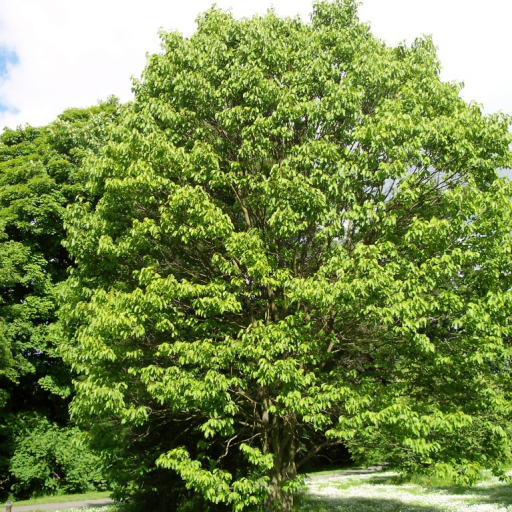
Plant Overview
Often called the Japanese Raisin Tree, this deciduous beauty is a hidden gem for foragers and landscape lovers alike. Native to the mountain forests of East Asia, it is famous for a botanical quirk: the "fruit" people eat is actually a swollen flower stalk that tastes remarkably like a sugary raisin. It’s a hardy, fast-growing tree that provides both dense shade and a sweet autumn harvest.
🔍 How to Identify
- 🍃 Heart-Shaped Leaves: The foliage consists of large, glossy, dark green leaves that are broadly ovate (egg-shaped) with finely toothed edges.
- 🌸 Fragrant Clusters: In mid-summer, the tree produces small, star-shaped, cream-colored flowers that emit a delicate, sweet scent that attracts bees.
- 🍇 Knobby "Raisins": As the seeds mature, the stalks (peduncles) supporting them swell up, turn reddish-brown, and become contorted. These fleshy, knobby stalks are the edible portion of the plant.
🏡 In Your Garden
- ☀️ Sun and Space: This tree loves the spotlight! It thrives in full sun and requires well-draining soil. Because it can reach heights of 30 to 40 feet, it should be planted in a spot where its wide, rounded canopy has room to spread.
- 🍂 Low Maintenance Beauty: Once established, Hovenia dulcis is incredibly self-sufficient. It is remarkably resistant to most common garden pests and diseases, making it an ideal choice for low-intervention "food forests" or permaculture gardens.
⚠️ Safety & Toxicity
- ✅ Safe and Edible: The swollen, pear-flavored stalks are safe for human consumption and can be eaten raw, dried, or brewed into tea.
- 🐾 Pet Safety: While not listed as a toxic plant for cats or dogs, the high sugar content in the "raisins" can cause digestive upset if a pet overindulges. The actual hard seeds are not typically consumed.
✨ Fun Fact
🧪 The Hangover Helper: For over a thousand years, traditional medicine in China and Korea has used extracts from this tree to treat alcohol intoxication. Modern science has confirmed that the plant contains a compound called Dihydromyricetin (DHM), which helps the liver break down alcohol and may actually reduce the symptoms of a hangover!

Detailed Care Instructions
To grow Hovenia Dulcis, also known as the Japanese Raisin Tree or Oriental Raisin Tree, you can follow these steps:
- Obtain seeds or seedlings: Purchase Hovenia Dulcis seeds or seedlings from a reputable supplier. Make sure to choose healthy and good quality seeds/seedlings.
- Prepare the soil: Hovenia Dulcis prefers well-draining soil. Mix compost or organic matter into the soil to enhance fertility and drainage.
- Planting seeds or seedlings:
- If starting from seeds, plant them in the prepared soil. Place the seeds about 1 inch deep in the soil and cover them lightly.
- If using seedlings, dig a hole in the soil slightly larger than the container. Gently remove the seedling from the container and place it in the hole. Fill the hole with soil, ensuring the seedling is at the same level as it was in the container.
- If starting from seeds, plant them in the prepared soil. Place the seeds about 1 inch deep in the soil and cover them lightly.
- Watering and sunlight:
- Keep the soil consistently moist, watering it regularly but avoiding waterlogging.
- Place the plant in a location that receives full sunlight or partial shade. Ideally, it should get 6-8 hours of sunlight per day.
- Keep the soil consistently moist, watering it regularly but avoiding waterlogging.
- Fertilization:
- Apply organic fertilizer once every two to three months to provide nutrients for the plant's growth.
- Apply organic fertilizer once every two to three months to provide nutrients for the plant's growth.
- Pruning:
- Prune your Hovenia Dulcis plant to maintain its shape and promote air circulation. Remove any dead, damaged, or diseased branches.
- Prune your Hovenia Dulcis plant to maintain its shape and promote air circulation. Remove any dead, damaged, or diseased branches.
- Pests and diseases:
- Monitor the plant regularly for any signs of pests or diseases, such as aphids or powdery mildew. If detected, take appropriate measures to control and treat them.
- Monitor the plant regularly for any signs of pests or diseases, such as aphids or powdery mildew. If detected, take appropriate measures to control and treat them.
- Harvesting:
- Hovenia Dulcis produces edible fruits known as "raisins." Harvest the fruits when they turn golden-brown and become soft. Simply pick them from the tree.
- Hovenia Dulcis produces edible fruits known as "raisins." Harvest the fruits when they turn golden-brown and become soft. Simply pick them from the tree.
- Winter care:
- Provide protection during colder months if you live in an area with freezing temperatures. Use mulch or other insulation materials around the base of the plant to protect its roots.
Remember that it may take several years for the Hovenia Dulcis plant to bear fruit. Patience and proper care are essential for successful cultivation.
- Provide protection during colder months if you live in an area with freezing temperatures. Use mulch or other insulation materials around the base of the plant to protect its roots.

Place in a bright room that is sun drenched almost all day. Or directly in a south-facing window.

To water this plant, ensure that the soil is dry before watering. Ensure that the water drains well from the soil surface and the roots. Avoid over-watering which can lead to root rot. Watering around the base of the plant is the preferred method. It is advised to water regularly, but you should decrease the frequency during winter or when the plant is dormant.
To fertilize this plant, use a balanced fertilizer that has an equal ratio of nitrogen, phosphorus, and potassium. Use a slow-release granular fertilizer, or mix a liquid fertilizer with water according to the manufacturer's instructions. Apply the fertilizer in early spring and again in mid-summer, avoiding the coldest and hottest months. Be sure to water the plant thoroughly before and after fertilizing to prevent burning the roots.
When planting this plant, it is important to use a well-draining soil mix that is rich in nutrients. The soil should be slightly acidic with a pH range of 5.5 to 6.5. A mix of peat moss, perlite, and sand is a great option for this plant. It is also important to ensure that the soil is consistently moist but not waterlogged, as overwatering can cause root rot. Adding organic matter such as compost or aged manure to the soil can also improve soil fertility and promote healthy growth of the plant. Regular fertilization can also benefit the plant, with a balanced fertilizer applied every 2-3 weeks during the growing season.
Propagation of this plant can be done through seed or cutting. For seed propagation, obtain the seeds from the plant and soak them in water for 24 hours. Sow the seeds in a well-draining soil mix that is kept slightly moist. Germination can take up to a month.
For cutting propagation, take a stem cutting about 4 inches long from the parent plant and remove all but a few leaves from the stem. Dip the cut end in rooting hormone and plant in a well-draining soil mix. Keep the soil moist and provide bright, indirect light. Rooting should occur in about a month.
Regardless of the method of propagation, keep the young plants in a sheltered location protected from extreme temperatures and direct sunlight. Once the plants have established roots and have grown several inches tall, they can be transplanted into their permanent location in the garden.








