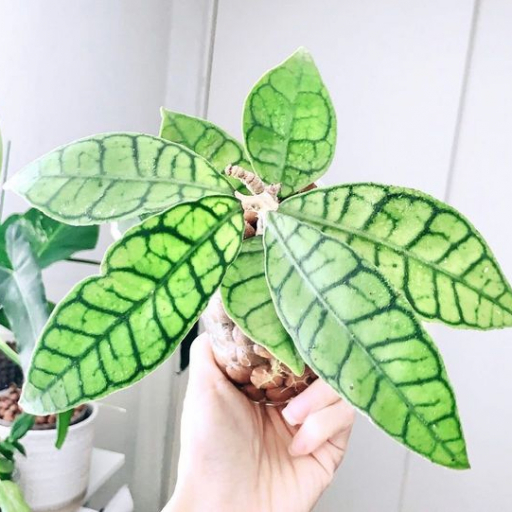
Plant Overview
Known as the "Stained Glass Hoya," the Hoya callistophylla is a crown jewel for foliage collectors. While many Hoyas are prized for their fragrant blooms, this Bornean beauty steals the show with leaves that look like they’ve been hand-painted with intricate, dark green webbing. In the wild, it spends its life scrambling up tropical trees, using its stiff vines to reach the dappled light of the rainforest canopy.
🔍 How to Identify
- 🍃 The Foliage: Large, lance-shaped leaves that are stiff and cardboard-like to the touch. They feature a light green base color contrasted by heavy, dark emerald veins that create a distinct geometric pattern.
- 🌸 The Blooms: Small, star-shaped flowers that grow in clusters (umbels). They are typically a creamy-yellow or white with a striking reddish-brown center, emitting a sweet, spicy fragrance.
- 🧶 Growth Habit: A semi-woody climbing vine. Unlike some "floppy" Hoyas, this species has rigid stems that prefer to be trellised upward rather than hanging down.
🏡 In Your Garden
- 🌳 The Epiphytic Edge: Because it naturally grows on trees, its roots require massive amounts of oxygen. It will struggle in heavy potting soil; instead, it thrives in a "chunky" mix of orchid bark, perlite, and charcoal to mimic its forest home.
- ☀️ Light & Texture: To keep those dark veins prominent, it needs bright, indirect light. If the leaves start to turn a pale yellow-green, it’s likely getting too much direct sun, which can bleach the stunning "stained glass" effect.
- 💧 Thirst Cues: This plant is sensitive to overwatering. Wait until the leaves feel slightly flexible or the potting medium is nearly dry before giving it a soak.
⚠️ Safety & Toxicity
- 🐾 Pet Safe: Like most members of the Hoya family, Hoya callistophylla is considered non-toxic to cats, dogs, and humans.
- 🧪 Sticky Sap: When the vine is cut or damaged, it leaks a milky white latex sap. While not poisonous, this sap can be very sticky and may cause mild skin irritation for those with latex allergies.
✨ Fun Fact
The name callistophylla is derived from the Greek words kallistos (most beautiful) and phyllon (leaf). It is one of the few plants in the botanical world where the scientific name perfectly captures its most famous physical attribute!

Detailed Care Instructions
To grow Hoya Callistophylla, also known as the Wax Plant, you can follow these steps:
- Light: Place the plant in bright, indirect sunlight. Hoyas prefer at least a few hours of sunlight a day, but direct sunlight may scorch their leaves. A north or east-facing window is usually ideal.
- Temperature: Hoya Callistophylla prefers warmer temperatures between 65-80°F (18-27°C). Avoid exposing the plant to extreme temperature fluctuations.
- Watering: Water the plant thoroughly when the top inch of soil feels dry. Allow the potting mix to drain properly to avoid waterlogged roots, as excessive moisture can cause root rot. Reduce watering during the winter months or when growth slows down.
- Humidity: Hoyas enjoy higher humidity levels, so misting the leaves or using a humidifier can be beneficial. Grouping plants together can also create a more humid microclimate.
- Potting mix: Use a well-draining potting mix specifically formulated for houseplants. A mix containing peat moss, perlite, and orchid bark works well for Hoyas. Avoid overpotting; select a pot size that accommodates the roots with a bit of extra space.
- Fertilizer: Feed your Hoya once a month during the growing season (spring and summer) with a balanced, water-soluble fertilizer. Dilute the fertilizer to half strength to prevent overfertilization. Reduce or stop fertilizing during the winter months when the plant's growth rate slows down.
- Pruning: Prune your Hoya Callistophylla to control its size and shape. Pruning can also help stimulate fuller growth. Trim back leggy stems or remove dead or damaged leaves to maintain a healthier appearance.
- Trellis or support: Provide a trellis or a support system for your Hoya plant to climb on, as it is a vining plant. Natural supports like moss poles or trellises made of wood or metal can help the plant grow vertically.
- Propagation: Hoyas can be propagated through stem cuttings. Take a cutting with a few nodes and place it in a well-draining potting mix or water until roots develop. After roots have formed, transplant the cutting into a pot.
Remember that Hoya Callistophylla is a slow-growing plant, so be patient with its growth. With proper care and attention, you'll be able to enjoy a healthy and thriving Hoya Callistophylla plant in your home.

Place in a window with dappled sun or a spot in the middle of a room. Or directly in a window facing west or east.

When it comes to watering this plant, it is important to keep in mind its specific needs. One key factor to consider is the type of soil it is planted in - it should be well-draining and not retain too much moisture. Overwatering can lead to root rot and ultimately harm the plant.
To water, it is recommended to wait until the soil has dried out a bit before watering again. This can vary depending on factors such as the temperature, humidity, and amount of sunlight the plant is receiving. When it is time to water, slowly and evenly pour water onto the soil and avoid getting water on the leaves or stems. Allow any excess water to drain out of the bottom of the pot.
To ensure the plant is getting the right amount of water, it is helpful to monitor its growth and health. If the leaves begin to turn yellow or droop, it may indicate that the plant is getting too much or too little water. Adjust accordingly and continue to observe how the plant responds.
To fertilize the Hoya Callistophylla plant, follow these instructions:
- Choose a well-balanced, water-soluble fertilizer specifically formulated for houseplants.
- Dilute the fertilizer according to the instructions on the packaging. It is crucial not to apply a concentrated solution directly to the plant.
- Apply the fertilizer during the plant's active growing season, which is typically in the spring and summer.
- Ensure the plant's soil is moist before fertilizing. Avoid applying fertilizer to dry soil, as it can potentially harm the plant's roots.
- Pour the diluted fertilizer solution onto the soil, being careful not to splash it on the leaves.
- Allow any excess fertilizer solution to drain out from the pot's drainage holes.
- Avoid over-fertilizing the Hoya Callistophylla plant, as this can lead to nutrient burn and damage the plant's roots. It is better to under-fertilize than over-fertilize.
- Monitor the plant for any signs of nutrient deficiencies, such as yellowing leaves or stunted growth. Adjust the fertilization frequency or concentration accordingly.
- During the plant's dormant period, typically in the fall and winter, reduce or cease fertilization as the plant requires fewer nutrients during this time.
- Regularly flush the soil with plain water to prevent a buildup of excess fertilizer salts.
Remember to always refer to the specific fertilizer's instructions and follow them accordingly.
Hoya Callistophylla prefers a well-draining soil that is rich in nutrients, but not too dense. The ideal soil mixture should be a combination of organic materials such as peat moss or coconut coir, as well as sand or perlite to promote good drainage. It is important to avoid using heavy soil mixes as they can suffocate the plant's roots and lead to root rot. Adding a small amount of slow-release fertilizers to the soil mix can also benefit the plant's growth and development. Overall, a balanced soil mix that is light, well-aerated, and nutrient-rich will help Hoya Callistophylla thrive.
To propagate Hoya Callistophylla, also known by its scientific name, you can follow these steps:
- Choose a healthy and mature plant: Look for a mature Hoya Callistophylla plant that is disease-free and has well-established roots. This will ensure the success of propagation.
- Select the method of propagation: There are different methods to propagate Hoya Callistophylla, including stem cuttings, leaf cuttings, or division. Choose the method that suits you best.
- Stem cuttings: To propagate using stem cuttings, select a healthy stem with several leaves. Make a clean cut below a leaf node using a sharp and sterilized knife or pruners. The cutting should be around 4-6 inches in length.
- Remove lower leaves: Remove the bottom 1-2 leaves from the cutting, leaving a few leaves at the top. This helps in reducing moisture loss and allows the cutting to focus on root development.
- Hormone rooting powder (optional): Dip the cut end of the stem in a rooting hormone powder (optional) to promote rooting and ensure faster growth.
- Prepare the rooting medium: Prepare a well-draining rooting medium by combining perlite, vermiculite, or a mix of perlite and peat moss. This medium provides good aeration and prevents excess moisture.
- Plant the cutting: Make a small hole in the rooting medium and insert the cut end of the stem into it. Gently firm the medium around the cutting to secure it in place.
- Provide the right conditions: Place the cutting in a warm, bright location where it will receive indirect sunlight. Avoid direct sunlight as it can scorch the plant. Maintain a temperature between 65-75°F (18-24°C) for optimal growth.
- Watering and humidity: Water the cutting lightly and keep the rooting medium slightly moist, but not soggy. Maintain a level of humidity around the cutting by covering it with a clear plastic bag or using a humidity dome. This helps in retaining moisture and promoting root development.
- Root development: After a few weeks, check for root development by gently tugging the cutting. If you feel resistance, it means roots have started to form. If not, wait a bit longer until roots develop.
- Transplanting: Once the cutting has developed a good root system, carefully transplant it into a well-draining potting mix suitable for Hoya Callistophylla. Provide proper care, including regular watering and indirect sunlight, to help it establish and thrive.
Remember to be patient during the propagation process, as it may take several weeks or even months for successful rooting and establishment.
Common pests of the hoya callistophylla include Scale insect, mealybugs, spider mites. Make a habit of checking your hoya callistophylla frequently for pests so that any infestations can be caught and managed early.








