Plant Overview
Known affectionately as the "Eskimo Hoya" or "Heart-Leaf Hoya," Hoya krohniana is a darling of the indoor jungle. This miniature climber is native to the Philippines and is prized for its petite, heart-shaped leaves that grow densely along trailing vines. It is a champion of small spaces, offering a romantic, teardrop aesthetic that fits perfectly in hanging baskets or climbing up a small moss pole.
🔍 How to Identify
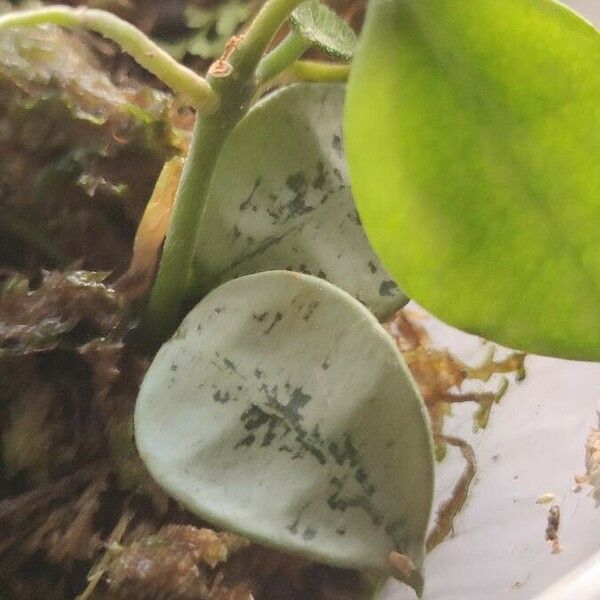
- 🍃 Heart-Shaped Foliage: The leaves are small, thick, and waxy, typically measuring only an inch or two long. They feature a distinct "dimple" at the base, giving them a perfect heart or spade shape.
- 🌸 Fuzzy Flower Clusters: It produces "umbels" of about 15–20 tiny, star-shaped flowers. These blooms are off-white or creamy and are covered in fine, velvety hairs that make them look like miniature puffs of cotton.
- 🧶 Trailing Vines: The stems are thin but sturdy, naturally seeking something to climb or cascading gracefully downwards. In high-light conditions, some varieties develop heavy silver "splash" or speckling across the green surface.
🏡 In Your Garden
- 🪴 The Epiphytic Edge: In the wild, this Hoya grows on trees rather than in the ground. Because of this, it hates "wet feet." To keep it happy, use a very chunky, airy substrate—think orchid bark, perlite, and charcoal—rather than standard potting soil.
- 🌬️ Scented Evenings: The blooms are famous for their intense, spicy-sweet fragrance, which is often described as a mix of jasmine and cloves. The scent becomes much stronger at night to attract nocturnal pollinators, making it a natural evening air freshener.
⚠️ Safety & Toxicity
- 🐾 Pet Friendly: Good news for animal lovers! Hoya krohniana is generally considered non-toxic to cats and dogs, making it a safe choice for households with curious four-legged friends.
- 💧 Sap Sensitivity: Like most Hoyas, it produces a milky white latex sap when a leaf or stem is broken. While not highly toxic, this sap can cause mild skin irritation for people with latex allergies and may cause a mild tummy ache if a pet decides to chew on the vine.
✨ Fun Fact
For decades, this plant was a "botanical ghost." It was frequently sold and grown under the name Hoya lacunosa until it was finally recognized and described as its own distinct species in 2009. It was named in honor of Philip Krohn, a researcher who helped differentiate its unique heart-shaped leaves from its relatives.

Detailed Care Instructions
Hoya Krohniana is a beautiful and unique plant that can be grown easily with the right care and conditions. Here are some tips on how to grow Hoya Krohniana:
- Light: Hoya Krohniana prefers bright, indirect light. Place your plant near a south or west-facing window where it can get plenty of sunlight throughout the day.
- Watering: Water your Hoya Krohniana when the top inch of soil feels dry to the touch. Make sure to water the plant thoroughly, allowing excess water to drain out of the bottom of the pot.
- Temperature: Keep your Hoya Krohniana in a warm environment with temperatures between 65-80 degrees Fahrenheit. Avoid placing the plant in drafty areas or near air conditioning vents.
- Humidity: Hoya Krohniana prefers high humidity levels. You can increase humidity by misting the plant regularly or placing a humidifier nearby.
- Soil: Use a well-draining potting mix for your Hoya Krohniana, such as a mix of peat moss, perlite, and orchid bark. Repot your plant every 2-3 years to refresh the soil.
- Fertilizing: Feed your Hoya Krohniana with a balanced, water-soluble fertilizer diluted to half strength every 2-3 weeks during the growing season (spring and summer).
- Pruning: Hoya Krohniana can be pruned to shape the plant and encourage new growth. Use clean, sharp scissors to remove any leggy or dead stems.
- Repotting: Repot your Hoya Krohniana when it becomes root-bound or outgrows its current pot. Choose a slightly larger pot with good drainage holes.
With the proper care and attention, your Hoya Krohniana plant will thrive and reward you with its beautiful foliage and fragrant flowers.

Place in a window with dappled sun or a spot in the middle of a room. Or directly in a window facing west or east.

To water this plant, you should first check the soil moisture level by sticking your finger into the soil. If the top inch feels dry, it is time to water. Use a watering can or pitcher to slowly pour water directly onto the soil, avoiding the leaves. Allow the water to drain out of the bottom of the pot, then discard any excess water. Do not let the plant sit in standing water for an extended period of time, as this can lead to root rot. Water this plant sparingly during the winter months.
To fertilize your Hoya Krohniana plant, use a balanced liquid fertilizer diluted to half strength. Feed your plant once a month during the growing season, typically from spring to early autumn. Make sure to water your plant before applying the fertilizer to prevent root burn. Avoid over-fertilizing as it can harm the plant.
Hoya Krohniana plant prefers well-draining soil that is rich in organic matter. A good mix for this plant would be one part peat moss, one part perlite, and one part coarse sand. This type of soil will allow for adequate aeration and moisture retention, which is important for the health and growth of Hoya Krohniana. Additionally, adding some orchid bark or charcoal to the soil mix can further enhance drainage and prevent waterlogging. Overall, a light and airy soil mix with good water retention properties is ideal for Hoya Krohniana plant.
Hoya Krohniana plants can be propagated through stem cuttings. To do this, you will need a pair of clean and sharp scissors or pruning shears, a small container filled with well-draining soil, and some rooting hormone (optional).
First, select a healthy and mature stem from the Hoya Krohniana plant to use as a cutting. Make a clean cut just below a node, which is where a leaf is attached to the stem. The cutting should be around 4-6 inches long.
Remove any leaves from the lower half of the cutting to expose the nodes. Dip the cut end of the stem into rooting hormone (if using) to encourage root growth.
Plant the cutting in the container filled with moist soil, making sure the node is buried underground. Place the container in a warm and bright location, but out of direct sunlight.
Keep the soil consistently moist, but not waterlogged, and avoid letting the cutting sit in standing water. You can cover the cutting with a plastic bag or dome to create a humid environment and increase the chances of successful rooting.
Check the cutting regularly for signs of root growth, which typically takes a few weeks to a few months. Once roots have formed, you can transplant the cutting into a larger pot with well-draining soil.
Continue to care for the new plant as you would an established Hoya Krohniana plant, providing it with adequate sunlight, water, and occasional fertilization to promote healthy growth and flowering.
Common pests of the krohniana 'super silver' include Scale insect, mealybugs, spider mites. Make a habit of checking your krohniana 'super silver' frequently for pests so that any infestations can be caught and managed early.








