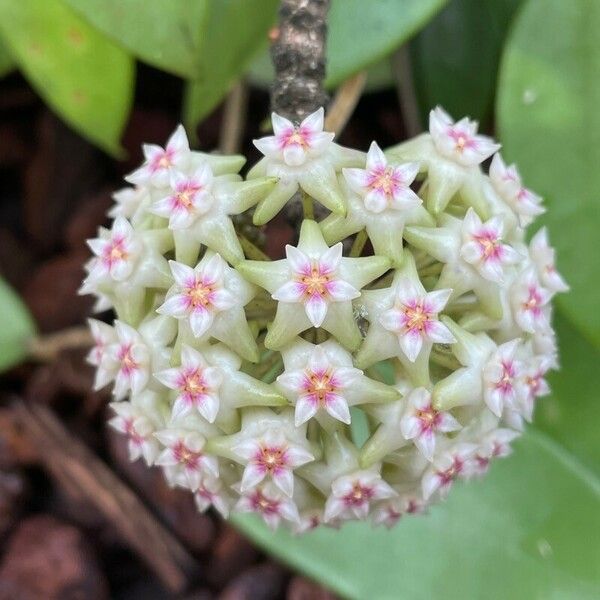
Plant Overview
Often called the "Waxy-Leaved Vine" or previously known by the slightly misleading name Hoya parasitica, this stunning evergreen climber is a jewel of Southeast Asia. Despite its old scientific name, it isn't a parasite at all; it’s a friendly epiphyte that simply uses trees for support as it reaches for the canopy. It is beloved by collectors for its incredibly fragrant, porcelain-like flowers and its ability to transform a bookshelf into a living jungle.
🔍 How to Identify
- 🍃 The Foliage: The leaves are thick, waxy, and lance-shaped, often featuring beautiful silver "splashes" or flecks that shimmer when they catch the light.
- 🌸 The Blooms: It produces rounded clusters (umbels) of up to 30 small, star-shaped flowers. These are typically creamy white or pale pink with a distinct, darker center called a corona.
- 🧶 The Growth Habit: As a vigorous climber, it develops long, wiry tendrils that search for something to grab onto long before the leaves actually appear.
🏡 In Your Garden
- ☀️ Light & Color: While it survives in lower light, it needs bright, indirect sun to trigger its famous blooms. If the leaves turn a slight reddish tint, it’s "sun-stressing"—a natural tan that many collectors find beautiful.
- 🪴 The Tight Squeeze: This plant is a bit of a homebody; it actually prefers being slightly root-bound. Moving it to a giant pot too soon can lead to "wet feet" and root rot, as the soil stays damp for too long.
- 🌬️ Nightly Perfume: If you keep this plant indoors, you’ll notice the scent intensifies significantly at night. It produces a spicy, citrus-like fragrance designed to attract nocturnal pollinators in the wild.
⚠️ Safety & Toxicity
- 🐾 Status: Generally non-toxic and pet-friendly!
- 💧 The Sap: Like most Hoyas, it contains a milky white latex sap. While not poisonous, this sap can be a mild skin irritant for humans with latex allergies and might cause an upset stomach if a curious pet decides to chew on the stems.
✨ Fun Fact
The Hoya verticillata is a master of disguise in the botanical world. Because it grows across such a wide geographic range, its leaf shape can change drastically depending on its environment, leading botanists to accidentally give it dozens of different names over the last century!

Detailed Care Instructions
To grow Hoya Verticillata, follow these steps:
- Select a healthy Hoya Verticillata plant or obtain a cutting from an existing plant. Make sure it has well-developed roots.
- Choose a suitable pot with good drainage. Hoya plants prefer slightly cramped conditions, so a smaller pot is preferable. Make sure the pot has drainage holes to prevent waterlogging.
- Fill the pot with a well-draining potting mix. A mixture of peat moss, perlite, and orchid bark will work well. You can also add a handful of slow-release fertilizer granules to provide nutrients for the plant.
- Create a hole in the potting mix and carefully place the Hoya Verticillata plant or cutting in it. Gently firm the soil around the plant or cutting and ensure it is stable.
- Place the pot in a spot with bright, indirect light. Hoya plants do well in a bright but shaded location, as direct sunlight can scorch their leaves.
- Water the plant thoroughly, allowing excess water to drain out. Hoya plants prefer to dry out slightly between waterings, so ensure the top inch of soil is dry before watering again. Avoid overwatering, as it can lead to root rot.
- Hoya plants thrive in high humidity. You can increase humidity by placing a tray filled with water near the plant or by using a humidifier. Alternatively, you can mist the leaves regularly.
- Fertilize the plant every 2-4 weeks during the growing season with a balanced liquid fertilizer diluted to half strength.
- Hoya Verticillata is a vining plant, so provide it with support such as a trellis or moss pole as it grows. This will help it climb and prevent the vines from trailing on the ground.
- Prune the plant occasionally to maintain its shape and control its size. You can also propagate new plants by taking stem cuttings and rooting them in water or well-draining soil.
By following these steps, you can successfully grow a Hoya Verticillata plant. Remember to provide adequate light, water, and humidity, and your plant will thrive.

Place in a window with dappled sun or a spot in the middle of a room. Or directly in a window facing west or east.

To properly water Hoya Verticillata plants, follow these guidelines:
1. Observe the soil: Check the soil moisture level before watering. The top inch of soil should be dry to the touch. Inserting your finger into the soil can assist in determining the moisture level.
2. Choose the correct watering method: It is best to water Hoya Verticillata plants from the bottom rather than overhead. Use a saucer or tray underneath the plant's pot to catch excess water and allow the roots to absorb it gradually.
3. Use room temperature water: Fill the saucer or tray with room temperature water. Remember that cold water can shock the roots and potentially harm the plant.
4. Allow for proper absorption: Let the plant sit in the water for approximately 15-20 minutes. During this time, the roots will absorb the necessary moisture. Avoid leaving the plant in standing water for extended periods to prevent root rot.
5. Remove excess water: After the desired time has passed, remove any remaining water from the saucer or tray to prevent the roots from sitting in soggy conditions.
6. Monitor and adjust watering frequency: Hoya Verticillata plants prefer to slightly dry out between waterings. The frequency of watering will depend on environmental conditions such as humidity levels, room temperature, and season. Remember to adjust your watering schedule accordingly.
7. Consider environmental factors: Pay attention to the plant's surroundings. Factors such as air conditioning, heating vents, or drafts can affect the rate at which water evaporates from the soil and may impact the plant's water requirements.
By following these watering instructions, you can help promote the health and well-being of your Hoya Verticillata plant.
To fertilize your Hoya Verticillata plant, follow these instructions:
- Choose a balanced liquid fertilizer with equal amounts of nitrogen, phosphorus, and potassium.
- Dilute the fertilizer according to the package instructions, usually at a ratio of 1 teaspoon per gallon of water.
- Water your plant thoroughly before applying the fertilizer to avoid burning the roots.
- Pour the diluted fertilizer solution directly onto the soil around the base of the plant, avoiding foliage contact.
- Ensure the soil is evenly moistened but not waterlogged after applying the fertilizer.
- Repeat the fertilization process every two to four weeks during the active growing season, which is typically spring and summer.
- Reduce fertilization frequency to every six to eight weeks during the plant's dormant period in fall and winter.
- Monitor your plant for any signs of nutrient deficiency or excess, such as discolored leaves or stunted growth, and adjust the fertilization accordingly.
- Additionally, consider using organic compost or slow-release fertilizer granules for a more gradual and prolonged nutrient release.
- Remember to always follow the specific fertilizer instructions and adjust the dosage accordingly to the size and health of your Hoya Verticillata plant.
The optimal soil type for Hoya Verticillata plant is one that provides good drainage while retaining some moisture. It is recommended to use a well-draining potting mix that is specifically formulated for epiphytic plants. Such a mix typically consists of a combination of organic matter (such as peat moss or coconut coir), perlite or vermiculite for improved aeration, and pine bark or orchid bark for additional drainage.
The ideal pH range for Hoya Verticillata is slightly acidic to neutral, ranging from 5.5 to 7.0. Therefore, it is beneficial to include materials that help maintain this pH range, such as sphagnum moss or leaf mold. These components also enhance moisture retention without causing the soil to become overly saturated, which could lead to root rot.
Adding a small amount of well-rotted compost or organic fertilizer to the potting mix can provide beneficial nutrients to support the plant's growth. However, it is important to avoid excessive fertilization, as Hoya Verticillata plants are generally not heavy feeders.
Overall, the recommended soil for Hoya Verticillata is a well-draining mixture that contains organic matter, such as peat moss or coconut coir, along with perlite or vermiculite for improved aeration and drainage. Including materials like sphagnum moss or leaf mold helps maintain a slightly acidic to neutral pH, promoting optimal growth conditions for the plant.
To propagate Hoya verticillata, you can follow these steps:
- Take a healthy stem cutting: Choose a mature stem that is at least 6 inches long. Make sure it has a few nodes (where the leaves meet the stem).
- Prepare the cutting: Using a clean, sharp knife or shears, cut the stem just below a leaf node. Remove any lower leaves to expose the nodes.
- Promote root growth: Dip the cut end of the stem into a rooting hormone powder or gel to enhance root formation.
- Potting mix selection: Choose a well-draining potting mix specifically formulated for houseplants or succulents. You can also create your own mix by combining equal parts of peat moss, perlite, and coarse sand.
- Potting the cutting: Fill a small pot with the potting mix and create a hole in the center. Insert the cutting into the hole, ensuring that the lowest node is in contact with the soil. Gently press the soil around the cutting to secure it in place.
- Provide the right environment: Place the potted cutting in a warm and bright location, but away from direct sunlight. Hoya verticillata prefers temperatures between 60-80°F (15-26°C) and high humidity.
- Watering: Water the cutting moderately, keeping the soil moist but not soggy. Overwatering can lead to root rot, so allow the top inch of soil to dry out slightly between waterings.
- Encourage root development: To promote root growth, you can cover the pot with a clear plastic bag or place it inside a propagation dome to increase humidity. This will create a mini-greenhouse environment for the cutting.
- Monitor growth: After a few weeks, check the cutting for signs of new growth. This indicates that root development has occurred. Be patient, as Hoya verticillata cuttings can sometimes take longer to root compared to other plant species.
- Transplanting: Once the cutting has rooted and established a healthy root system, it can be transferred to a larger pot with regular potting soil. Continue caring for it as you would a mature Hoya verticillata plant.
Remember, propagating plants can be a trial-and-error process, so it may take a few attempts before achieving success. Good luck!
Common pests of the ridley's hoya include Scale insect, mealybugs, spider mites. Make a habit of checking your ridley's hoya frequently for pests so that any infestations can be caught and managed early.








