Plant Overview
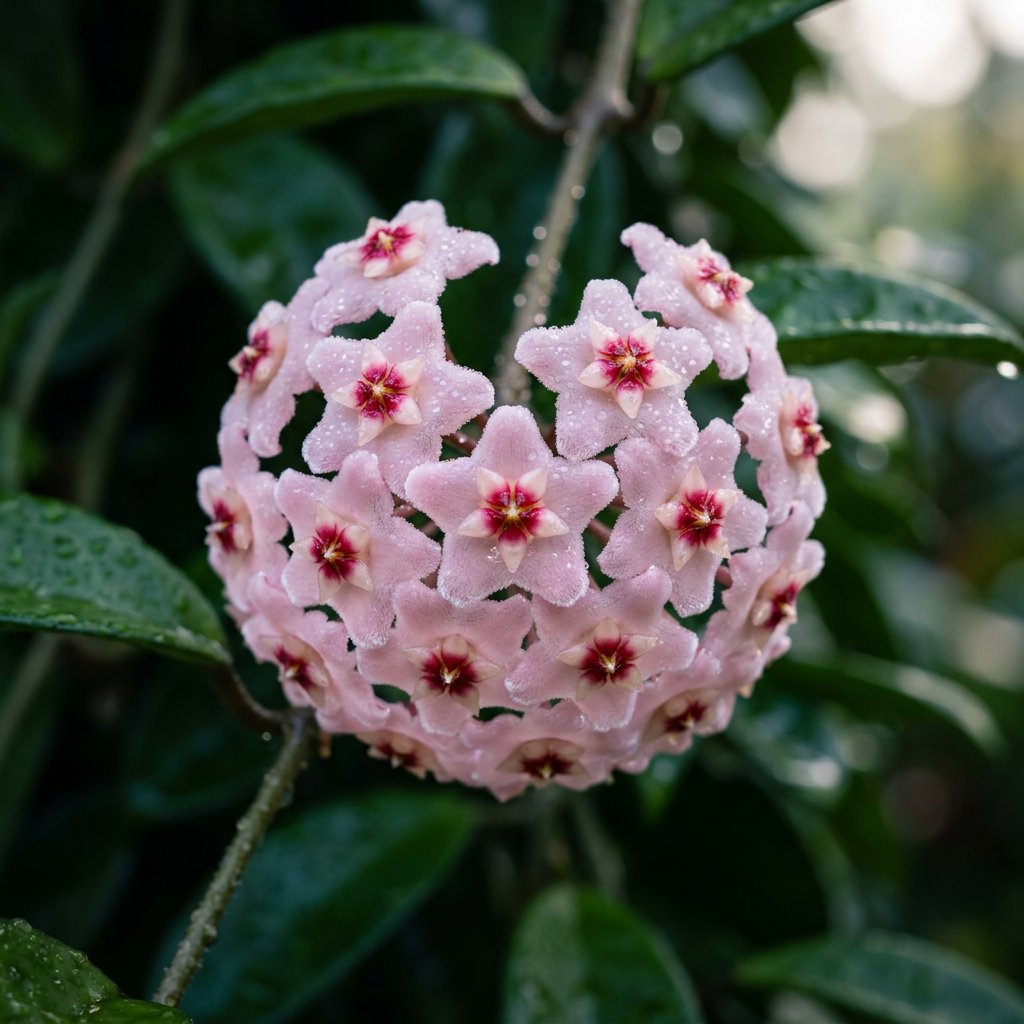
Often called the "Wax Plant" or "Porcelain Flower," the Hoya is a timeless houseplant favorite that feels like a living heirloom. These tropical climbers are beloved for their thick, succulent-like foliage and geometric flower clusters that look almost too perfect to be real. Native to the humid rainforests of Southeast Asia and Australia, they bring a touch of exotic, slow-growing elegance to any bookshelf or hanging basket.
🔍 How to Identify
- 🍃 Waxy Foliage: The leaves are typically thick, fleshy, and have a distinct sheen. Depending on the variety, they can be deep forest green, heart-shaped, or splashed with silvery "variegation."
- 🌸 Umbel Blooms: They produce "umbels"—perfectly round clusters of tiny, star-shaped flowers. Each individual flower often has a secondary star (a corona) in the center, giving it a 3D appearance.
- 🌿 Vining Tendrils: Hoyas are famous for sending out long, leafless "scout" vines. These tendrils search for light or something to climb before the plant eventually fills them in with leaves.
🏡 In Your Garden
- 🧗 Epiphytic Nature: In the wild, many Hoyas grow on trees rather than in the ground. Because of this, they crave airy, "chunky" soil (like an orchid mix) and hate having "wet feet," which can quickly lead to root rot.
- 🚫 The Golden Rule: Never prune off the leafless flower spurs, known as peduncles. Unlike most plants, Hoyas bloom from the exact same spot year after year. If you snip them off, you are accidentally removing the plant's ability to flower in the future!
- ☀️ Light & Stress: While they tolerate lower light, they need bright, indirect sun to produce flowers. Some varieties even "sun-stress," turning beautiful shades of red or pink when they receive the perfect amount of high-intensity light.
⚠️ Safety & Toxicity
- 🐾 Pet Friendly: Great news for animal lovers! The Hoya is widely considered non-toxic to cats, dogs, and horses, making it a "worry-free" choice for pet-filled homes.
- 💧 Sap Sensitivity: When a leaf or stem is broken, the plant leaks a thick, milky white latex sap. While not poisonous, this sap is very sticky and can cause mild skin irritation for people with latex allergies.
✨ Fun Fact
Hoya flowers are "nocturnal performers." They are most fragrant at night, pumping out scents of chocolate, vanilla, or spicy cinnamon to attract nocturnal moths for pollination.

Detailed Care Instructions
To successfully grow a Hoya plant, follow these steps:
- Choose the right location: Hoyas thrive in bright, indirect light. Avoid placing them in direct sunlight, as it can scorch their leaves. A well-lit spot near a window with filtered light is ideal.
- Provide the right temperature and humidity: Hoyas enjoy warm temperatures between 60-80°F (15-27°C). Additionally, they prefer high humidity levels, so consider placing a humidifier nearby or mist the leaves regularly.
- Use well-draining soil: Choose a well-draining potting mix specifically formulated for indoor plants. A mix of peat moss, perlite, and orchid bark works well for Hoyas.
- Water properly: Hoyas prefer to dry out slightly between watering. Water them thoroughly, allowing excess water to drain out of the drainage holes. Ensure the top inch of soil is dry before watering again. Be cautious not to overwater, as Hoya plants are susceptible to root rot.
- Fertilize occasionally: Feed your Hoya plant with a balanced houseplant fertilizer during its active growing season (spring and summer). Dilute the fertilizer to half strength and apply it every other watering.
- Prune as needed: If your Hoya becomes leggy or starts to outgrow its space, you can prune it back. Pinch off the stems to the desired length, and new growth will emerge from the nodes below.
- Support climbing growth: If your Hoya is a climbing variety such as Hoya carnosa, provide a support structure like a trellis or moss stick for it to cling to.
- Propagate Hoyas through cuttings: Hoyas are relatively easy to propagate through stem cuttings. Take a cutting that includes at least one or two nodes, remove the lower leaves, and place it in a well-draining potting mix. Keep the soil lightly moist until roots develop.
- Clean the leaves: Occasionally wipe the leaves with a damp cloth to remove dust and keep them looking healthy.
Following these tips should help you successfully grow your Hoya plant and ensure its flourishing growth.

Place in a window with dappled sun or a spot in the middle of a room. Or directly in a window facing west or east.

Hoya plants should be watered thoroughly but sparingly, allowing the top inch of soil to dry out between waterings. When watering, ensure that the water is able to drain out of the bottom of the pot to prevent the roots from becoming waterlogged. It is important to avoid getting water on the leaves, as this can cause damage or encourage fungal growth. Water should be given at room temperature and be free of any contaminants, such as chlorine or fluoride. During the winter months, watering should be reduced, as the plant will require less moisture.
For optimal growth, fertilize this plant during the growing season (spring and summer) using a balanced, water-soluble fertilizer every three to four weeks. Dilute the fertilizer to half strength and apply it to the soil around the base of the plant. Avoid fertilizing during the dormant season (fall and winter). Additionally, provide adequate water and sunlight, and maintain a consistent temperature and humidity level for healthy growth.
The ideal soil for a Hoya plant should be well-draining and have a slightly acidic to neutral pH level. It should contain a mix of organic materials such as peat moss, perlite, and vermiculite to ensure proper aeration and moisture retention. A high-quality potting mix that is specifically designed for tropical plants is recommended. It's important to avoid using soil that is too dense or compacted as this can lead to root rot and poor plant growth. Additionally, the soil should be kept moist but not saturated, and fertilizer should be applied regularly during the growing season to promote healthy growth and blooming.
To propagate this plant, take a stem cutting that includes two or three nodes and a few leaves. Remove the bottom set of leaves and set the cutting into a pot filled with moist potting mix. Place a plastic bag over the pot to create a humid environment. Keep the soil moist and place the pot in a bright, but indirect, location. After a few weeks, roots should start to form and new growth will appear. Once the new plant has grown enough, it can be moved to its own pot and treated as a mature plant.







